





































































































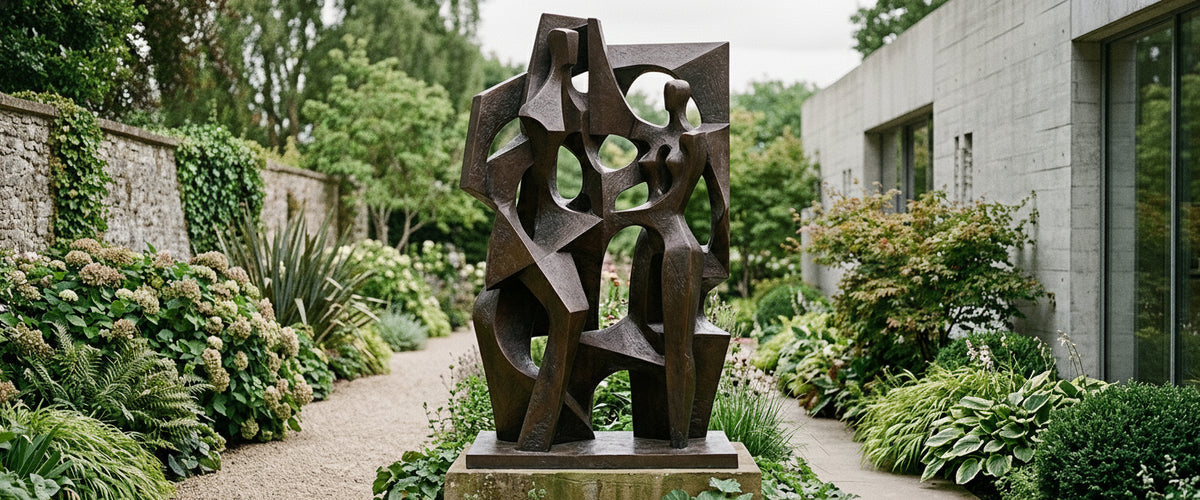

The hardest part of an abstract bronze sculpture sale is not the casting. It is the half-dozen decisions made weeks earlier, when the form is still clay and nobody outside the studio has seen it yet. Get those right and a piece holds its nerve across a Napa courtyard or a Manhattan lobby. Get them wrong and you end up with something that photographed beautifully on the maquette and feels thin once it is standing in front of you.
Abstract work is unforgiving in a way figurative work is not. There is no face to read, no anatomy to anchor the eye, so every choice about mass, surface, and silhouette has to carry weight on its own. That is exactly why buyers benefit from knowing what we are actually thinking about when an inquiry lands.

Key Takeaways for an Abstract Bronze Sculpture Sale
- Scale is a relationship, not a number. A form that sings at 10 ft (3 m) can collapse at 30 ft (9 m) of viewing distance.
- Patina is a material decision, not a paint job. It changes how light moves across the surface and how the piece ages outdoors.
- Wall thickness and internal armature drive cost more than height. Engineering is invisible and expensive.
- The maquette is your contract with the final piece. Approve it slowly.
- Budget depends on material, scale, complexity, finishing, and install. Ask for a tailored quote rather than trusting a flat figure.

What Sculptors Think About Before Taking On a Commission
When a brief arrives for an abstract bronze sculpture for sale or a fresh commission, the first questions are rarely aesthetic. We want to know where it lives, how far back the main viewing point sits, what the light does across the day, and whether anyone will touch it. A piece in a high-traffic Texas hotel lobby has different demands from one anchoring a private garden in the Hamptons, where it will sit in salt air and shift through four seasons.
The second thing we weigh is whether the form can survive translation into metal. Clay forgives. Bronze does not. A delicate cantilever that holds in a small model becomes a structural problem at full height, and that is where an honest studio earns its fee. We have turned down forms that looked good on paper because the only safe way to build them would have compromised the line the client fell for in the first place.
If you are still narrowing down what you want, browsing a focused selection of bronze abstract sculptures helps you separate the silhouettes you actually respond to from the ones that just look impressive in a thumbnail.

Craft Decisions That Change the Final Result and the Price
Three things move the needle on an abstract bronze sculpture sale more than height alone: alloy and wall thickness, the casting method, and the patina.
Most of our exterior work uses silicon bronze for its corrosion resistance and the way it takes a patina. Wall thickness is the quiet cost driver. Thicker walls mean more metal, more weight, and a heavier base or footing, but they also resist denting and read as solid rather than hollow. A tall, slender form needs a hidden stainless or bronze armature to keep it standing through wind load, and that engineering is invisible to everyone except the person paying for it.
Casting method matters too. Lost-wax casting, the method museums have relied on for centuries, captures fine surface detail and is the standard for serious work; the Getty collection is full of examples that show how durable a well-cast piece can be across generations. Sand casting is cheaper and coarser, fine for some industrial forms but rarely right for a refined sculpture.
Then patina. A warm brown, a deep near-black, a verdigris green, or a polished highlight all change how the eye travels across the surface. On a piece like the Monumental Modern Abstract Geometric Figures bronze sculpture at 280cm, the interplay between flat planes and the chosen patina is doing most of the visual work; swap the finish and the same geometry reads completely differently. Patina is also a maintenance decision, because outdoor pieces benefit from periodic waxing to keep the surface stable.

Why Some Pieces Read Right at 10 Ft and Wrong at 30
This is the mistake I see most often, and it is expensive to fix after casting. Buyers approve a maquette on a table, viewing it from two or three feet away, then install the full-size piece where the primary sightline is across a lawn or a forecourt. At that distance, fine surface texture disappears and only the silhouette survives.
A form loaded with intricate detail can flatten into a blob at 30 ft (9 m). A bolder, simpler mass with strong negative space keeps its shape at distance and rewards closer inspection when you walk up to it. We always ask for the real viewing distances early, then adjust the proportions of the maquette so the gesture survives the trip across the space.
Negative space deserves special attention here. The gaps are not empty; they frame sky, planting, or architecture behind the piece, and they change as you move around it. A sculpture that looks dense from the driveway can open up entirely from the terrace. If you want to compare how different masses behave at scale, the broader large bronze sculptures range is a useful reference for the way height and silhouette interact.

Studio Process: Maquette, Sample, Fabrication, Install
A bespoke abstract bronze sculpture sale at Giant Sculptures moves through four stages, and each one is a checkpoint where you can still change course.
- Maquette. A scaled model, usually in clay or a hard modeling material, that fixes proportion and gesture. This is the stage to be fussy. Walk around it, photograph it, and view it from your real distances if you can.
- Sample and finish approval. Before full casting, we agree the patina and surface on a sample so there are no surprises. Light in a studio differs from light in an Aspen garden, so we discuss the destination conditions here.
- Fabrication. Casting (typically lost-wax), chasing the welds and seams, and applying the patina. For larger pieces this is done in sections and assembled, with the joins worked so they vanish into the form.
- Install. Footing, fixing, and craning into position. A tall piece needs an engineered base sized to wind and ground conditions, which is why we plan the foundation before the metal ever ships.
Shipping worldwide adds its own discipline. A recent piece bound for the US West Coast was crated in custom timber with internal bracing tuned to the sculpture's weak axis, because the danger in transit is rarely the obvious one. The lesson, learned the hard way years ago, is that the crate is part of the commission, not an afterthought.

Honest Red Flags to Ask About Before You Commit
A good supplier will answer all of these without flinching. Use them as a buyer checklist.
- What alloy and wall thickness? If the answer is vague, the engineering may be too.
- How is it cast? Lost-wax for refined work; be cautious if a coarse method is offered for a detailed form.
- Is there an internal armature, and what is it made of? Tall or cantilevered forms need one, ideally stainless steel.
- Will I approve the patina on a sample first? You should never see the final finish for the first time at install.
- What does the foundation or fixing require? Outdoor pieces need a base engineered to site conditions.
- What care does it need long term? Expect honest guidance on cleaning and re-waxing, not a claim that it is maintenance-free.
- How is it crated and shipped? Especially for international delivery, ask how the piece is braced.
One more flag worth naming: anyone who quotes a firm price before understanding scale, site, and finish is guessing. Cost on an abstract bronze sculpture for sale is driven by material volume, complexity, engineering, finishing, and installation, so the responsible answer is a tailored quote once the brief is clear.
Where Abstract Sits Against the Rest of a Bronze Collection
Abstract work asks more of the buyer than figurative work, because there is no shortcut to reading it. Where a setting wants instant recognition, a figurative piece such as the Life-Size Contemporary Greyhound Bronze Sculpture - 100cm tells you immediately what it is; an abstract piece makes you do the looking. That is its strength in a considered space. It holds attention across years because it never resolves into one fixed meaning.
If you are weighing abstract against figurative for a particular setting, it helps to see both in context across our wider abstract sculptures selection before you commit to a direction. The right answer depends on the architecture, the planting, and how the piece will be lived with rather than any rule about what looks current.
Bronze rewards patience at every stage, from the slow approval of a maquette to the slow earning of a patina outdoors. Treat the buying process with the same care the metal deserves, and the result is a piece that still feels right decades after the crate is recycled.
For wider placement ideas, Metal Abstract Garden Sculpture: What Sculptors Weigh up Before They Cast a Single Piece is useful companion reading before finalising the setting and sightlines.