

































































































A metal abstract garden sculpture has to do something most indoor art never will: hold its own against sky, weather, and a lawn that keeps shifting around it. Most clients arrive with a photograph of a shape they love and a stretch of grass they want to fill. What they rarely arrive with is a sense of how the piece behaves six months in, when the lawn frosts over and the sun rakes across it sideways. This is a sculptor-first look at what we weigh before quoting a metal abstract garden sculpture, what shifts the cost, and what separates a metal abstract garden sculpture that anchors a setting from one that looks lost in it.
We work on monumental bespoke metalwork at Giant Sculptures, so the lens here is large-scale: bronze, stainless, Corten, and the engineering they demand. Clients searching for a metal abstract garden sculpture for sale in Hampton NY and similar coastal locations will find the material choices especially relevant.
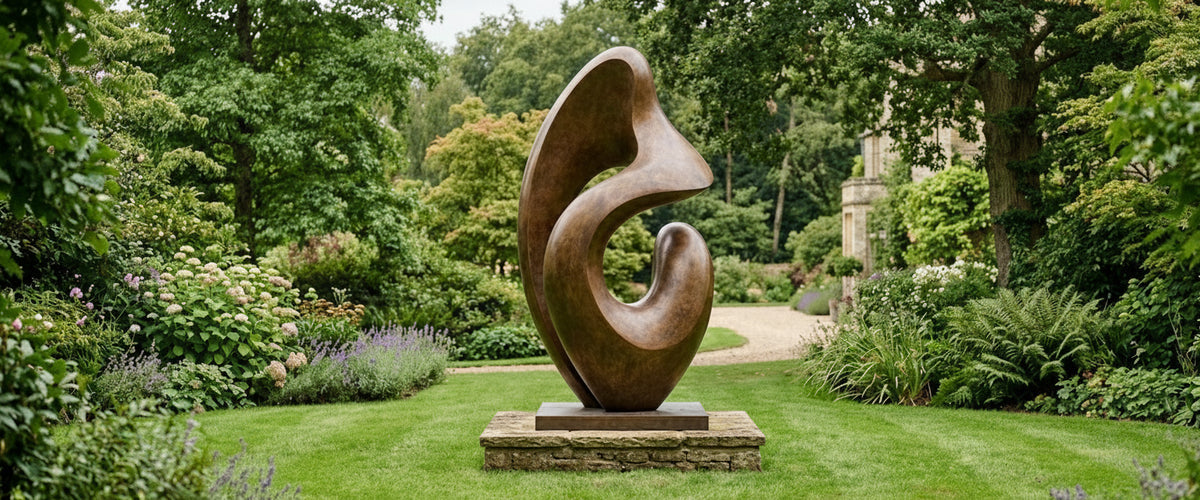
A monumental abstract bronze sited against mature planting in a Hamptons-style garden.

Key Takeaways Before You Commission a Metal Abstract Garden Sculpture
Form first, finish second. A bad silhouette cannot be rescued by a beautiful patina.
Scale is read from sightlines, not floor plans. A 10 ft metal abstract garden sculpture at 30 ft can vanish.
Alloy choice (bronze, 316 stainless, Corten) drives lifespan, weight, and price.
Maquette and on-site mock-up are non-negotiable for large commissions.
Engineering, base, and install often equal 20-35% of the total project.
Pricing depends on material, scale, complexity, finishing, and shipping; ask for a tailored quote.

What Sculptors Actually Think About Before Taking on the Commission
The first question in the studio is rarely "what shape?" It is "where is it going, and what will it have to live next to?" A metal abstract garden sculpture set in a clipped boxwood parterre needs a completely different mass and rhythm to one anchoring a meadow planting in the Hudson Valley. Hard geometry reads as confident against soft planting and lazy against architecture; biomorphic forms do the opposite.
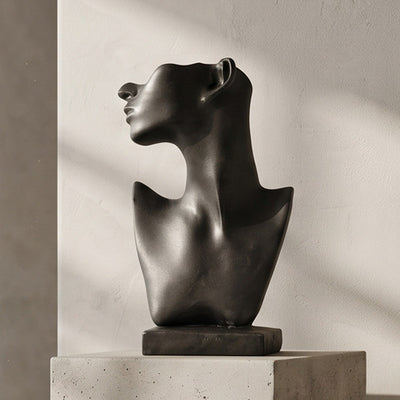
We also look hard at the viewer's path. Will the work be approached head-on down an allee, or glimpsed at an angle from a terrace? An abstract garden sculpture in metal depends on rotation. If there is only one good viewing angle, the design has failed. Where a garden allows full 360-degree circulation, a piece like the Monumental Modern Abstract Biomorphic Bronze Sculpture - 340cm earns its keep, because the curves keep generating new silhouettes as you walk around them.
Then comes the honest conversation about climate. Coastal salt air in the Hamptons or Malibu chews through poor-grade stainless. Freeze-thaw in Aspen or Greenwich will lift a badly applied patina off bronze. None of this is a reason to avoid a metal abstract garden sculpture outdoors; it is a reason to specify it properly from day one.
Craft Decisions That Change the Final Result (and the Price)
Buyers often assume cost is mostly material weight. It is not the dominant factor. What really moves the number is complexity of form, wall thickness, number of welded sections, internal armature, and finishing of the metal abstract garden sculpture itself.
Alloy and Material
Three families do almost all the work in a monumental abstract garden sculpture in metal:
Silicon bronze: the traditional choice, taking patina beautifully and lasting centuries with light care. Heavy, expensive, and forgiving of complex casting.
316 marine-grade stainless steel: ideal for mirror or satin abstracts, especially near coasts. Reads as light and contemporary. Welds and polish lines are visible if rushed, so finishing hours matter.
Corten weathering steel: develops a stable rust skin, suited to architectural geometric forms. Needs correct drainage detailing or it streaks the plinth.
Where the setting calls for a contemporary reflection rather than classical bronze weight, a satin stainless metal abstract garden sculpture such as the Crescent Abstract Steel Outdoor Sculpture - 120cm is closer to the right design language: the surface picks up sky color and planting tones rather than competing with them. That is a deliberate craft choice, not an accident of the alloy.
A satin 316 stainless abstract sited in a Long Island coastal garden, chosen for salt-air resistance.
Construction Method
Lost-wax cast bronze, fabricated sheet, and CNC-cut plate each have a fingerprint. Cast bronze gives soft transitions and weight in the hand of the form. Fabricated sheet gives crisp edges and lighter visual mass. Plate construction reads architectural and graphic. Choosing the wrong method for the design is the most common mistake we see in a metal abstract garden sculpture from less specialized makers. A biomorphic curve fabricated in flat panels always looks faceted and tired.
Finishing Hours
On a large stainless abstract, hand-finishing can be 30-40% of total studio hours. On a patinated bronze, the chemistry and torch work to land the right color is a specialist job, not a final coat. This is where quotes from different studios diverge most sharply, and where buyers should ask exactly what is included.
Why Some Pieces Read Right at 10 Ft and Wrong at 30
Scale is the single most misjudged variable in a metal abstract garden sculpture. A work that feels imposing in a studio at arm's length can disappear on a lawn the size of a tennis court. The reason is simple: outdoors, the eye reads sculpture against sky, trees, and architecture, all of which are vast.
Our working rule is that the piece should occupy a meaningful slice of the viewer's cone of vision from the primary viewing point. For a sculpture seen from a terrace 60 ft away, that usually means a minimum height of 8-10 ft (about 2.4-3 m), often more. For a lawn that needs punctuation rather than decoration at that distance, something on the scale of the Monumental Modern Abstract Arch Bronze Sculpture - 370cm is closer to the right answer than a 6 ft piece on a tall plinth, which tends to read as undersized once trees mature around it.
There is also a planting question. Mature trees will eventually dwarf an underscaled metal abstract garden sculpture. We routinely ask landscape architects for a five-year planting projection before finalising height. Getting the scale right is partly mathematics and partly experience: you learn it by standing in gardens where it went wrong.
Studio Process: Maquette, Sample, Fabrication, Install
A serious metal abstract garden sculpture commission moves through four stages, and short-cutting any of them is where projects come unstuck.
Maquette. A scaled model, usually 1:10, in clay, plaster, or 3D-printed resin. This is the moment to argue about form. Changes here cost almost nothing. Changes after fabrication starts cost a great deal.
Material sample. A flat panel or small section in the proposed alloy and finish, sent to the client. For patinas especially, photos lie. You need the sample in the actual garden light.
Fabrication. Casting, welding, grinding, polishing. For a monumental piece this is typically 12-20 weeks of studio time, sometimes more for grouped works such as a Monumental Modern Trio of Abstract Geometric Figures Bronze Sculpture - 250cm, where each figure must work alone and as part of the group, and the spacing on site becomes part of the composition.
Engineering and install. Footings, anchor bolts, internal pins, lifting plan. Pieces over about 500 lb (around 225 kg) usually need a small crane and ground protection. On a finished lawn that planning starts weeks before the truck arrives.
For broader context on outdoor bronze care and longevity, the American Institute for Conservation publishes useful background on how trained conservators approach metal artworks, which is worth reading before committing to long-term placement.
Honest Red Flags to Ask About Before You Commit
Most metal abstract garden sculpture commissions go well. The ones that go badly usually had warning signs at the quoting stage. Press on these points:
"What alloy and what grade, exactly?" "Stainless steel" is not an answer. 304 will pit near the coast; 316 will not. "Bronze" should be silicon bronze for outdoor work, not a brass mix.
"Can I see a material sample in my garden light?" A studio that refuses is hiding something about the finish.
"Who does the patina, and is it sealed?" Patinas should be applied hot by a specialist and protected with wax or a conservation-grade coating.
"What is the internal structure?" Large hollow forms need stainless armatures, drainage holes, and weep points. Ask to see the engineering drawing.
"What does the base detail look like?" A beautiful metal abstract garden sculpture on a clumsy plinth fails. Plinth design is part of the commission, not an afterthought.
"What is included in the quote?" Crating, freight, customs, crane hire, footings, and post-install snagging are often quietly excluded. Get them in writing.
One last thing worth saying plainly: the budget for a metal abstract garden sculpture depends on material, scale, complexity, engineering, finishing, and shipping distance. Anyone giving you a firm number before they have seen the site, the form, and the brief is guessing. A proper quote follows a proper conversation.
Where to Look Next
If you are weighing options for a metal abstract garden sculpture, it helps to see the range of finishes and silhouettes side by side. Our metal sculptures collection gathers bronze, stainless, and Corten abstract work in one place, and the garden statues collection shows how those forms sit in landscape settings. From there, a conversation about a bespoke metal abstract garden sculpture, sized and finished for your specific garden, is the natural next step.
For wider placement ideas, Angel Garden Statues: A Buyer's Guide to Scale, Stone and Placement is useful companion reading before finalising the setting and sightlines.