










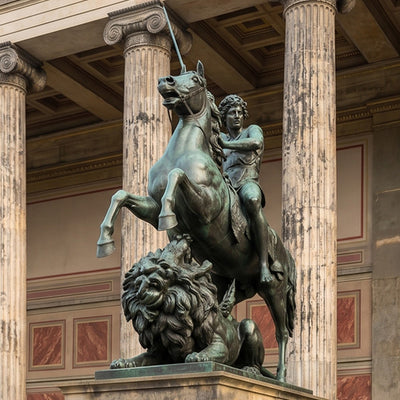




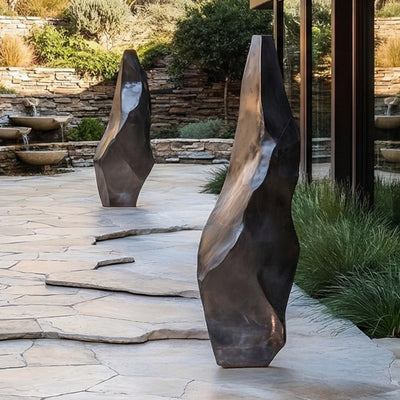

















A garden changes with the seasons; bronze does not. That permanence is exactly why bronze garden statues sit at the top of most serious buyers' lists, whether the setting is a clipped formal lawn in the Hamptons or a wide gravel court outside a Napa winery. Cast bronze holds fine detail for generations, weathers into a patina most owners grow to love, and reads as the real thing from across a long lawn. The catch is that the word "bronze" gets stretched a long way in the garden market, and the gap between a solid cast piece and a coated lookalike is the difference between an heirloom and a disappointment.
Looking for the full range in this category? Browse our Bronze Deer Statues collection for every available finish, size, and configuration.
Below is a working guide to buying, scaled to the kind of large statement pieces we make and ship at Giant Sculptures.

Key Takeaways Before You Buy Bronze Garden Statues
- Solid cast bronze is the benchmark. Foundry-cast bronze ages gracefully outdoors and keeps crisp detail; resin or coated alloys do not behave the same way over decades.
- Scale is the most common mistake. Pieces that look big indoors shrink outside. Plan the footprint and sight lines before you commit.
- Patina is a finish, not an accident. Browns, greens and near-blacks are chemically applied at the foundry, then sealed; you can specify the tone you want.
- Weight drives logistics. A life-size animal can run into hundreds of pounds, so plan the base, access route and craning early.
- Bespoke is normal at this scale. Subject, pose, height and patina can all be commissioned rather than bought off a shelf.

What Bronze Garden Statues Are, and Who They Suit
When people search for bronze garden statues, they usually mean a free-standing figure or animal cast in bronze and finished for outdoor life. Bronze is a copper alloy, traditionally mixed with tin, and it has been the material of choice for outdoor sculpture for thousands of years for one practical reason: it forms a stable protective layer as it weathers rather than corroding away. The Smithsonian's American Art collection holds outdoor bronzes more than a century old that still read clearly, which tells you most of what you need to know about longevity (americanart.si.edu).
These pieces suit buyers who want a permanent focal point: collectors, landscape designers planting a long-term scheme, architects finishing a courtyard, and venue owners who need a piece that survives weather, foot traffic and time. If you are furnishing a short-term display or rental staging, a lighter material may make more sense. If you want something your grandchildren will still see in place, bronze is the honest answer.

How to Compare Bronze Garden Statues Options
Start with the casting, not the photo. The phrase "garden bronze statues" covers genuine foundry-cast work, cold-cast bronze (resin loaded with bronze powder), and metal pieces simply painted to look bronzed. They photograph alike and behave nothing alike. Ask three blunt questions before you buy:
- Is it solid cast bronze, and by what method? Lost-wax (cire perdue) casting is the standard for detailed figurative and animal work. It captures fine surface texture that coatings cannot fake.
- What is the wall thickness and internal structure? A large piece needs enough metal and internal armature to stand up to wind load and the odd knock without flexing.
- How is it finished and sealed? A proper patina is applied and then protected with wax or lacquer suited to outdoor exposure.
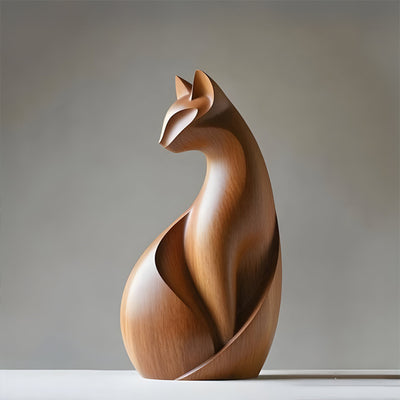
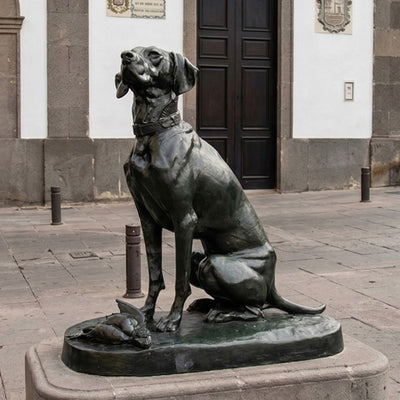
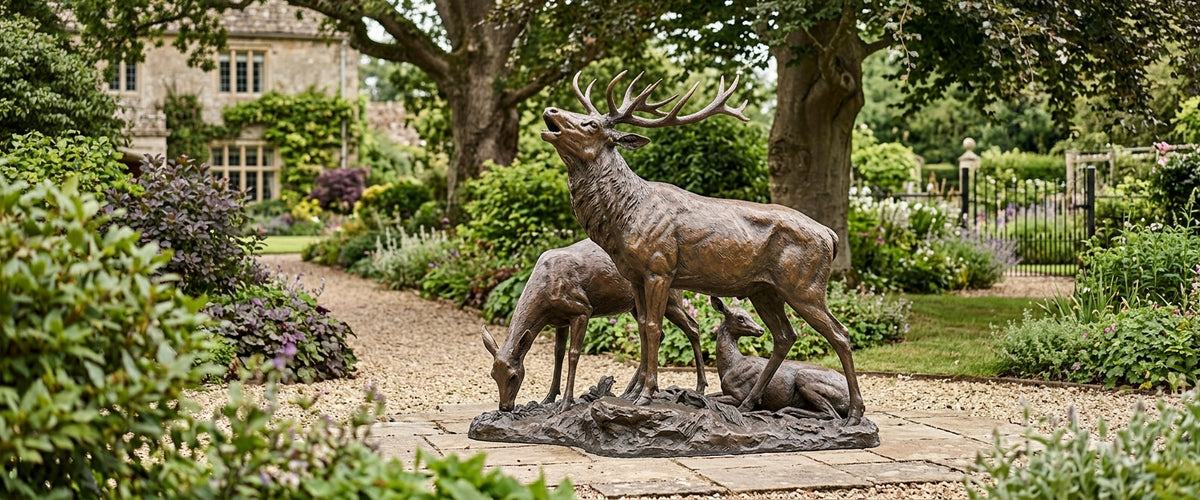
Subject matters too, because it sets the mood of the whole space. A pair of bronze cranes brings a quiet, poised line to a water's edge. A figure such as a garden statue of Hebe, the classical cup-bearer, leans formal and traditional. Wildlife reads more relaxed: a bronze deer garden statue suits naturalistic planting, a bronze cat garden statue works as a wink of detail near a doorway, and a bronze elephant garden statue makes an unmistakable centerpiece. Where the planting is loose and naturalistic rather than formal, a group such as the Life-Size Bugling Stag and Deer Bronze Sculpture - 290cm holds a large open lawn without ever feeling staged.

Materials, Finishes and Scale Decisions
Bronze gives you more finish control than people expect. The patina, that chemical coloring on the surface, can be pushed warm brown, verdigris green, or a deep near-black, then sealed. Left fully exposed and unsealed, copper alloys will continue to react with the air and shift over years; a maintained wax or lacquer coat slows that and keeps the tone you chose. The American Institute for Conservation has good plain-language guidance on caring for outdoor bronze if you want to read further (culturalheritage.org).
Scale is where most gardens go wrong. A figure that feels generous in a showroom can vanish on a wide lawn. As a rough rule, a piece meant to be seen from the house should stand tall enough to break the horizon line of its planting, and a piece on an axis or at the end of a path should be sized to the length of that view, not to the spot it stands on. When in doubt, go larger. We have lost count of the buyers who came back wishing they had sized up.
Weight follows scale and it is not a footnote. A monumental life-size animal can weigh several hundred pounds (well over 100 kg), which shapes your base design, your access route, and whether you need a crane or a few strong people on the day. A piece like the Monumental Life-Size Walking Elephant Bronze Sculpture - 360cm, at roughly 12 feet long (around 360 cm), needs its footings and approach planned before it ever leaves the foundry.
Where to Place Bronze Garden Statues for Impact
For wider placement ideas, Bronze Cranes Garden Statues: A Placement Guide for Real Gardens is useful companion reading before finalising the setting and sightlines.
Placement is half the result. A few principles that consistently work:
- Anchor a sight line. Put the piece at the end of a path, an allee, or a clear axis from a key window so it pulls the eye through the garden.
- Give it breathing room. A strong sculpture needs negative space around it. Crowded planting fights the silhouette.
- Use water and reflection. Bronze near a pool or pond doubles its presence. A bronze fountain does both jobs at once, holding the eye and adding sound.
- Think about morning and evening light. Raking low sun across a patinated surface shows the modeling far better than flat midday light. Site accordingly, and consider discreet uplighting for the dark months.
- Mind the backdrop. A dark patina disappears against dense yew or evergreen; pull it forward against sky, gravel, or pale stone instead.
Where a courtyard or formal pool needs a single piece to carry the whole composition, a water feature such as the Large Traditional Elephant and Calf Bronze Fountain - 320cm combines figure, scale and movement, holding the eye and adding sound at once. You can see the wider range in our bronze garden statues collection, and pieces with water in the garden fountains and water features collection.
Budget, Commissioning and Delivery
Honest answer on cost: it depends, and any supplier quoting a flat figure before knowing the brief is guessing. Price on a serious bronze tracks the material volume, the scale, the complexity of the modeling, the patina work, any engineering for water or wind load, plus crating and installation. A small animal and a monumental rearing elephant are not in the same conversation. The right move is to set your scale and subject, then ask for a tailored quote against that brief.
Commissioning is the norm at this end of the market, not a luxury add-on. A typical bespoke route runs: brief and reference images, a maquette or scaled drawing for sign-off, clay modeling, mold making, foundry casting, then patina and finishing. Lead times reflect the real handwork involved, so plan around your landscaping schedule rather than against it. If a piece is feeding a fountain, settle the plumbing and reservoir design before casting, not after.
Delivery for large bronze is a logistics exercise. Confirm the access route, gate widths, ground bearing and lifting plan early. Most of our international shipments live or die on that site survey, so the more you tell us about the approach and final position, the smoother the install day runs.
How Giant Sculptures Helps With Bespoke Bronze Projects
We make and ship large-scale bronze worldwide, and most of our work is either scaled up from an existing model or commissioned from scratch. That means you can change a pose, adjust a height, specify a patina tone, or develop a subject that does not exist yet. We have shipped monumental elephants, stag groups and figurative bronzes to private gardens and commercial sites, and the projects that go best are the ones where scale, base and access are agreed before the foundry starts.
If you are weighing up a piece for a specific spot, send us the dimensions of the space, a photo of the position, and a sense of the mood you want. We will tell you honestly whether to size up, where the piece will read best, and what the patina will do over time.