

































































































A gargoyle put down carelessly reads as a gift-shop curiosity. Set it on the right axis, at the right height, against the right wall, and the same piece stops traffic on the drive. That gap between forgettable and formidable is almost never about the sculpture itself. It is about placement. Outdoor weatherproof gargoyle statues carry more visual weight than most garden pieces because the eye reads them as guardians, so where you point them and what they look back at does real work.
Looking for the full range in this category? Browse our Garden Statues collection for every available finish, size, and configuration.
We field a lot of gargoyle statue commissions from clients who love the subject but have never lived with a figure that big outdoors. This is the advice we give before anyone commits to a pose or a plinth.
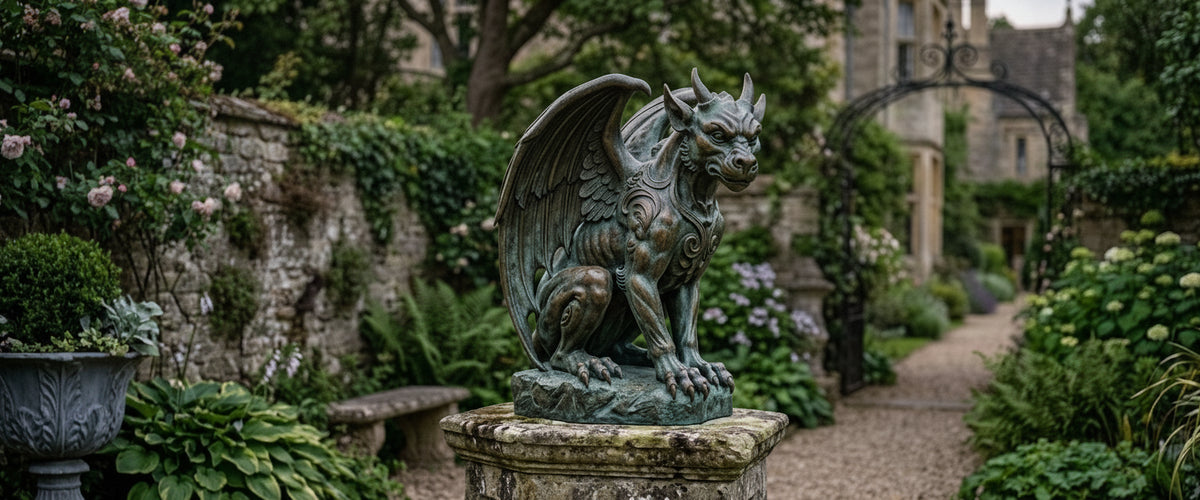
A raised pedestal turns a gargoyle into a sentinel at the head of a drive.

Key Takeaways Before You Place a Gargoyle
For wider placement ideas, Bronze Outdoor Garden Statues: How to Choose One That Earns Its Place is useful companion reading before finalizing the setting and sightlines. Gargoyle statues reward this kind of planning.
Height matters more than size. A gargoyle reads as a guardian when it sits slightly above eye level, so pedestal height often changes the piece more than the sculpture does.
Material decides where it can live. Bronze, Corten and stone shrug off weather for decades; lighter composites need more sheltered spots.
Gargoyles want a backdrop. Open lawn swallows them. Walls, hedging, gateposts and rooflines give the silhouette something to bite against.
Sightline first, then plinth. Decide where people see it from before you fix anything in concrete.
What Outdoor Weatherproof Gargoyle Statues Actually Look Like in Different Settings
The subject bends to its setting more than people expect. A crouching gargoyle on a low stone wall in a walled garden feels architectural, almost medieval, as though it has always been there. Lift the same figure onto a tall pedestal at the head of a formal drive and it becomes a sentinel; the mood shifts from folklore to authority.
Winged pieces behave differently again. Where the wingspan has room to breathe and a hard edge behind it, a gate pier or a clipped yew wall, a heraldic form such as the Large Heraldic Winged Lion-Dragon Gargoyle Bronze Sculpture (150cm) keeps its outline legible from a distance. Push a winged gargoyle into a tight border and the wings vanish into the planting.
Indoors, gargoyle statues play a quieter, stranger role. In a double-height entrance hall or a converted barn, a seated demon on a stone base becomes a conversation piece rather than a guardian. We have shipped seated forms to interior atriums where the client wanted the mythology without the weather exposure. The pose that works there, compact and grounded, is often the wrong one for a windswept terrace.

Scale, Sightlines and Pedestal Height
Three numbers decide how a gargoyle reads: the height of the figure, the height of the plinth, and the distance from where people usually stand or drive. Get those in balance and a 5-foot (1.5 m) sculpture can dominate a courtyard. Get them wrong and the same piece looks stranded.
Our rule of thumb from years of gargoyle statue commissions: for a guardian effect, put the gargoyle's face at or slightly above the viewer's eye line at the primary viewing point. On a terrace where people stand, that might mean a low base. At the end of a long drive seen from a moving car, you want more mass and more height, because distance shrinks everything and detail falls away.
Pedestal height and proportion is where most people slip. A plinth that is too slim makes a heavy bronze look top-heavy and precarious; one that is too bulky turns the sculpture into an afterthought sitting on a block. We usually specify the base alongside the figure so the two are designed as one object, not bought separately and hoped for.
Sightlines: Decide the View First
Before anything is cast or carved, we ask clients to stand at the two or three points where the piece will be seen most: the front door, the kitchen window, the top of the steps. A gargoyle almost always has a strong three-quarter angle where the face, the crouch and the wings all resolve. Orient that angle toward the main sightline. It sounds obvious, and it is the single fix that rescues the most disappointing gargoyle statue installs.
A contrasting wall behind the figure keeps its silhouette legible across a courtyard.

Indoor Versus Outdoor Placement: When Each Wins
Outdoors wins when you want the guardian narrative, the drama of weather and the play of daylight moving across the surface through the day. A bronze gargoyle on a north-facing gatepost or a garden wall earns its keep precisely because it lives in the elements. Bronze develops a patina outdoors that a climate-controlled hall will never give you; the Getty's conservation guidance on outdoor bronze explains how that surface layer both changes the look and helps protect the metal underneath (Getty Conservation Institute). This is where outdoor weatherproof gargoyle statues really come into their own.
Indoors wins for detail lovers and for climates that punish stone. If a client wants intricate carving to stay crisp, or lives somewhere with freeze-thaw cycles that attack porous material, an interior setting protects the finish. Wall-mounted gargoyle statues are the natural indoor choice; where a freestanding figure would crowd the floor, something like the Classical Gargoyle Demon Bronze Wall Sculpture (90cm) sits comfortably over a fireplace or on a stair landing.
For most buyers the honest answer is that the subject was born outdoors. These carved guardians began as functional waterspouts on Gothic churches, throwing rain clear of the masonry, which is why gargoyle statues read so naturally against architecture and open sky. That heritage is worth respecting when you choose the spot.

Light, Backdrop and Contrast
A gargoyle is mostly silhouette and shadow, so light is not decoration; it is the thing that makes the sculpture legible. Side light early and late in the day rakes across the surface and pulls out every ridge, claw and fold. Flat midday light overhead flattens the whole piece. If your only viewing window is midday, position the figure so a wall or hedge throws it into partial shadow and gives the form some contrast.
Backdrop does the other half of the job. Dark bronze against a pale stone wall snaps into focus. The same bronze against a dense green hedge can read beautifully or disappear entirely, depending on how much sky sits behind it. We generally steer clients toward a backdrop that contrasts with the material: light behind dark, or texture behind smooth. Set low against a rendered pale wall, a piece like the Large Contemporary Crouching Gargoyle Demon Bronze Sculpture (150cm) holds its shape from across a courtyard in a way it never would floating on open lawn.
At night, uplighting turns a gargoyle theatrical, throwing the face into relief and casting a large shadow up the wall behind it. It is one of the highest-impact, lowest-cost moves you can make with gargoyle statues. Aim a single warm ground-mounted light from below and slightly to one side, never dead-front, or you flatten the whole thing back out.

Common Placement Mistakes We See, and How to Avoid Them
Every so often a client sends a photo of a finished install and we can see the problem immediately. The same handful of errors come up again and again with gargoyle statues.
Marooning it on open lawn. With no wall, gate or planting behind it, the figure loses scale and looks smaller than it is. Give it architecture to relate to.
Under-scaling for the approach. A piece chosen at studio-viewing distance often looks modest at the end of a long drive. Buy for the real viewing distance, not the showroom.
Facing it the wrong way. The best angle often points away from where people actually stand. Set the three-quarter view toward the main sightline.
Skimping on the base. A heavy sculpture on an under-built or badly proportioned plinth looks unstable and cheapens the whole install. Engineer the base for the weight and design it to match.
Ignoring drainage and fixing. These weatherproof pieces need proper anchoring and a base that sheds water. On any large bronze or stone commission we specify the fixing detail so it survives wind load and does not sit in a puddle.
Commissioning a Gargoyle That Suits Your Site
Because placement drives so much, we prefer to talk about the site before the sculpture. A bespoke gargoyle statue commission with Giant Sculptures lets us tune the pose, wingspan, base and finish to a specific wall, gatepost or terrace rather than forcing a stock figure into a spot it does not fit. Material is chosen for the climate: bronze and Corten for exposed coastal or mountain sites, stone or marble where you want a quieter, weathered look over decades.
Cost depends on material, scale, complexity, the engineering of the base and the finishing work, so we quote each project individually rather than list a figure that would mislead you. If you know the wall it will guard and the point it will be seen from, we can steer you toward the right size and pose for your gargoyle statues from the first conversation. The Outdoor Sculptures & Statues collection gives a sense of scale and finish, then send us the sightlines.
A gargoyle is one of the few subjects that rewards a bit of theater. Place your gargoyle statues with intent and they do exactly what their Gothic ancestors did: they hold the edge of your space and make everyone glance up.