





































































































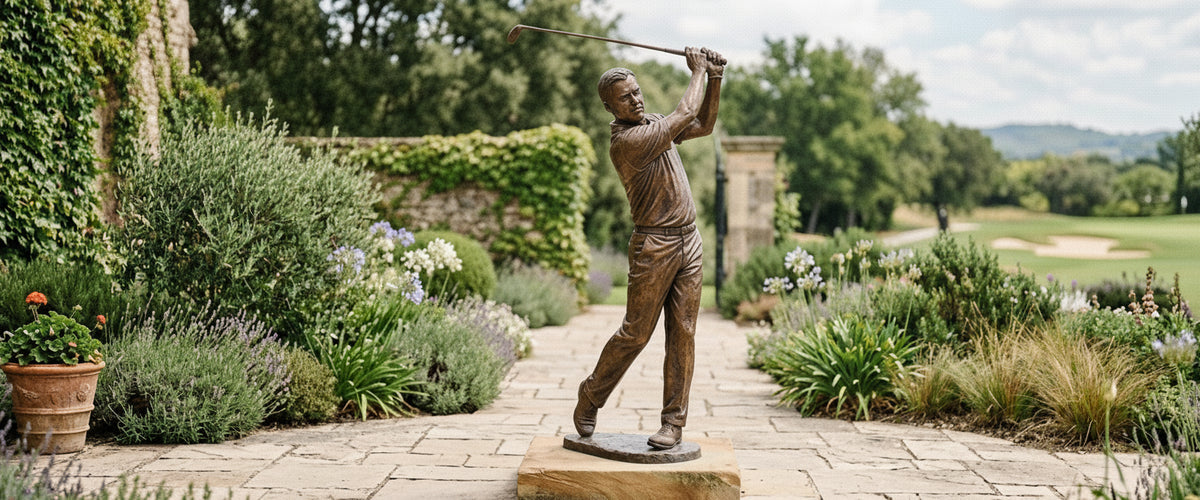

A bronze figure that looks perfect in a catalog can shrink to nothing on a wide lawn, or crowd a courtyard until the whole space feels tense. That gap between the photo and the finished garden is the single most common regret we hear about. Bronze outdoor garden statues are one of the few purchases that get better with age, but only when the piece is matched to the site, the sightlines, and the way you actually live with the space. Get that right and the statue becomes the reason people stop and look.
Bronze earns its reputation outdoors because it holds fine detail, survives freeze-thaw cycles, and develops a living surface over time. This guide walks through what you are really buying when you shop for bronze outdoor garden statues, how to judge scale before you commit, and where a cast bronze piece does the most work.

Key Takeaways for Buying Bronze Outdoor Garden Statues
Bronze is a long-term material. Cast well and cared for, bronze outdoor garden statues outlast the garden around them, which is why we treat the buy as a decades-long investment rather than a seasonal one.
Scale is decided on site, not in the browser. Measure the space, mark it out, and view from your main sightlines before choosing a height.
Patina is a choice. Warm browns, verdigris greens, and darker near-black finishes each read very differently in a garden.
Placement beats size. A well-sited life-size figure outperforms a giant piece dropped in the wrong spot.
Budget depends on the piece. Material volume, scale, complexity, engineering, and installation all move the number, so ask for a tailored quote rather than guessing.

What Bronze Outdoor Garden Statues Are, and Who They Suit
A true bronze statue is cast, usually by the lost-wax method, from an alloy that is mostly copper. That casting process is what lets the metal capture the crease of a sleeve or the tension in an animal's shoulder and keep it for a century or more. Bronze outdoor garden statues weather gracefully because the surface reacts with the air to form a protective layer rather than corroding through, the opposite of what happens to untreated steel. The Metropolitan Museum of Art notes that the lost-wax method has been used to cast bronze for thousands of years, which is a fair measure of how durable the results can be.
These pieces suit buyers who think in decades. Private collectors placing a centerpiece in a Napa or Hamptons garden, landscape designers specifying a focal point for a client, hotel and winery owners who want something with real presence at the entrance. If you want a piece to move indoors every winter or refresh every few years, cast metal is overkill. If you want something your grandchildren might argue over, bronze outdoor garden statues are exactly right.

Materials, Finishes and Scale Decisions
Not everything sold as "bronze" is bronze. Cold-cast or bonded bronze mixes bronze powder into resin; it can look convincing indoors but does not age the same way and is a different proposition outdoors. For permanent bronze outdoor garden statues we steer buyers toward genuine cast metal, and we are happy to explain the difference on any specific model.
Patina is where personality enters. A warm chestnut brown flatters classical figures and reads well against stone and clipped hedging. A verdigris green leans historical and settles beautifully into planting. A darker, near-black patina suits contemporary and animal subjects, giving clean lines a graphic edge. The patina is applied with heat and chemistry at the foundry, then sealed with wax; over years outdoors it will keep shifting, which most owners come to love.
Scale is the decision people underestimate. A life-size figure such as the Contemporary Life-Size Male Golfer Bronze Sculpture - 230cm (around 7 feet 6 inches) has real human presence up close but can vanish across a wide lawn. For a piece meant to be read from the house or a driveway, you often need to go monumental. Where the setting needs to hold its own against tall trees or architecture, something like the Monumental Contemporary Winged Angel Bronze Sculpture - 300cm (roughly 9 feet 10 inches) is built for that kind of distance.
Weight follows scale, and it matters for delivery and foundations. A large solid-walled figure can run into hundreds of pounds (well over 100kg), so the base and access route are part of the buying decision, not an afterthought. We work this out with you before anything ships.

Where to Place Bronze Outdoor Garden Statues for the Strongest Impact
For wider placement ideas, Bronze Garden Statues: How to Choose a Piece That Earns Its Spot is useful companion reading before finalizing the setting and sightlines.
The best siting trick we know is to give a statue one job. A figure that terminates a view down a path, a fountain that anchors the center of a formal garden, an animal caught mid-stride at the edge of a lawn where it looks like it just arrived. Each of these works because the piece has a clear relationship to the space, and it is how the strongest bronze outdoor garden statues earn their keep.
Focal points and sightlines. Stand where you look most often, from the kitchen window, the terrace, the top of the drive, and place the statue at the end of that line. Where water is part of the plan, a bronze fountain such as the Classical Kneeling Female Figure with Conch Shell Bronze Fountain - 90cm earns a spot at the heart of a courtyard where the sound carries and the figure reads from every side.
Movement and surprise. Animal groups reward placement that suggests they are passing through. We once shipped a set of running wolves to a client with a long meadow edge, and siting them low against the tree line, rather than up on a plinth, made people do a double take. A group like the Large Contemporary Running Wolves Bronze Sculpture - 180cm works precisely because the pose implies motion; put it somewhere a real animal might actually run.
Contrast with planting. Dark patinas pop against silver foliage and pale gravel. Green verdigris almost disappears into dense evergreen, which can be the effect you want or the mistake you regret. Test it by holding a large board of the target color in the spot for a day and watching how the light moves across it.
Give it breathing room. The most frequent placement error is crowding. Bronze outdoor garden statues need empty space around them to register as a focal point. If in doubt, clear more than you think you need.

Budget, Commissioning and Delivery
There is no honest single price for bronze outdoor garden statues, and anyone quoting one without seeing the piece is guessing. Cost is driven by the volume of metal, the finished scale, the complexity of the form, the engineering needed to keep it stable outdoors, the patina, and the installation. A compact animal and a monumental figural group are not remotely the same job. The right move is to tell us the piece you have in mind and the site, and we return a tailored quote.
If you cannot find the exact subject, pose, or size in the catalog, that is where bespoke commissioning comes in. We regularly produce work to a client's brief: a specific animal, a portrait figure, a scaled-up version of an existing design to suit a larger garden. A commission runs from concept sketches through a scale maquette to the final cast and patina, and it is the surest way to get a piece that fits both the space and the story you want it to tell.
Delivery and installation deserve early attention. Bronze at scale is heavy and often needs mechanical lifting, a prepared base, and clear access. For international shipping we crate to protect the patina and detail in transit, and we brief you on foundation requirements so the ground is ready when the piece arrives. Sorting this at the enquiry stage avoids the classic problem of a beautiful statue stranded on a driveway because the gate is too narrow.
A Quick Buyer's Checklist
Confirm it is genuine cast bronze, not cold-cast resin, for a permanent outdoor piece.
Mark out the footprint on site and view it from your main sightlines before choosing height.
Choose a patina against your actual planting and hardscape, not on a screen.
Check access, lifting, and base requirements for the finished weight.
Plan for occasional re-waxing to keep the surface protected.
Ask for a tailored quote that includes finishing, crating, and installation guidance.

How Giant Sculptures Helps with Bespoke Bronze Projects
Giant Sculptures specializes in large-scale and bespoke work, which means we spend as much time on siting, scale, and installation as on the casting itself. If you are weighing several subjects for your own bronze outdoor garden statues, browse the full bronze garden statues range to see how different poses and scales behave, or the bronze fountains collection if water is part of the plan. When the piece you picture is not on the page, send us the brief; a commission is often the same investment for something made exactly for your garden.
Buy the right bronze once, put it in the right place, and give it a little care, and bronze outdoor garden statues will still be doing their job long after the rest of the garden has been replanted twice. That is the whole point of the material.