






















































































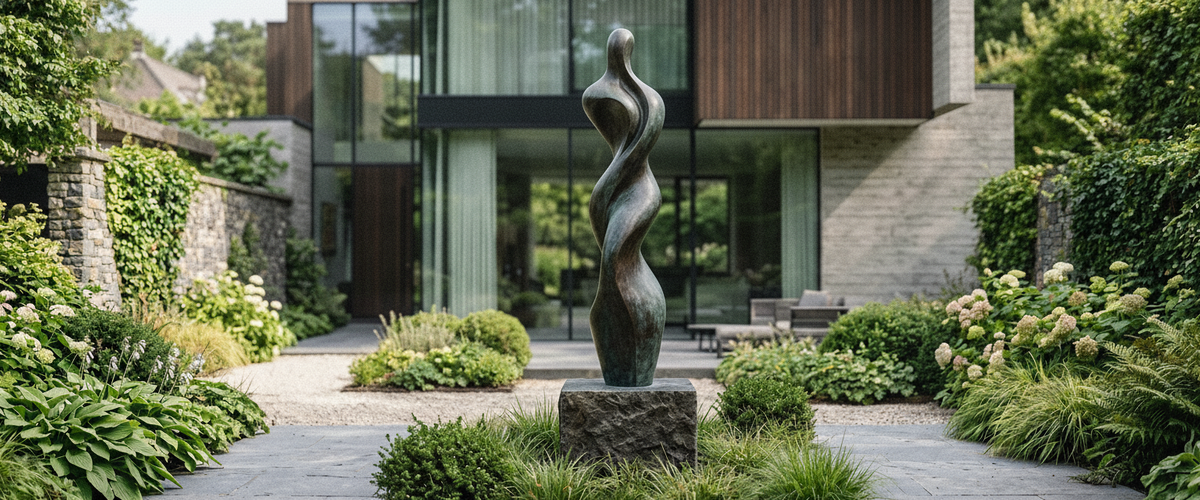

The reason a contemporary art sculpture succeeds or embarrasses everyone involved rarely shows up in the sketch. It shows up on install day, when a piece that looked confident in a rendering suddenly reads flat against a limestone wall, or sits two feet too low for the sightline it was meant to command. We have shipped enough large commissions to know the failure points early, and most of them are decided long before fabrication starts.
This is a look at how the studio actually thinks through a contemporary art sculpture brief: what we weigh, what changes the result, and where budgets quietly move. If you are commissioning a contemporary art sculpture for a Napa courtyard, a Texas lobby, or a garden in the Hamptons, the logic below is the same conversation we would have with you on a call.
A scale maquette is where form and silhouette get approved before any metal is cast.

Key Takeaways Before You Commission
Scale is a design decision, not a size setting. A form that reads right at 10 ft can look wrong at 30, and the fix is proportion, not more inches.
Material drives cost more than height. Bronze, stainless steel, and Corten each behave differently over decades outdoors.
The maquette earns its keep. Approving a small model saves expensive changes during fabrication.
Budget depends on material, scale, engineering, finishing, and install, so ask for a tailored quote rather than a headline figure.
Red flags are usually about process, not talent. If a maker cannot explain their fixing and drainage plan, pause.

What Sculptors Weigh Before Taking On a Contemporary Art Sculpture
The first question is never "what does it look like." It is "where does it live, and who walks past it." A commissioned contemporary art sculpture on a public plaza gets viewed in motion, from changing distances, often in full sun. A work in a private gallery room is read slowly, up close, under controlled light. Those two briefs produce very different objects even if the client sends the same reference image.
We map the approach angles, the primary viewing distance, and the light through the day. A modern contemporary sculpture that will sit against a bright sky needs a silhouette that holds up as a shape, because you will spend half the day seeing it backlit. Detail you carve into the surface simply disappears at that point. That single fact reshapes many designs before we cost anything.
Weight and ground conditions come next. A tall bronze figure needs a footing and an internal armature spec that matches the site, and that is engineering, not decoration. On our end, taking a contemporary art sculpture commission we cannot anchor safely is not worth the reputational risk, so we ask about substrate early.

Craft Decisions That Change the Result and the Price
Two sculptures of identical height can differ wildly in cost because of choices most buyers never see. Wall thickness in a cast bronze changes the metal volume. A mirror-polished stainless steel surface takes far more hand finishing than a brushed one. A patina with three tones is more labor than a single dark brown.
Surface finish is where a contemporary bronze sculpture lives or dies. Patina is both protective and aesthetic, and a good foundry treats it as part of the structure rather than a coat of color on top. When we quote a contemporary art sculpture, the finish specification is often the line that moves the most, because it is hours of skilled hand work.
Patina work is skilled hand labor, and it is often the line item that moves a quote most.
Casting method matters too. Lost-wax casting captures fine surface information and suits figurative and organic forms; a gesture-heavy commission like Large Contemporary Violinist Bronze Sculpture - 220cm at 220cm is exactly where that fidelity earns its cost, because every fold and finger carries the movement. The Metropolitan Museum of Art's overview of the lost-wax process explains why the method has been trusted for fine detail for thousands of years. For a bolder, more graphic contemporary wall sculpture or a large geometric form, fabricated and welded metalwork can be the smarter route, both structurally and financially.
Then there is the base. A plinth is not an afterthought. It sets viewing height, it hides the fixing, and it changes the perceived proportion of the whole object. We have redrawn plinths three times on a single contemporary art sculpture because the piece was right and the pedestal was fighting it.

Why a Piece Reads Right at 10 ft and Wrong at 30
Here is a lesson we learned the hard way years ago. A client wanted an abstract figure enlarged from a tabletop maquette to garden scale for a property outside Aspen. Scaled straight up, the head looked correct at conversation distance and shrank oddly once you stepped back across the lawn. Our brain expects certain proportions when an object gets large, and a literal enlargement breaks that expectation.
Big work often needs its proportions adjusted, not just multiplied. Sculptors have understood this for centuries; the deliberate distortions in monumental figures exist so the piece reads true from below and from far off. A contemporary art sculpture at architectural scale usually gets its limbs, negative space, and mass retuned so it feels honest at the distance people will actually stand.
This is also why a subtlety in a small model can vanish or dominate once enlarged. A quiet twist in the torso, an intended focus of many contemporary sculptures, might be the whole point at 45cm and completely lost at 12 ft. Deciding what the contemporary art sculpture is about, and protecting that one idea through the scale change, is the part that separates a considered commission from a blown-up souvenir.

Studio Process: Maquette, Sample, Fabrication, Install
Our commissioning path follows four checkpoints, and each one exists to catch a specific kind of mistake.
Maquette. A scale model, usually one-tenth or one-eighth. This is where you approve form, gesture, and the reading of the silhouette. Changing your mind here costs almost nothing. Changing it later costs plenty.
Material sample. A finish sample so you can see the actual patina or polish in your own light, not on a screen. Screens lie about metal.
Fabrication. Casting or building at full size, including the internal armature and mounting hardware engineered for the site.
Install. Delivery, rigging, and fixing. For anything tall or heavy this needs planning, access checks, and often a crane. We plan this at quote stage, not the week before.
Browsing finished work helps you brief us better on your own contemporary art sculpture. Our Contemporary and Modern Sculptures collection is a good place to see the range of forms and finishes we produce, and it tends to sharpen a client's own taste quickly. Seeing what you dislike is as useful as seeing what you love.

Honest Red Flags to Raise Before You Commit
Some warning signs have nothing to do with artistic ability. Ask any maker these questions and listen to how specific the answers are.
No drainage or water-management plan for outdoor bronze or steel. Trapped water inside a hollow form causes long-term damage. A serious studio has an answer.
Vague fixing details. "We'll bolt it down" is not an engineering spec. You want to hear about footing depth, anchor type, and wind load for tall pieces.
Patina promised as permanent and maintenance-free. Every outdoor metal finish needs care over decades. Corten weathers, bronze shifts, stainless steel wants cleaning.
A single headline price with no breakdown. Material, scale, engineering, finishing, and installation all move the number. If none of that is itemized, you cannot judge value.
No maquette stage offered. Skipping the model to save time is how expensive surprises happen.
For buyers who want a name to research while they shape a brief, looking at contemporary sculpture artists whose work you respond to is genuinely useful; our Adam Illes contemporary sculptures pages show how a distinct hand carries across different subjects. That kind of consistency is what you are really buying in a contemporary art sculpture commission.

Where Smaller Pieces Fit
Not every sculpture contemporary buyers want needs to be monumental. A single strong object can anchor a room or a courtyard entrance without dominating it. For a client who wants to test how they respond to bronze at close range before committing to something large, a focused cast head such as Contemporary Boar Head Bronze Sculpture at 45cm sits well on a console or plinth and reads as a deliberate gesture rather than an ornament. Several of the collectors we work with started their first contemporary art sculpture exactly there.
Whatever the scale, the discipline is the same: decide what the piece is about, protect that idea through material and size, and plan the boring structural things properly. Get those right and a contemporary art sculpture will still look deliberate in thirty years. As a bespoke sculpture supplier, that longevity is the part of the job we care about most.
For wider placement ideas, Acrylic Art Wall Commissions: What Sculptors Weigh Before They Say Yes is useful companion reading before finalising the setting and sightlines for your contemporary art sculpture.