






































































































Most acrylic art wall problems are set in motion long before anything is hung. A client sends a photo of a double-height lobby, asks for something bold, and expects the piece to look sharp from the door and from the mezzanine 30 feet (9 m) up. Those are two different design problems, and pretending they are one is how you end up with a wall that photographs well and disappoints in person.
At Giant Sculptures we build large-scale and bespoke work for people who are going to live with it for years, so we treat an acrylic art wall as a commission, not a print order. That mindset changes what we ask, what we sample, and what we tell you before we ever quote.

Key Takeaways Before You Commission Acrylic Wall Art
- Scale and viewing distance come first. A piece read at 10 ft is designed differently from one read at 30 ft.
- Acrylic behaves like glass, not like canvas. Edge quality, thickness, and mounting all show.
- Custom acrylic wall art pricing moves with material grade, size, layering, and install, so a tailored quote beats any published number.
- Ask for a maquette and a physical sample before full fabrication.
- Mounting hardware is part of the design, not an afterthought at the end.

What Sculptors Actually Think About Before Taking On an Acrylic Art Wall Commission
The first questions are rarely about the art. They are about the wall, the light, and the traffic. Is this a west-facing atrium that will get raking afternoon sun? Is it a corridor where people pass at 3 feet, or a boardroom where the piece is viewed head-on across a table? We have shipped acrylic wall art into hospitality lobbies, private homes in California, and corporate reception spaces, and the same design will read completely differently in each.
Cast acrylic (PMMA) is prized for optical clarity, but that clarity is unforgiving. Cast holds color and light better than extruded sheet and machines to a cleaner edge, which matters when the edge is part of the composition. The maker of the original Plexiglas material, Röhm, publishes useful technical data on how cast acrylic differs from extruded, and it is worth understanding before you sign off on a spec (Plexiglas technical resources).
We also think about weight and safety early. Large acrylic panels are lighter than glass of the same size but still heavy enough that fixing into stud, masonry, or steel changes the whole hanging strategy. That is a structural conversation, not a decorating one.

Craft Decisions That Change the Final Result (and the Price)
A few choices quietly drive both quality and cost. Getting them right early saves reworks later.
- Thickness. Thicker acrylic reads as more substantial and refracts light with more depth, but it needs more support and careful edge finishing.
- Layering and 3D relief. Flat printed acrylic prints wall art is one thing; layered, hand-painted or sculpted relief is another discipline entirely. Where a composition needs to throw real shadow under side light, stacked forms such as the Terracube 3-Set Hand-Painted Framed Acrylic 3D Wall Art - Fixed Sizes hold up in ways a single flat panel never will.
- Edge finish. Flame-polished, diamond-polished, or matte-frosted edges each catch light differently. On a piece where the acrylic glass wall art is meant to glow, the edge treatment is half the effect.
- Color method. Pigment can be surface-applied, reverse-printed behind the panel, or built as acrylic paint wall art on layered sheets. Reverse application protects the color and gives that lacquered depth.
None of these has a fixed price. Budget on an acrylic art wall depends on material grade, overall size, how many layers, the finishing work, and the install conditions. We quote each commission individually rather than pretend a headline figure means anything.

Why Some Acrylic Art Wall Pieces Read Right at 10 ft and Wrong at 30
This is the single most common miss we correct at the maquette stage. A composition with fine detail and tight color shifts can look exquisite at arm's length and turn to visual mush across a large room. The opposite also happens: a piece designed for long-range impact can feel crude when you walk right up to it.
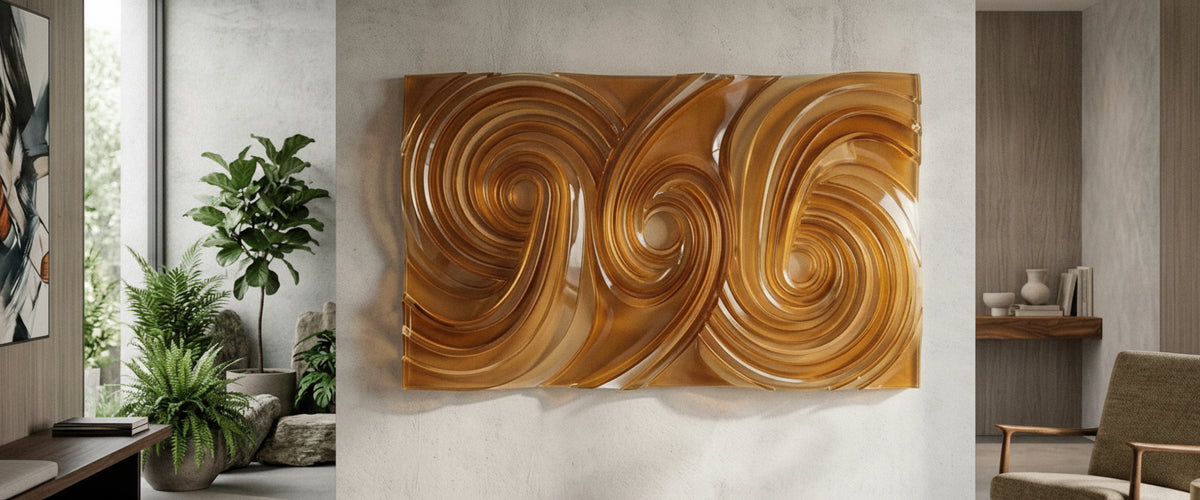
Optical, spiraling forms behave especially oddly at distance. A piece like the Cyclastra Amber optical spiral acrylic 3D wall art relies on how the spiral catches and bends light as you move, so that motion effect only lands at the right viewing distance. Specify the wrong scale and the whole trick collapses.
So we ask for the real viewing distances, not the ideal ones. Where does someone first see the piece? Where do they linger? For large acrylic wall art we often design in two registers: a bold silhouette or color field that carries the room, and finer detail rewarded up close. Both have to be deliberate.
Studio Process: Maquette, Sample, Fabrication, Install
The sequence matters, and we do not skip steps for large commissions.
- Maquette. A scaled model or accurate digital mockup placed into a photo of your actual wall. This is where scale and viewing-distance decisions get locked.
- Physical sample. A real acrylic sample showing the exact thickness, edge finish, and color method. Screens lie about clarity and depth; a sample tells the truth.
- Fabrication. Cutting, layering, painting, and finishing to the approved spec. On layered work like the Fractura Emerald Green square 3D acrylic wall art, this stage is where the depth and shadow are built up sheet by sheet.
- Install planning. We confirm the wall substrate, specify standoffs or a concealed cleat system, and package for safe transit worldwide.
If you want to browse how these pieces sit together as a body of work, our acrylic art collection is the clearest place to see the range of finishes and forms in one view.
How to Hang Acrylic Wall Art Without Regret
Hanging acrylic is closer to hanging a mirror or a framed glass piece than a lightweight print. A few rules keep it safe and looking sharp.
- Find the real structure. Locate studs or fix into masonry with proper anchors. Never trust plasterboard alone for a large panel.
- Use the specified hardware. Standoff barrels, French cleats, or a hidden subframe are chosen for the weight and look. Do not substitute lighter fixings to save time.
- Level twice. Acrylic edges show even a slight tilt because they catch light along the whole run.
- Clean with the right cloth. Microfiber and a plastic-safe cleaner only. Solvents and paper towels scratch and haze the surface, which is exactly why the American Institute for Conservation recommends gentle, non-abrasive methods for acrylic-based works (American Institute for Conservation).
- Plan the light. Grazing light emphasizes 3D relief; flat frontal light flattens it. Decide the effect you want before you position track lighting.
Honest Red Flags Buyers Should Ask About Before They Commit
A specialist should welcome hard questions. If a supplier dodges these, be cautious.
- "Cast or extruded acrylic?" For premium wall art on acrylic you want cast for clarity and edge quality. A vague answer is a warning sign.
- "How is the color protected?" Surface color can scratch or fade faster; reverse-applied or embedded color lasts.
- "What is the mounting system, and who confirms my wall can take it?" The answer should reference your actual substrate.
- "Can I see a physical sample before full fabrication?" On a bespoke piece, yes should be automatic.
- "How will it be packed and shipped?" Large acrylic needs corner protection, rigid crating, and edge guards. We ship worldwide and treat crating as part of the commission.
Is it worth chasing the top modern acrylic wall art panels on the market? Only if "top" is defined by your space, not by a spec sheet. The best panel is the one engineered for your wall, your light, and your viewing distance. That is the whole argument for commissioning rather than buying blind.
Where an Acrylic Art Wall Fits Best
Acrylic suits interiors that already have movement and light: a stair core, a reception desk backdrop, a long gallery wall in an open-plan home. It pairs well with clean plaster, warm timber, and stone. If you are weighing acrylic against other materials for the same wall, compare it with our metal wall art range, which reads heavier and more industrial, or the broader wall art and wall decor collection for a sense of what different mediums do to a room.
Whatever you choose, treat the wall as a commission with a beginning, a middle, and a proper install. Do that and an acrylic art wall will still look intentional a decade from now, not like something that was ordered in a hurry.
For wider placement ideas, Inspirational Wall Art for the Office: What Sculptors Weigh Before They Say Yes is useful companion reading before finalising the setting and sightlines.