





































































































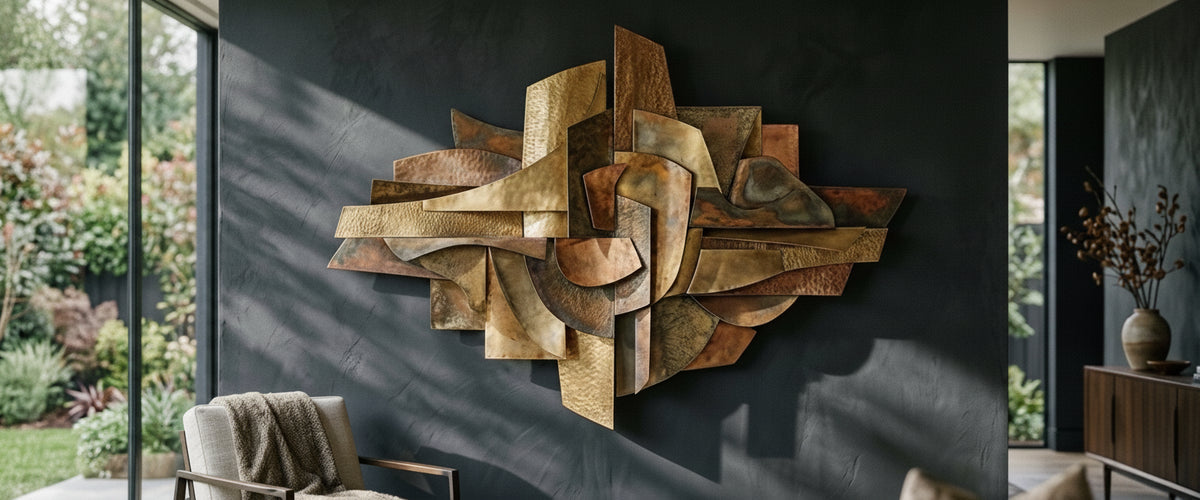

The single most common regret we hear about sculpture wall art has nothing to do with the piece itself. It is hung too high, floating above a sofa like a warning sign, or squeezed onto a wall that swallows it whole. The object was right. The placement was wrong. That gap between a piece that commands a room and one that just occupies a rectangle is almost entirely about scale, sightline and light, and those are choices you can plan before anything ships.
Sculpture wall art sits in a useful middle ground: it reads with the depth and shadow of a freestanding piece, but it hangs like art and frees up your floor. Done well, it turns a flat wall into a focal point. Done casually, it becomes expensive wallpaper.
Scaled to the sofa and lit from above, a dimensional piece anchors the wall instead of floating over it.

Key Takeaways Before You Hang Anything
Scale to the wall, not the frame. A piece should own roughly two-thirds to three-quarters of the visual field it anchors.
Center height matters more than ceiling height. The visual center of your sculpture wall art usually wants to land around 57 to 60 inches (145 to 152 cm) from the floor for seated and standing sightlines.
Light is a material choice. Relief and dimensional work lives or dies on raking light and shadow.
Outdoor changes the rules. Weather, mounting substrate and metal choice all shift once a piece leaves the interior.
Bespoke solves the awkward wall. Odd proportions, double-height voids and specific palettes are exactly what a commission is for.

What Sculpture Wall Art Actually Looks Like Room to Room
The same category of sculpture wall art behaves very differently depending on where it lands. In a living room with a long, low sectional and a plaster feature wall, a wide horizontal composition reads as a landscape and calms the space. In a narrow entry hall, a tall vertical relief does the opposite job: it pulls the eye up and makes a tight footprint feel intentional.
Sculpture wall art for a living room usually finds its natural home on the sofa wall, and that is also where the most mistakes happen. When the sofa wall needs depth that shifts with the day rather than a static image behind the seating, a layered metal piece such as the Eclat Sphere Red Abstract Metal Wall Art throws real shadow across the plaster as afternoon light moves.
Softer, tactile compositions play a different role. The paper-craft bloom pieces in our wall art and wall decor range read as texture and quiet in a bedroom or guest suite, where you want presence without visual noise. When the brief calls for that low-noise calm rather than a hard-edged focal point, something like the TerraLuma Ivory White Bloom Paper Craft 3D Wall Art is closer to the right register. Match the temperament of the piece to the job the room needs done.

Scale, Sightlines and Pedestal Height for Wall Work
Freestanding sculpture has a pedestal; wall-mounted sculpture wall art has a hanging height, and the logic is similar. The visual center is the anchor. For a mixed standing-and-seated room, aim the perceived center of the composition around 57 to 60 inches (145 to 152 cm) from the floor. Museums often hang to a center line near that band for a reason: it suits the average adult eye whether people are moving through or settled on a sofa. Most gallery hanging standards work from a center-line rule rather than a top-of-frame rule, and that is the habit worth stealing (si.edu).
Anchor the visual center around 57 to 60 inches, and leave 4 to 8 inches above furniture below it.
Scale is the harder discipline. On a sofa wall, your sculpture wall art should span roughly two-thirds of the sofa width. Go smaller and it looks stranded; a 30-inch (76 cm) piece over an 8-foot (2.4 m) sectional will always look like it wandered in from a smaller room. Above a console or fireplace, leave a consistent gap of 4 to 8 inches (10 to 20 cm) between the top of the furniture and the base of the piece so the two read as a group, not two unrelated objects.
Sightline is the third factor and the one people forget. Walk the route you actually take through the space. If you approach the wall from an angle, a deep relief will show its shadow beautifully; a flat piece will flatten further. Buy for how you move, not just how you stand still in front of it.

Indoor Versus Outdoor: When Each Wins
Interior placement gives you control. Stable temperature, predictable light and a forgiving substrate mean delicate media, paper craft, layered wood, fine metal leaf, all behave. This is where the wood wall art pieces earn their place; a modular grid or a fabric-and-timber composition wants a dry wall and controlled humidity to stay true over years.
Outdoor sculpture wall art is a different conversation, and it is where our large-scale background matters. Once a piece faces weather, material stops being a style choice and becomes an engineering one. For a shaded loggia or a north-facing courtyard, we steer clients toward marine-grade stainless steel, powder-coated aluminum or bronze. Corten develops its rust patina intentionally and suits garden walls, but expect run-off staining on pale stone or render beneath it, so plan the wall below as carefully as the piece itself.
Mounting is the quiet dealbreaker. An exterior masonry or stone wall needs correctly rated fixings and, ideally, a small standoff gap so water drains behind the piece rather than pooling. We have shipped commissions where the sculpture wall art was perfect and the failure point would have been a builder's generic anchor in soft brick. Specify the fixing with the piece; do not leave it to chance on install day.
Light, Backdrop and Contrast
Dimensional sculpture wall art is a shadow instrument. Flat, even lighting kills it. What you want is a degree of directional or raking light that skims across the surface and pulls the relief forward. A picture light angled from above, or a recessed spot set slightly off-axis, does more for a sculptural piece than any amount of ambient brightness.
Backdrop contrast decides whether the piece reads at all. A gold-toned metal composition like the Astrid Gold Edge Earthy Abstract Wall Art almost vanishes on a warm cream wall and comes alive against a deep charcoal, forest green or clay-toned surface. Before committing to a finish, hold a large sample of your wall color next to the piece, or the reverse. Contrast in value (light versus dark) matters more than matching the hue.
Two conservation notes worth respecting indoors. Keep dimensional pieces off walls that back onto a wet room or unheated garage where humidity swings, and keep leafed or painted surfaces out of direct, sustained sunlight; UV fades pigment and can lift delicate finishes over time. The Getty's conservation guidance on light exposure is a sensible primer if you want the detail (getty.edu).
Common Placement Mistakes We See in Commissions
For wider placement ideas, Wall Art For Living Room: When Scale Earns Its Keep is useful companion reading before you finalize the setting and sightlines for your sculpture wall art for the living room.
The patterns repeat, so here is the shortlist we watch for:
Hanging too high. The most frequent one. If your eye has to travel up to find the center, drop it. Furniture, not the ceiling, sets the anchor.
Undersizing the piece. A double-height entry or a long gallery wall needs mass. When a single piece cannot fill it, a paired or modular composition often reads better than one lonely rectangle.
Ignoring depth. Buyers choose a photo, then hang the real thing flat-lit and wonder why it looks dull. Plan the light before the piece arrives.
Wrong material outdoors. Interior-grade wood or paper craft on an exterior wall will not last a season. Match the medium to the environment.
Fixings as an afterthought. Heavy dimensional work needs proper anchoring into studs or masonry. Weight and substrate should be confirmed before delivery, not discovered on the day.
When to Commission Instead of Buy Off the Shelf
An awkward wall is the clearest signal to commission your sculpture wall art. Double-height voids, curved plaster, a specific palette pulled from a rug or a client's existing collection, these are hard to solve from a catalog and straightforward to solve from a brief. As a bespoke sculpture supplier, Giant Sculptures builds wall work to a wall's actual dimensions and light, in the material the setting demands, whether that means engineered metalwork for an exterior courtyard or a refined interior composition for a gallery landing.
Budget for a commission depends on material, scale, structural complexity, finishing and installation rather than any fixed figure, so the honest answer is to send us the wall, the sightlines and a photo of the light at different times of day, and we will quote against that. If you want to browse finishes first, the metal wall art and bronze wall art collections are the fastest way to see how material changes the mood of a sculpture wall art piece before you decide between stock and bespoke.
Get the scale, the center height and the light right, and even a modest piece holds a room. Get them wrong, and the finest sculpture wall art on the market still looks like it is apologizing for being there.