
























































































An elephant cast at 10 feet tall is not a decoration. It is a piece of architecture you happen to call sculpture, and the second you push it into the wrong corner of a driveway it shrinks to the size of a garden gnome. That is the central problem with bronze African animal sculptures: the casting can be flawless, the patina can be museum grade, and the piece can still fail because somebody chose the spot in five minutes.
This guide is about the choices that actually move the needle, drawn from commissions we have shipped to homes from Napa to the Hamptons and to a handful of resorts in between. Scale, sightlines, plinth height, indoor versus outdoor, light and backdrop, and the placement errors we end up fixing on site for bronze African animal sculptures.
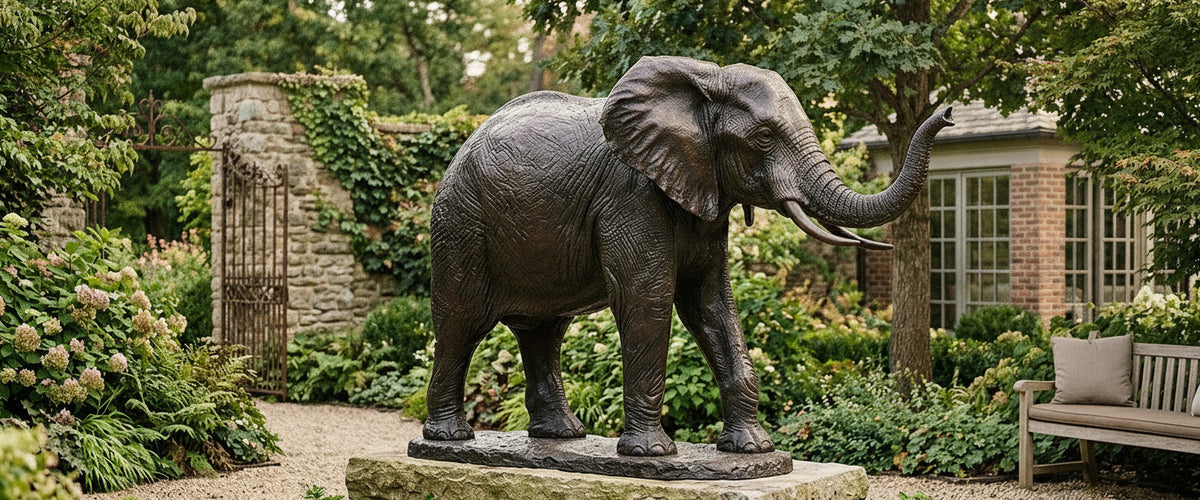
A life-size elephant placed on the primary approach line, with pale gravel throwing bounce light into the belly.

Key Takeaways
Read the sculpture from the primary approach line first; everything else follows from that.
Plinth height should put the animal's eye line in conversation with the viewer, not above them.
Bronze wants contrast: a dark patina dies against dark stone, a green patina dies against planting.
Outdoors, bronze African animal sculptures need roughly twice the breathing room you think they do.
For monumental pieces, base engineering and ground prep matter as much as the casting.

What These Pieces Actually Look Like in a Real Setting
The category covers a huge range. At one end you have a tabletop pangolin or a 12-inch (30 cm) warthog you could carry under one arm. At the other end you have full-herd installations of bronze African animal sculptures: elephants at life size, a rhino pair flanking an entrance court, a leaping kudu set against a pool wall. The bronze animal sculpture field as a whole runs from polished, near abstract studio pieces to highly traditional, anatomically faithful work in the lost-wax tradition that East and West African foundries have practiced for centuries.
For most private clients, the brief sits in the middle. They want bronze African animal sculptures that read clearly as savannah animals (elephant, lion, leopard, rhino, buffalo, giraffe, cheetah) cast in bronze, finished with a patina that suits the setting, and scaled so the piece dominates without dwarfing the room or garden it sits in. Designers and architects tend to push harder: contemporary stylisation, exaggerated stride, simplified planes that catch raking light. Both briefs benefit from the same placement discipline.

Scale, Sightlines and Plinth Height
Scale is the first decision and the one buyers of bronze African animal sculptures most often get wrong. The instinct is to size the sculpture to the wall or the lawn. The better instinct is to size it to the viewer at the point they first see it.
Stand at the front door, the gate, the top of the stairs, or wherever the piece will first appear. Measure that distance. As a rough rule, an animal bronze sculpture wants to occupy roughly 8 to 12 degrees of your field of view at that primary sightline. Closer than that and it looks like a tchotchke. Wider and it overwhelms. A 10-foot (3 m) elephant 40 feet from the front door reads as monumental. The same elephant 12 feet away reads as a wall.
Plinth height is the next lever. The default mistake is to put a large piece on a plinth that lifts the eyes well above human height. It looks imposing in the foundry photo and slightly absurd in situ. Our working rule for bronze African animal sculptures: for predators (lions, leopards, cheetahs), drop the plinth so the animal's eyes meet a standing adult's eyes, or sit just below. The piece reads as alert, watchful, in your space. For herbivores at life size, a low plinth or no plinth at all keeps the proportions honest. When the brief genuinely calls for monumental presence on a long approach, something like the Monumental Traditional African Elephant Bronze Sculpture - 330cm is already tall enough that lifting it any further turns it into a billboard rather than an animal.

Indoor Versus Outdoor: When Each Wins
The category divides cleanly. Indoor bronze African animal sculptures let you control light, climate and viewing distance. Outdoor pieces gain weather, depth of landscape and the changing light of a full day, but lose the controlled drama of a single beam at the right angle.
Indoors works best for two situations. The first is detailed, finely chased work: leopards mid-crouch, elephants with deep skin texture, anything where you want the viewer within arm's reach. For a double-height entrance hall where the spotted patina and the tension in the shoulders are meant to be read at close range, a piece in the spirit of the Large Traditional Crouching Leopard Bronze Sculpture - 110cm earns its keep far better than a larger animal that needs distance to breathe. The second is climate-sensitive interiors where humidity and salt air would otherwise force a heavier maintenance schedule.
Raking light across a chocolate patina; flat front light would flatten the same surface entirely.
Outdoors is where most monumental commissions for bronze African animal sculptures belong. Bronze takes weather beautifully when it is patinated and waxed properly, and the larger the piece, the more it benefits from sky behind it. A bull or buffalo at full stride, in the manner of the Large Traditional Striding Bull Bronze Sculpture (Rocky Terrain Base) - 120cm, wants distance and a horizon line. Push it into a courtyard with walls on three sides and you lose the gesture entirely.
One caveat for coastal sites. Salt-laden air accelerates patina change and demands a tighter wax cycle. The American Institute for Conservation has useful guidance on outdoor bronze care that we share with clients in Florida, the Carolinas and the Pacific coast.

Light, Backdrop and Contrast
Bronze is a low-reflectance material. It does not throw light back at you the way stainless steel or polished marble does. What it does brilliantly is hold shadow, and shadow is what gives a cast animal its musculature. Place bronze African animal sculptures so a real light source (sun, uplight, window) rakes across them at an angle. Flat front light kills the form.
Backdrop matters as much as light. A dark brown or chocolate patina disappears against weathered timber, dark brick or mature evergreen planting. The same patina sings against pale limestone, white render or a clipped lawn. Green and verdigris patinas reverse the problem: they need a hard, mineral backdrop, not foliage.
For an elephant or rhino, we usually recommend a pale gravel apron around the base. It throws bounce light up into the belly of the animal, where shadow would otherwise turn the piece into a silhouette. Where the setting includes water, a leaping composition such as the Giant Contemporary Leaping Dolphins Bronze Sculpture - 320cm shows how reflection and wet surface around the base can be designed into the piece rather than treated as a maintenance problem; the same logic applies to a kudu or springbok set above a reflecting pool.

Placement Mistakes We See Most Often
For wider placement ideas, Bronze Horse Statue Buying Guide: Scale, Patina and Placement is useful companion reading before finalising the setting and sightlines for bronze African animal sculptures.
After enough commissions you start to recognise the same handful of errors. Some of them are obvious in hindsight and very expensive to fix once a 1,500-pound (680 kg) bronze is bolted to a pad.
Centering on the architecture, not the approach. Buyers align the sculpture with a window or a door axis when nobody actually walks along that axis. Always place bronze African animal sculptures to the real footpath.
Underestimating breathing room. Outdoor pieces want roughly twice their own height as clear space on at least two sides. Crowded planting strangles the silhouette.
Plinth too tall. Discussed above and worth repeating. When in doubt, lower.
Wrong patina for the backdrop. A dark patina against dark planting is the single most common mistake we see in retrofit photos.
Ignoring the second viewing angle. Every monumental piece has a primary view and a secondary view (the side you see from the kitchen window, the back you see walking up the drive). If the secondary view is dull, the piece deflates.
Skimping on the base. A poured concrete pad with stainless threaded anchors is the minimum for anything over life size. Paving slabs on sand fail within two seasons.
Commissioning a Bespoke Piece
The catalog is a starting point. Most of the work we ship is adjusted in some way: a different patina, a modified base, a stride opened up, a scale change to suit a specific courtyard. Bespoke bronze African animal sculptures take longer than buyers expect, usually 16 to 28 weeks from approved maquette to delivered piece, because the lost-wax process does not compress. Engineering review for any bronze African animal sculpture over 6 feet (1.8 m) tall is non-negotiable.
Bronze animal sculpture artists vary widely in style, and part of our job is matching the right hand to the right brief. A client who wants a contemporary, planar leopard is not the same client who wants a deeply textured traditional elephant. Tell us which photographs in the catalog you respond to, and which you bounce off, and the brief tightens quickly.
A Quick Placement Checklist
Walk the primary approach. Mark the spot where the piece first becomes visible.
Measure the distance. Aim for 8 to 12 degrees of field of view at that point.
Cardboard mock-up. Tape boxes to the rough silhouette and live with it for 48 hours.
Check the secondary view. Walk every interior or garden route the piece will be seen from.
Confirm backdrop contrast against the chosen patina, in both morning and late afternoon light.
Pour a proper base. Engineer for the full weight plus wind load.
Plan the wax cycle. Once a year inland, twice a year on the coast.
Get those right and bronze African animal sculptures stop being objects you bought and start being a piece of the place. That is the whole point. Browse our bronze animal sculpture catalog or send through a site photograph and we will tell you honestly whether the bronze African animal sculpture you are circling is the right one for the spot.