








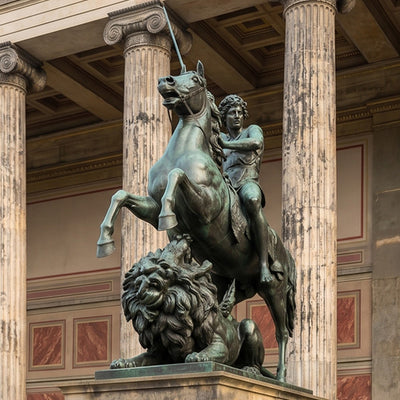


















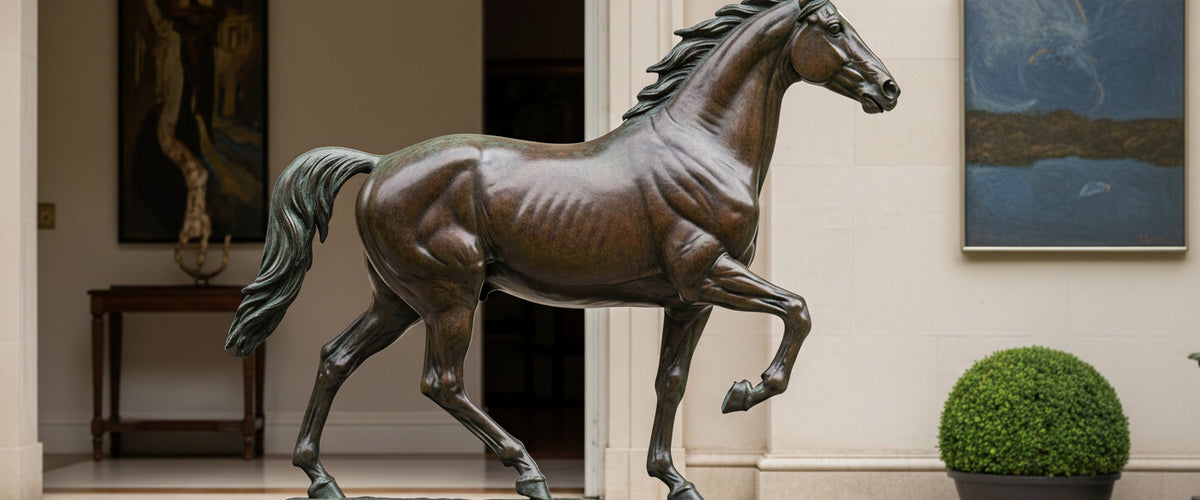

A bronze horse statue is one of the few sculptural subjects that carries equal weight in a Napa winery courtyard, a Manhattan lobby, and a private equestrian estate in Wellington. The form is universally read; the execution is what separates a piece that looks rented from one that will be photographed for the next thirty years. This guide covers what a serious bronze horse statue actually is, how to size and finish one for your space, and what to ask before you commit to a commission.

Key Takeaways at a Glance
- Material matters more than style. Cast bronze, properly alloyed and patinated, outlives resin or cold-cast reproductions by generations.
- Scale is the single biggest decision. A 4 ft (122 cm) tabletop trotter and a 16 ft (488 cm) rearing stallion are completely different commissions.
- Pose dictates placement. Rearing and galloping forms need approach space; standing and grazing forms anchor a single view.
- Antique, vintage and new each carry different risks. Provenance, repairs and patina honesty are the three things to check.
- Budget tracks weight, complexity and finish. Ask for a tailored quote rather than chasing a headline number.

What a Bronze Horse Statue Actually Is, and Who It Suits
A true bronze horse statue is lost-wax cast in a copper-tin alloy, finished by hand, and chemically patinated to a stable surface. That last part is what most buyers underestimate. A good patina is grown, not sprayed; it sits in the metal rather than on top of it, and it ages with the piece instead of flaking off it. The Smithsonian's conservation guidance on outdoor bronze is a useful primer if you want to understand why a well-made bronze can sit in coastal air for a century with only annual waxing (si.edu/mci).
The buyer profile splits cleanly. Private collectors and equestrian families tend to want a single signature piece, usually life-size or larger, sited where it can be seen from the house. Hospitality and commercial clients (hotels, vineyards, corporate campuses) want presence at the arrival sequence and durability against weather and accidental contact. Designers working on residential projects often look for a smaller bronze statue horse for a library, entry hall or terrace, where it functions as the room's strongest object.

Materials, Finishes and the Patina Question
Bronze is the headline, but the decisions inside that word are where pieces succeed or fail. Standard sculptural bronze runs around 90% copper with tin, small amounts of zinc and trace lead. Foundries vary the alloy slightly for casting behavior and final color response. The patina then layers on top: classic dark brown, French brown with green highlights, verdigris green, black, or polished gold-bronze where the surface is left bright and waxed.
For an outdoor bronze horse statue in a humid or coastal site, a darker, deeper patina with annual microcrystalline wax tends to age most gracefully. Verdigris looks beautiful at first but moves quickly under salt air and can become patchy if the underlying chase work is uneven. Interior pieces have more freedom; a polished or two-tone patina reads well under gallery lighting and stays stable indefinitely.
Where a client wants the equestrian subject but a brighter, cooler material against dark planting or stone paving, a full-figure marble piece such as the Noble Standing Horse Marble Outdoor Sculpture - 220cm reads very differently from a patinated bronze of the same scale. Marble gives you stillness and weight; bronze gives you movement, tension and a darker silhouette against planting or sky.

Scale: The Decision That Sets Everything Else
Scale is where most first-time buyers go wrong, almost always by going too small. A horse in real life stands roughly 5 to 6 ft (152 to 183 cm) at the withers, which means a life-size bronze horse statue with a raised head can easily reach 8 to 9 ft (244 to 274 cm) tall. In a 30 ft (9 m) wide motor court that reads as correct. On a 10 ft (3 m) terrace it reads as overwhelming.
A working rule from the studio: measure the longest sightline the piece will be viewed from, divide by six, and that is roughly the minimum height the sculpture needs to register as a sculpture rather than an ornament. A piece seen from 60 ft (18 m) away across a lawn wants to be at least 10 ft (3 m) tall to hold the view. A piece in a 20 ft (6 m) entry hall can sit comfortably at 3 to 4 ft (91 to 122 cm) on a plinth.
For a terrace or courtyard where a full-height horse would overwhelm the space, a carved head at architectural scale, such as the Noble Horse Head White Marble Outdoor Sculpture - 120cm, often makes more sense than scaling the full figure down past the point where the anatomy reads. The same logic applies in bronze: a fragment at correct scale beats a whole figure at the wrong one.
Weight follows scale and it is not a footnote. A life-size cast bronze horse can weigh 1,500 to 2,500 lb (680 to 1,134 kg) depending on wall thickness and internal armature. That changes how you ship it, how you crane it into position, and whether your terrace, roof deck or gallery floor can carry the load. We have shipped pieces to clients in Aspen where the final 200 ft (61 m) of the route mattered more than the 5,000 miles before it.

Antique, Vintage or Newly Cast?
The market splits into three tiers and each behaves differently.
Antique Bronze Horse Statue
Generally pre-1920, often French or Italian, frequently signed by the Animalier school or their followers. Provenance documentation, foundry stamps and casting marks matter enormously. The patina should be coherent across the whole piece; recoloring on one leg or the tail usually signals a repair. Expect honest wear on high points where hands have rested over decades.
Vintage Bronze Horse Statue
Roughly 1920s to 1980s. This is the most variable category. You will find genuine foundry casts alongside later reproductions sold as period work. Check the weight against the size, look inside through any opening for casting texture rather than the smooth interior of a resin pour, and ask for the foundry mark. A vintage bronze horse statue with clean provenance can be an exceptional buy; one without can be a slow problem.
Newly Cast and Bespoke
This is where Giant Sculptures works most often. A new cast lets you control scale, pose, patina and base, and gives you full documentation from day one. For clients who want a specific breed, a portrait of a particular horse, or a scale that simply does not exist on the secondary market, commissioning is usually the only honest route.

Placement: Where a Bronze Horse Statue Earns Its Keep
For wider placement ideas, Decorating with Animal Garden Sculptures: A Buyer’s Guide is useful companion reading before finalising the setting and sightlines.
The pose tells you where the piece wants to live.
Standing or grazing forms are anchor objects. They work at the end of a sightline, centered on a lawn, at the turn of a gravel drive, or as the focal point of a walled garden. Approach is mostly frontal, so the strongest profile faces the main view. These are the pieces that hold a Hamptons garden together through every season.
Walking and trotting forms reward a longer approach. Site them so the viewer arrives along the direction of travel and the horse appears to be moving into the space. Driveways and long terraces suit this pose.
Rearing and galloping forms are the most demanding to place. They need air around them, a clean background and enough setback that the viewer can read the full silhouette. A rearing bronze in a tight courtyard looks trapped; the same piece on a Texas ranch entrance reads as heraldic. Where the setting needs that sense of motion but a contemporary, lighter design language, a sculpted form like the Fluid Motion Horse Head Marble Outdoor Sculpture - 100cm is closer to the right vocabulary than a classical galloping bronze. Browse our bronze horse statues collection to see how pose changes the spatial demand.
Indoors, the rules tighten. Ceiling height needs to clear the highest point of the sculpture by at least 18 in (46 cm) for the piece to breathe. Lighting should come from two directions to avoid a flat read; a single downlight kills the modeling that the sculptor spent weeks chasing into the wax.
Budget, Commissioning and Delivery
Pricing on serious bronze work is driven by weight of metal, complexity of pose, finish detail and engineering. A rearing horse with only two points of ground contact needs a hidden internal armature and a heavier base; a standing four-square pose is structurally simpler and costs less to engineer. Rather than chase a price band that will mislead you, we recommend sending the brief (scale, pose, site, timeline) and asking for a tailored quote.
Commissioning timelines for a life-size or larger bronze horse statue typically run several months from approved maquette to delivered piece. The maquette stage is where you make the real decisions: head angle, weight distribution, musculature, tail position. Changes are cheap in clay and expensive in bronze.
Delivery is its own project. International freight for a 2,000 lb (907 kg) crated sculpture involves export packing, customs documentation, and a rigging plan at the receiving end. We coordinate this for clients in the US, Europe and the Middle East as standard, and the rigging survey at the destination usually happens before the piece leaves the studio.
How Giant Sculptures Approaches a Bronze Horse Commission
Our work sits at the larger end of the market: pieces that need engineering, not just modeling. A typical project starts with a site conversation (often a few photos and dimensions from the client or their landscape designer), moves into reference gathering, then into a scaled maquette for approval. From there the full-size clay is built, molded, cast in sections, welded, chased and patinated. Nothing leaves the studio without a finish review under the same lighting conditions it will live in where possible.
Clients often arrive thinking they want one specific antique pose and leave with something better suited to their site. That conversation, honestly had at the start, is the single biggest reason commissions land well. If you are weighing a bronze horse statue against a marble alternative for a planted setting, our bronze animal sculptures and marble horse pieces give you a useful comparison before you commit.
Quick Buyer Checklist
- Confirm the casting method (lost-wax, sand cast) and the alloy.
- Ask for foundry marks, signatures and provenance documentation on any antique or vintage piece.
- Measure your sightline before you fix on a size.
- Check structural load at the final position, including any route to get there.
- Agree the patina in person or on a sample, not from a screen.
- Plan annual waxing for outdoor pieces in temperate and coastal climates.
- Get the rigging and base detail confirmed before the piece ships.