






















































































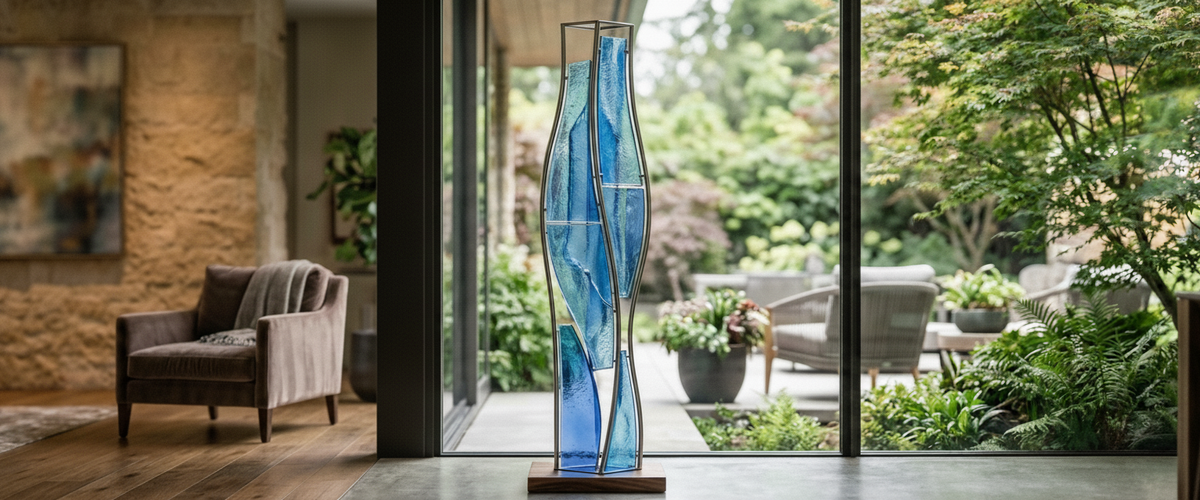

A glass sculpture that dazzles in a studio photograph can look wrong the moment it lands in your entry hall. The color goes flat. The edges catch dust instead of light. The base looks like an afterthought. Choosing the best contemporary glass work is less about the material behaving like jewelry and more about understanding how light, structure, and scale argue with each other before anything gets made. Get that conversation right and you own a piece that reads beautifully for decades. Get it wrong and you own an expensive paperweight.
At Giant Sculptures we build large-scale and bespoke work, and the best contemporary glass rarely travels alone. It pairs with bronze, stainless steel, or engineered metalwork that carries the load and frames the transparency. That pairing is where most of the real decisions live.

Key Takeaways for Contemporary Glass Buyers
- Glass almost never stands alone at scale. Metal armatures and bases do the structural work; the glass does the light.
- Scale changes everything. A form that sings at 10 ft (3 m) can read confused at 30 ft (9 m), and the reverse is just as common.
- Sampling is not optional. Color, opacity, and surface finish behave differently in the best contemporary glass than in any render.
- Budget depends on material, scale, complexity, engineering, and installation. Ask for a tailored commission quote rather than trusting a headline figure.
- Red flags are answerable. A serious studio will talk openly about annealing, mounting, and long-term care.

What Sculptors Actually Think About Before Taking On a Glass Commission
The first question is not aesthetic. It is structural. Glass is heavy, it is brittle at edges and connection points, and it moves differently to metal as temperature shifts. Before anyone sketches a form, we are working out how the piece stands up, how it handles thermal expansion, and where the stress will concentrate. A tall vertical element behaves nothing like a horizontal cast panel, and the mounting strategy for each is a different problem entirely.
The second question is light. The best contemporary glass is only as good as the light it has to work with. On a gallery wall with strong afternoon sun, the same piece that glowed in the studio can bleach out or throw harsh shadows across a floor. We map where the light comes from and how it changes across the day, because glass either collaborates with light or fights it. There is no neutral setting.
Then comes the pairing. The best contemporary glass and metal sculptures for home decor usually succeed because the metal is doing quiet, deliberate work. Think of a polished stainless steel spine holding cast-glass elements, or a Corten frame that lets warm rust tones set off cool blue glass. That contrast is a craft decision, not a default. We have shipped pieces where the client fell for the transparent form and only later understood that the bronze mount was carrying half the visual weight.

Craft Decisions That Change the Final Result and the Price
Small choices compound. Cast glass reads solid and sculptural; blown work reads lighter and more gestural; kiln-formed panels give you flat planes and controlled color fields. Each demands a different studio, different tooling, and a different timeline. None of them is objectively the best contemporary glass approach. They are best for a specific brief.
Color is its own rabbit hole. The material shifts with thickness, so a hue that looks right in a 1 in (25 mm) sample can turn nearly opaque at 4 in (100 mm). Opacity, bubble content, and surface texture all change how the piece behaves at distance. A frosted surface hides fingerprints and diffuses light softly; a polished surface throws sharp highlights and shows every mark. That single decision affects both the look and the long-term maintenance of the best contemporary glass you commission.
The metalwork drives cost as much as the glass. A simple plate base is one thing; a fabricated stainless armature with hidden fixings and a hand-finished patina is another. Where a design needs glass and cast metal to share a single object rather than sit side by side, a piece like the Contemporary Seated Nude Female Figure Bronze Sculpture (Glass-Top Table) - 140cm illustrates the balance, with the bronze figure carrying the narrative and the glass keeping the form open and light.
We never quote a flat figure for glass and metal work, because the honest answer is that budget depends on material, scale, complexity, engineering, and installation. A tall outdoor piece with a wind-load calculation and a concealed footing costs differently to an interior tabletop form. Ask for a tailored quote and expect the studio to explain what drives it.

Why Some Contemporary Glass Pieces Read Right at 10 ft and Wrong at 30
Scale is where taste meets physics. A form with fine internal detail, delicate ripples in the glass, subtle color gradients, rewards close viewing. Put it in a double-height atrium where the nearest sightline is 30 ft (9 m) away and all that detail vanishes. You paid for nuance nobody can see. This is where the best contemporary glass either earns its place or disappoints.
The opposite failure is just as common. A bold, simple silhouette designed for a plaza can look blunt and empty when you shrink it for a hallway. Glass compounds this because transparency changes with distance and backdrop. Against a bright window the piece becomes a silhouette; against a dark stone wall it glows from within. We always ask what sits behind a piece, because the background is part of the sculpture whether you planned it or not.
If you are trying to gauge how much presence a form can hold at height, a large abstract statement such as the Large Contemporary Headless Figure Bronze Sculpture - 220cm shows how a simplified silhouette keeps its impact from across a room, which is the same reasoning that should guide the scale of a glass commission. For a broader sense of how presence changes with size, the Contemporary and Modern Sculptures collection already resolves much of that relationship between viewing distance and form.

Studio Process: Maquette, Sample, Fabrication, Install
A serious commission for the best contemporary glass moves through clear stages, and skipping any of them is where projects go sideways.
- Maquette. A scaled model, physical or precise 3D, that lets you judge proportion, stance, and how the form occupies space. This is cheap insurance against a full-size regret.
- Sample. Actual glass in the intended color, thickness, and finish, plus a metal finish swatch. This is the single most important step, because the material never quite matches the render. The Corning Museum of Glass documents how color and clarity depend on batch chemistry and thickness, which is exactly why a physical sample beats a screen every time.
- Fabrication. Casting or forming the glass, annealing it slowly to relieve internal stress, then fabricating and finishing the metal. Annealing is not a detail; rushed cooling leaves stress that can crack a piece months later.
- Install. Rigging, fixings, footing, and the final sightline check. For anything large or outdoor, this is engineering work, not two people and a trolley.
We have learned to treat the sample stage as non-negotiable. On one interior commission, a client approved a deep teal on screen and gasped, in a good way, when the physical sample came back reading almost turquoise where the light hit the thinner edges. That surprise belongs in the studio, not in your living room after the invoice clears. Even the best contemporary glass hides surprises like that until you hold a real sample.

Honest Red Flags to Ask About Before You Commit
Good questions separate a real fabricator from someone reselling stock. Before you pay for the best contemporary glass, ask these before money changes hands.
- How is the glass annealed, and how long does it take? Vague answers here are a warning. Proper stress relief takes time and controlled cooling.
- What holds the glass to the metal, and can it move? Rigid bonding between two materials with different expansion rates invites cracks. You want a considered, slightly forgiving connection.
- Is there a physical sample stage? If a studio wants to skip straight to full fabrication from a render, walk away.
- Who handles install and structural sign-off? For outdoor or large interior pieces, someone needs to own the footing and wind or seismic loading. In many jurisdictions that is not optional.
- What is the care routine, and what happens if a section is damaged? Ask whether an element can be replaced or re-fabricated, or whether damage means the whole piece is lost.
Care itself is straightforward but specific. The best contemporary glass wants gentle, non-abrasive cleaning and soft cloths; harsh pads scratch it permanently. Paired metals each have their own routine. Bronze develops and holds a patina that benefits from occasional waxing, while stainless steel wants a wipe-down to keep water spotting at bay. The Smithsonian's American Art conservation guidance on caring for outdoor and mixed-media sculpture is a sensible baseline for anyone owning a piece long term.

Bringing It Together for Your Space
The best contemporary glass work rewards buyers who think like the studio does: structure first, light second, then form and color. If you can describe where the piece sits, what light it gets, and how close people stand, you have already done the hard part. From there, a bespoke commission is a series of clear, answerable decisions rather than a leap of faith.
Giant Sculptures works in the best contemporary glass paired with bronze, stainless steel, Corten, and engineered metalwork for homes and venues that want a genuine statement, not a shelf ornament. If you are weighing a contemporary glass and metal piece for a home, a garden, or a commercial lobby anywhere we ship, start with a conversation about scale and light. The rest follows from there.
For wider placement ideas, How a Metal Contemporary Wall Art Commission Actually Gets Made is useful companion reading before finalising the setting and sightlines.