






































































































A maquette the size of your hand can lie to you. It looks resolved on the studio bench, every plane tidy, every curve reading cleanly. Blow that same form up to 12 feet (3.7 m) in bronze and the flaws you ignored at small scale become the only thing anyone sees. This is the part of buying modern contemporary sculptures that almost nobody talks about, and it is where most of the real decisions get made.
Looking for the full range in this category? Browse our Bronze Cat Statues collection for every available finish, size, and configuration.
We have shipped enough large pieces to know that the finished object is the easy part. The thinking that happens before the first weld or wax pour is what separates modern contemporary sculptures that hold a garden for forty years from ones that look tired by their second winter. So here is the honest version of how these pieces come together, and what to ask before you commit.

Key Takeaways
Material choice (bronze, stainless steel, Corten, stone) drives cost, weight, maintenance and how the piece ages outdoors.
Scale is not simply size; a form that works at 10 ft can read wrong at 30 ft, and the fix happens at the maquette stage.
A proper commission moves through maquette, material sample, fabrication and a planned install, with sign-off at each step.
Budget depends on material, scale, complexity, engineering and finishing. Ask for a tailored quote rather than trusting a flat figure.
The best protection against a bad outcome is asking about armature, mounting and warranty before you fall in love with the render.

What Sculptors Actually Think About Before Taking a Commission
The first conversation is rarely about art. It is about site. Where does the piece live, what is the ground made of, who walks past it, and what does the weather do there? A contemporary bronze sculpture destined for a windy coastal terrace faces different loads than the same form in a sheltered courtyard. Wind, salt, freeze-thaw cycles and foot traffic all change the engineering before anyone touches the shape.
Sightlines come next. Modern contemporary sculptures often rely on negative space and a single strong silhouette, so the sculptor needs to know the approach. Will people see the piece head-on from a driveway, or catch it in profile from a kitchen window? A form read mostly from one angle can be resolved on that axis; a piece in the round has to work from every direction, which is harder and usually costs more.
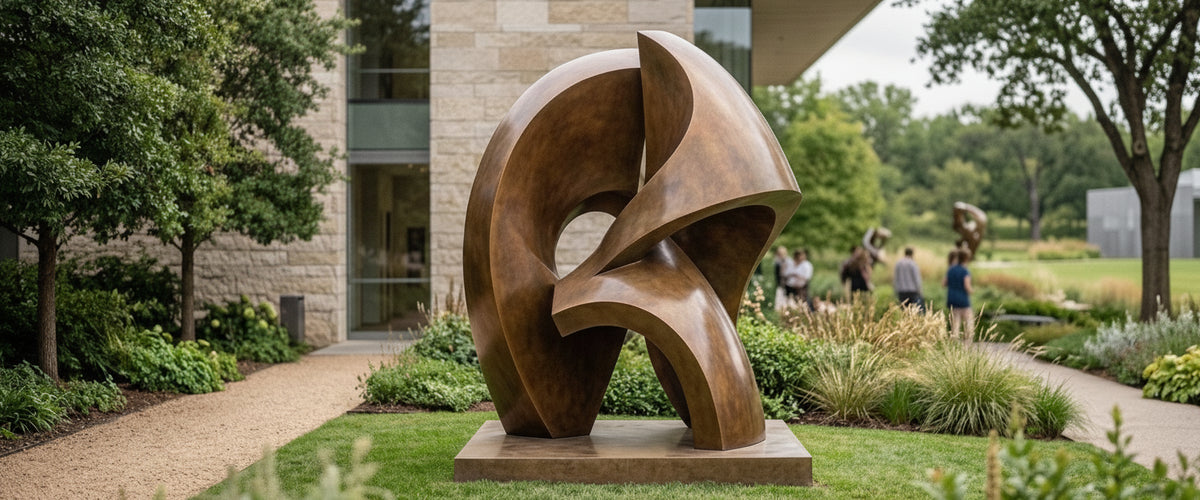
Then there is intent. What is one focus of many contemporary sculptures? Often it is a single idea pushed hard: a gesture, a tension, a reduction of a familiar subject down to its essential line. Where a commission leans on that kind of pared-back clarity, a modern contemporary sculpture like the Large Modern Abstract Bronze Sculpture - 94cm lives or dies on the strength of its silhouette alone. If the concept is muddy at the sketch stage, no amount of finishing will rescue it later.

What Is Contemporary Sculpture, and What Is It Made Of?
Contemporary sculpture is broadly the work made from roughly 1980 onward, a period that saw the field move away from the pedestal and toward site, material and idea. In practice, for the pieces we build, it means work that reads as current rather than historical: cleaner abstraction, unexpected subjects, and often a frank interest in the material itself. Most modern contemporary sculptures we make sit firmly in that camp.
So what is contemporary sculpture made of? The durable answer, and the one we push clients toward for outdoor and large-scale work, is metal and stone. Bronze remains the benchmark for figurative and animal pieces because it holds fine detail, ages into a patina you can control, and lasts generations when cast well. Stainless steel gives you that reflective, high-modern surface and shrugs off weather. Corten steel earns its rust deliberately, forming a stable oxide layer that suits sculptural gardens; weathering steel was developed precisely for this kind of low-maintenance exposure, and its corrosion resistance is documented by the ASTM A242 standard for high-strength low-alloy structural steel. Stone and marble carry weight, literally and visually, for carved work meant to stay put.
Resin and composite exist, and they have a place for lightweight interior or short-term display. For modern contemporary sculptures you want to own for decades, we steer toward cast metal or stone. Where a subject needs crisp modern styling without losing surface texture, a cast piece like the Contemporary Boar Head Bronze Sculpture - 45cm holds the fine grain that composite tends to flatten.

Craft Decisions That Change the Result (and the Price)
Small choices compound. Wall thickness in a bronze pour affects both durability and weight, and weight affects shipping, rigging and the base you will need. A hollow-cast piece and a solid one can look identical in a photo and behave completely differently on a plinth.
Patina is another quiet decision. A single sculpture can be finished warm brown, near-black, verdigris green, or a brushed metallic, and each reads differently against planting or pale architecture. Clients often assume patina is a paint job. It is a chemical process bonded to the metal, and reversing it later is expensive, so it belongs in the early conversation, not after casting. This is where a contemporary bronze sculpture rewards a careful hand.
Surface finish on a contemporary wall sculpture matters just as much as it does freestanding. A wall piece catches raking light across its face all day, which means every ripple and seam shows. We flag this early because a flatter, more forgiving finish is a legitimate design choice, not a compromise, and it changes the fabrication hours.
Why Some Pieces Read Right at 10 ft and Wrong at 30
Scale is where good intentions go sideways. A form with delicate limbs or a narrow waist, like the tall figurative lines of the Large Contemporary Violinist Bronze Sculpture - 220cm, can look elegant at life size and suddenly spindly when enlarged, because the eye expects mass to grow with height. Enlarge a figure and you often have to quietly thicken supports, widen the base of contact, and adjust proportion so it still feels honest. This is the trap that catches ambitious modern contemporary sculptures most often.
The reverse trap is detail loss. A texture that sings at 3 ft can vanish at 20 ft, leaving a form that looks under-worked from the lawn even though it is finely made up close. Good contemporary sculpture artists decide who the piece is for: the person standing beside it, or the person seeing it from across a courtyard. Rarely can one surface serve both perfectly.
This is exactly why we insist on a maquette and, for bigger commissions, a scaled mock-up on site. Cardboard and timber stand-ins are cheap. Recasting a 30 ft bronze because the proportions read wrong is not.
Studio Process: Maquette, Sample, Fabrication, Install
A sculpture commission we handle well follows a clear path, with the client signing off at each gate.
Maquette. A scaled model, often around 12 to 24 inches (30 to 60 cm), to lock the form, pose and silhouette. Changes here cost pennies.
Material sample. A patina swatch or a finished metal sample so you approve the actual color and surface, not a screen version of it.
Fabrication. Casting, welding or carving at full scale, with the internal armature and mounting engineered for the specific site.
Install. Rigging, fixing to a prepared foundation, and a final finish check on site once the piece is standing where it belongs.
Skipping the sample stage is the most common shortcut, and the one that generates the most regret. With modern contemporary sculptures, color perception on a phone has almost nothing to do with a 6 ft bronze in afternoon sun.
Honest Red Flags to Ask About Before You Commit
Some questions separate a serious workshop from a risky one. Ask them early and watch how confidently they get answered.
Armature and internal structure. What holds the piece up from the inside, and is it a non-corroding material? A bronze skin over a rusting steel frame is a future crack waiting to happen.
Mounting and foundation. How does it attach to the ground or wall, and who specifies the footing? Vague answers here mean the load path has not been thought through.
Weight and access. What does it weigh, and can the delivery route actually take it? We have re-planned installs because a gate was 4 inches too narrow.
Patina and repair. Can the finish be maintained and touched up locally, or does damage mean a return to the studio?
Warranty and provenance. Is there documentation, and what does the guarantee actually cover for outdoor exposure?
A subtlety worth naming about modern contemporary sculptures: the quietest pieces are often the hardest to make. A simple curved plane in polished stainless steel has nowhere to hide a bad weld. When a maker is happy to talk you through these details rather than rushing to the price, that is usually the studio worth trusting.
Where Giant Sculptures Fits
We work as a bespoke sculpture supplier focused on large-scale and durable work, which means most of what we build is meant to outlive its first owner. Buyers of modern contemporary sculptures tend to arrive with a mood rather than a brief, and part of our job is turning that mood into a form that survives weather, scale and time. Browsing the contemporary and modern sculptures collection is a good way to sharpen what you actually respond to before a commission conversation starts.
Whether you are placing a single figure in an entrance court or anchoring a commercial plaza with something monumental, the same discipline applies. Decide the material honestly, prove the scale with a maquette, sign off the finish in person, and ask the hard questions before the pour. Do that, and modern contemporary sculptures stop being a gamble and become the thing everyone remembers about the space.
For wider placement ideas, How Sculptors Really Think About Abstract Modern Wall Art is useful companion reading before finalising the setting and sightlines.