






































































































Walk past a Brancusi in a museum and most people slow down without knowing why. That is the quiet power of famous abstract sculptures: they carry weight, tension, and rhythm without telling you what to think. For buyers, designers, and collectors, studying the famous abstract sculptures of the masters is the fastest way to sharpen your own eye before you spend on a serious piece. They solved problems of balance, patina, and siting that you will face the moment a large work lands in your garden or lobby.
This guide reads the canon with a buyer's brain: what made the most famous abstract sculptures last, why the material choices held up, and how you translate that into something you actually own.

Key Takeaways
- Famous abstract sculptures reward long looking. Silhouette, negative space, and surface do the work, not literal subject matter.
- Material sets the mood and the lifespan. Bronze, stainless steel, Corten, stone, and carved wood each age differently outdoors.
- Scale is a design decision, not a shopping filter. A piece that sings at 7 feet can vanish at 2.
- Placement makes or breaks impact. Sightlines, backdrop, and viewing distance matter more than the sculpture alone.
- Budget depends on material, scale, engineering, and finish. Ask for a tailored commission quote rather than guessing.

What Abstract Sculpture Actually Means, and Who It Suits
So what is abstract sculpture? At its simplest, an abstract sculpture drops literal representation in favor of form for its own sake. Instead of copying a body or a bird, it distills gesture, mass, and movement into shapes that suggest rather than describe. Some works stay semi-figurative, where you can still read a torso or a wing. Others go fully non-objective: pure line and volume.
The famous abstract sculptures that shaped the field built the vocabulary. Barbara Hepworth pierced her forms so light and landscape passed straight through the stone, a move you can read in detail through the Hepworth estate archive. Constantin Brancusi polished bronze until the object nearly dissolved into reflection. Henry Moore let the void between shapes carry as much meaning as the bronze itself. What connects these famous abstract sculptures is restraint. They trusted the material and the silhouette.
An abstract art sculpture suits buyers who want a piece that changes as you move around it, and who do not want a literal statement dominating a room or garden. In a modern build in Napa or a glass-walled home outside Austin, an abstract form usually settles into contemporary architecture more easily than a detailed figurative work. It also gives designers room: the piece anchors a space without dictating the whole scheme.

Materials, Finishes, and the Decisions That Define a Piece
The masters teach one lesson hard: material is the personality. A shape cast in mirror-polished steel and the same shape carved in oak are two different sculptures.
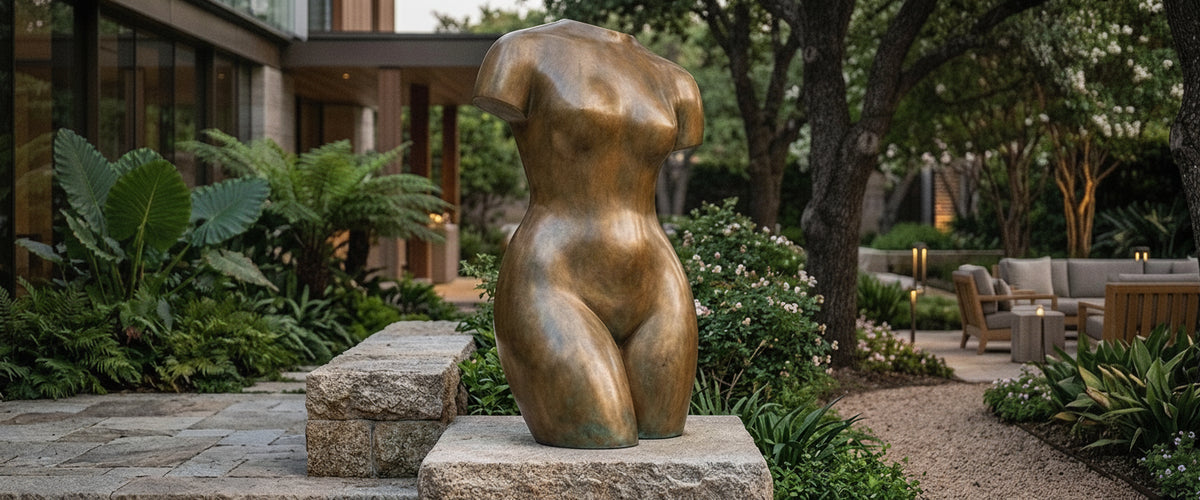
Bronze remains the workhorse of collectible abstract sculpture for good reason. It holds fine curves, takes a huge range of patinas, and lasts outdoors for generations with light care. Where a piece needs to read as both figurative and abstract at once, with the surface catching light along every contour, a flowing form such as the Large Contemporary Abstract Female Torso Bronze Sculpture - 140cm shows how far bronze can carry that ambiguity. A stable bronze patina, properly waxed, is one of the more forgiving finishes to maintain outdoors.
Stainless steel pushes the reflective, high-gloss direction that Brancusi hinted at and Anish Kapoor made monumental. Many of the best abstract sculptures ever made in this material throw the sky and surroundings back at the viewer, which is why steel works so well beside water or in bright open sites.
Corten (weathering steel) gives you a warm rust-orange skin that stabilizes over time. It suits sculptural, geometric abstraction and reads beautifully against green planting.
Stone and marble carry the Hepworth and Moore lineage. Carved stone feels permanent and quiet, and its weight anchors a large piece without extra engineering.
Abstract wood sculpture is the outlier people underestimate. Carved oak, teak, or reclaimed timber brings grain and warmth that metal cannot fake, and an abstract wood form indoors can feel more intimate than bronze. Outdoors, wood needs honest care: it moves with humidity, and it needs sealing or a sheltered spot. If you want the organic look of abstract sculpture wood with year-round outdoor durability, we often reproduce a carved timber design in cast bronze so you keep the flowing form and lose the maintenance risk.

Scale: The Choice Most Buyers Get Wrong
Here is a mistake we see often. A client falls for a piece at eye level in a studio, orders it small to be safe, then finds it looks lost in a double-height room or a wide lawn. Abstract forms need room to breathe, and their impact scales with distance. The famous abstract sculptures you remember from public plazas earn their power partly through sheer size.
As a rough working rule, a sculpture viewed from across a large garden wants to stand at least 6 to 7 feet (about 1.8 to 2.1m) to hold its own against mature planting and open sky. For a hallway or a courtyard where people pass within a few feet, a piece around 4 to 5 feet (roughly 1.2 to 1.5m) reads with presence without crowding. For long-view drama at the end of an axis or centered in a motor court, a piece built for that distance, such as the Monumental Contemporary Abstract Female Figure Bronze Sculpture - 220cm, is the scale you are actually reaching for.
Weight comes with scale, and it changes the whole project. A monumental bronze can run to several hundred pounds (well over 100kg), which brings foundations, fixings, and crane access into the conversation early. Plan the base before you plan the pedestal.
Where to Place Famous Abstract Sculptures for Real Impact
For wider placement ideas, Buying an Abstract Bronze Sculpture: What Sculptors Weigh Before They Cast is useful companion reading before finalising the setting and sightlines.
Placement is where amateur and professional installs part ways. The sculpture is only half the composition; the backdrop and the approach are the other half. The famous abstract sculptures that stay with you almost always sit in a setting that was planned as carefully as the form.
A few principles that hold across the canon:
- Give it a clean backdrop. A polished bronze or steel form needs a calm surface behind it, clipped hedge, plain render, or open water, so the silhouette reads.
- Design the approach. The strongest siting reveals the piece gradually as you walk toward it. Abstract forms change dramatically from different angles, so reward the walk-around.
- Mind the light. Reflective steel wants open sky. Matte patinated bronze and stone hold their form better in raking, low-angle light that models the curves.
- Think about the void. Pierced and open forms frame whatever sits behind them. Place them where the view through the sculpture is worth having.
Indoors, an abstract wood sculpture or a compact bronze on a plinth can carry an entryway or a stair landing. Where the space is intimate and viewers pass close, a smaller cast such as the Contemporary Abstract Female Torso Bronze Sculpture - 70cm holds presence without crowding the room. Outdoors, in a Hamptons garden or an Aspen terrace, a larger metal piece survives weather and gives you a year-round focal point when the planting dies back.
Budget, Commissioning, and Delivery
Buyers always want a number first. The honest answer is that price depends on material, scale, complexity of the form, the engineering needed to stand it safely, the finish or patina, and installation. A polished stainless piece with a mirror finish involves far more labor than a matte cast, and a monumental work needs internal armature and foundation design a tabletop piece never touches. Rather than quote a misleading range, we build a tailored quote around your actual piece.
Commissioning a bespoke abstract sculpture usually runs through a few clear stages: a conversation about intent and site, sketches or a maquette, sign-off on material and finish, fabrication, then delivery and installation. Because Giant Sculptures ships worldwide, we plan logistics into the design; crating, customs, and site access for a large bronze are part of the brief, not an afterthought.
If you are earlier in the process, browsing our abstract sculptures collection is a good way to calibrate your eye on scale and material before committing. Studying famous abstract sculptures alongside our own range helps too. Our wider bronze abstract sculptures range shows how the same abstract language plays across different sizes and poses.
How Giant Sculptures Handles Bespoke Abstract Work
We work mostly in large-scale, durable materials, bronze, stainless steel, Corten, stone, and marble, because those are what survive decades outdoors and reward the investment. If you arrive with a reference to one of the famous abstract sculptures you admire, we do not copy it; we use it as a starting point to develop something original and legally yours, tuned to your site and scale.
One recent example: a client wanted the organic, flowing quality of a carved wood maquette but needed it to stand on an exposed coastal terrace year-round. We translated the timber form into a cast bronze with a marine-appropriate patina, kept every curve of the original, and engineered a hidden fixing so it reads as if it grew from the stone. That is the practical side of the studio: the artistic idea and the long-term ownership have to agree.
Study the famous abstract sculptures for the ideas. Then commission something that fits your space, your material tolerance, and the life you want the piece to have. That is where a good abstract work stops being decoration and starts being the thing people slow down for.