























































































A garden statues sale tempts you with the object and says nothing about the space it will live in. That gap is where most buying regret comes from. We have shipped enough pieces to know that the sculpture almost never fails; the placement does. A bronze that looked commanding in a photo shrinks to nothing on a wide lawn, or a piece scaled for a courtyard ends up crammed against a fence where you can only see it from one bad angle.
Looking for the full range in this category? Browse our Garden Statues collection for every available finish, size, and configuration. A garden statues sale is a fine place to start, but the piece has to earn its spot on your ground.
So before you commit to anything in a sale, get the fundamentals straight. Scale, sightlines, pedestal height, light, and backdrop decide whether a piece reads as a focal point or fades into the shrubbery. Get those right and even a modest budget buys something that holds its own for decades.

Key Takeaways Before You Buy
Measure the viewing distance, not just the sculpture. A piece read from 40 feet (12 m) needs more mass than one seen from a patio 10 feet (3 m) away.
Pedestal height changes everything. Raising a figure to eye level or above shifts how dominant it feels.
Outdoor pieces earn their keep with material. Bronze, stainless steel, Corten, and stone handle weather; lighter composites rarely survive real seasons.
Contrast against the backdrop is what makes a piece pop, not the sculpture in isolation.
A garden statues sale is a good moment to buy, a bad moment to guess. Confirm dimensions, weight, and fixing before you pay.

What a Garden Statues Sale Actually Looks Like in Different Settings
The same sculpture behaves differently depending on where it lands. On a formal terrace, a paired bronze reads as architecture; it frames a view and anchors a symmetrical layout. Drop that same pair onto a loose, naturalistic planting scheme and it needs breathing room, a clearing, and a sightline from the house. A statues sale rarely tells you which of these settings a piece was designed for, so you have to judge it yourself.
Indoors, scale compresses fast. A 6-foot (1.8 m) figure that feels balanced on a lawn can overwhelm a double-height living room if it sits too close to the seating. We often tell clients to think in terms of the space the piece commands, not just the space it occupies. A well-placed sculpture owns a radius around it.
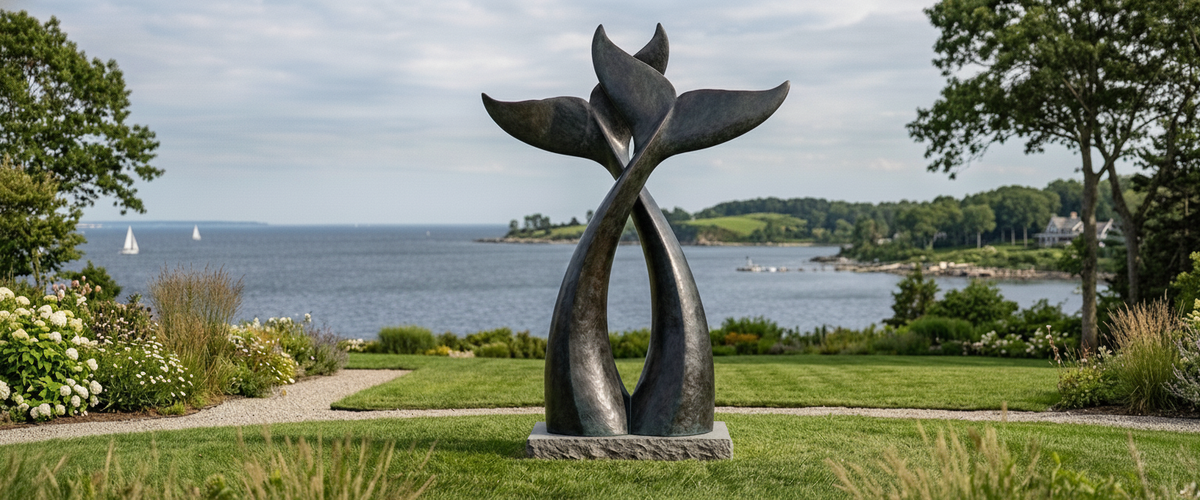
For genuinely large gardens, monumental work rewards the room you give it. Where the plot opens onto water or a long lawn, something like the Monumental Contemporary Paired Whale Tail Bronze Sculpture - 500cm is built to be read against open sky, its height and negative space carrying across the distance. Put something that scale near a wall and you lose the whole effect.

Scale, Sightlines, and Pedestal Height
Scale is the choice buyers get wrong most often, and it goes both ways. Undersize a piece and it looks apologetic in a wide setting. Oversize it in a courtyard and it feels aggressive. The honest fix is to map your main viewing points before you shop any garden statues sale, then match the sculpture to the longest sightline that matters.
Here is a working method we use with clients:
Identify the primary sightline. Usually it is the view from the main room, the kitchen window, or the approach up a drive.
Measure that distance. Longer views need more mass and simpler silhouettes; close views reward detail.
Mark the footprint. Cut a cardboard base or use stakes to see how the piece sits against paths and planting.
Test the height at eye level. A tape measure held vertically tells you more than any product photo.
Pedestal height then fine-tunes the read. Raise a figure and it gains authority and clears low planting; keep it grounded and it feels intimate and approachable. A pair of animals caught mid-motion, such as the Large Contemporary Cantering Horse Pair Bronze Sculpture - 180cm, usually works best grounded, so the movement reads at the height a real horse would occupy. Lifting that kind of piece onto a tall plinth can make the gesture look stiff.

Indoor Versus Outdoor Placement: When Each Wins
For wider placement ideas, Bronze Garden Statues: A Buyer's Guide to Scale, Finish, and Placement is useful companion reading before finalizing the setting and sightlines. It pairs well with anything you spot in a garden statues sale.
Outdoor placement wins when the piece needs distance and sky. Bronze develops its own patina over years of exposure, and the way weather softens a surface is part of why the material has anchored outdoor monuments for millennia; the Getty Conservation Institute has documented how controlled patination and waxing protect outdoor bronzes over time. That slow change is a feature, not a flaw, and it is one reason we steer serious buyers toward metal and stone rather than lightweight composites for anything meant to live outside.
Indoor placement wins when you want to protect a finish, control the light, or make a piece part of daily life rather than an occasional view. A polished surface indoors stays crisp; a matte or textured surface reads better in the diffuse light of a hallway. Smaller detailed work, wildlife studies for example, often earns more attention indoors where you pass it closely every day.
Some pieces genuinely cross over. Beside a pool or a pond, a water-adjacent subject like the Large Contemporary Leaping Dolphins Bronze Sculpture - 300cm reads beautifully outdoors, yet the same energy holds in a large atrium where the ceiling height allows it. When a piece can go either way, we plan the fixing and base for its most demanding home.

Light, Backdrop, and Contrast
A sculpture is only as strong as what sits behind it. A dark bronze against a dark yew hedge disappears; the same bronze against a pale rendered wall or open water snaps into focus. Before you buy anything in a garden statues sale, look hard at the backdrop from your main viewing point and ask whether it fights the piece or frames it.
Light does the rest of the work. Morning and evening raking light picks out texture and casts long shadows that give a piece drama. Flat midday light flattens everything, which is why a sculpture you photograph at noon can look dull even when it is well made. For evening use, one or two low-level uplights set a few feet from the base transform how a piece reads after dark. We advise clients to plan lighting at the same time as placement, not as an afterthought once the concrete has set.

Common Placement Mistakes We See
Over years of commissions we see the same avoidable errors, and a rushed garden statues sale purchase makes several of them more likely:
Buying for the photo, not the plot. A product image gives no sense of your sightlines. Always test the footprint on site.
Pushing the piece to the boundary. Fences and hedges crowd a sculpture and kill the sense of space around it. Pull it forward.
Ignoring weight and ground. Large bronze and stone need a proper base. Soft ground and a heavy piece is a slow disaster.
Choosing a backdrop that camouflages the piece. Match tone contrast deliberately.
Forgetting the winter view. Deciduous planting that hides a piece in summer leaves it exposed against bare stems in winter. Plan for both.
The fix for nearly all of these is the same: treat the site as the brief. When clients send us photos and measurements from their actual viewing points, the piece almost always lands right the first time. That holds whether you buy from a garden statues sale or commission from scratch.
Where a Bespoke Commission Beats a Sale Piece
Buying from stock is the right move when a catalog piece already suits your scale and setting, and a garden statues sale can put that stock within reach. Commissioning makes more sense when your space has a specific demand a catalog piece cannot meet: an exact height to clear a wall, a particular patina to match hardscape, a subject with personal meaning, or a footprint engineered for a rooftop load limit. As bespoke sculpture makers, Giant Sculptures builds pieces to those constraints in bronze, stainless steel, Corten, and stone, and we engineer the base and fixings for the site rather than hoping a standard plinth will do.
Budget for outdoor sculpture depends on material, scale, complexity, engineering, installation, and finishing, so the honest answer to what it will cost is a tailored quote rather than a guessed range. Searching for garden statues for sale near me will surface local stock fast, but a specialist can confirm exact dimensions, ship worldwide, and match the piece to your ground. If you are weighing a garden statues sale against a commission, send us your dimensions and viewing points and we will tell you straight which route serves the space better.
Ready to research further? Start with our Bronze Garden Statues for weather-ready focal pieces, or the wider Large Garden Statues collection when the plot calls for real scale. Whichever you pick, a well-judged garden statues sale purchase should still read right in ten years.