






















































































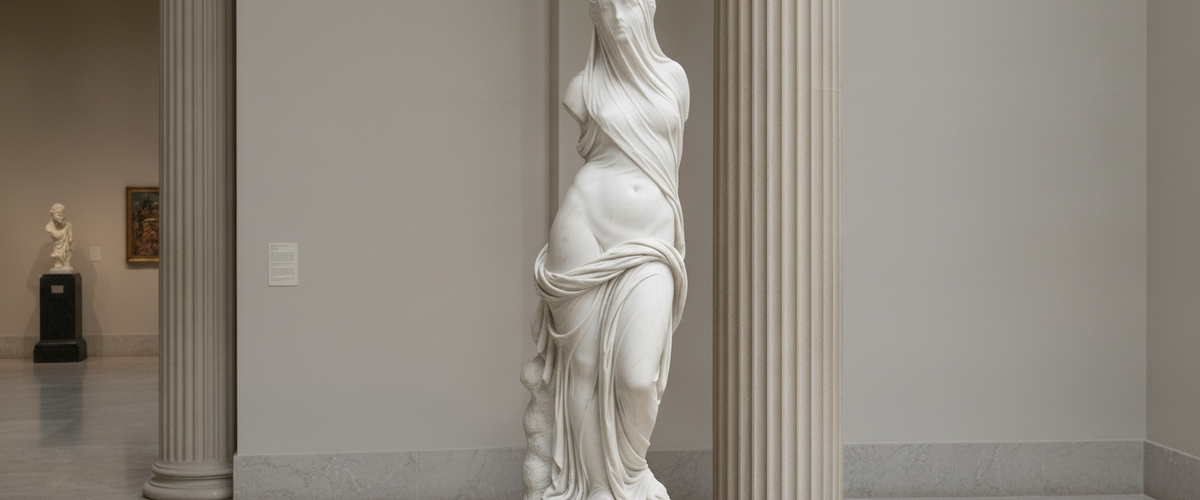

Marble does something to the human body that no other sculptural material can fake. Skin reads as skin. A veil reads as cloth thin enough to breathe through. Weight settles into a hip. That is the quiet trick of a good figurative marble sculpture, and it is also the reason so many buyers get the purchase wrong. They choose the subject before they understand the stone, the scale or the light the piece will live under.
This guide is written for collectors, designers and private clients seriously considering a figurative marble sculpture, whether that is a 60cm veiled bust for a Manhattan entrance hall or a life-size pair for a Napa courtyard. We will work through what the term actually means, how to read the figure, which marbles behave differently under the chisel, why size is a placement problem before it is a budget problem, and how lighting decides whether your figurative marble sculpture sings or sulks.

What Is a Figurative Marble Sculpture?
A figurative marble sculpture is a carved stonework that depicts the human form (or a human-like form such as a deity, angel or allegorical figure) in natural marble. The defining word is figurative: the piece represents an identifiable body, face or gesture, as opposed to abstract or geometric stonework. The defining material is marble, a metamorphic limestone whose calcium carbonate crystals let light enter the surface and scatter a few millimetres below it, which is why carved skin looks alive and a carved veil looks transparent.
In practice the term covers a wide range of work: standing nudes and clothed figures in the classical and neoclassical tradition, religious subjects such as the Pieta marble sculpture by Michelangelo, portrait and veiled busts, mythological groups, and contemporary or partially abstracted bodies. Sizes run from 50cm portrait busts to over-life-size garden figures above 2 metres. Common stones include Carrara, Statuario and Calacatta from Tuscany, along with coloured marbles such as black Marquina and Rosso Levanto.
Three things separate a serious figurative marble sculpture from a decorative copy: anatomy that reads correctly under raking light, drapery that describes the body underneath rather than sitting on top of it, and a block of stone whose veining serves the composition rather than fighting it. The rest of this guide unpacks each of those in turn.
Key Takeaways
A figurative marble sculpture is carved stonework depicting the human (or human-like) form, prized for translucency, fine detail and longevity.
Carrara, Statuario and Calacatta each give the figure a different temperature, vein pattern and price.
Life-size is harder to place well than over-life-size; intimacy and sightlines matter more than square footage.
Raking light reveals carving; flat overhead light flattens it. Plan lighting before you plan the plinth.
Bespoke figurative marble sculpture commissions let you control pose, drapery, stone selection and finish, which off-the-shelf rarely allows.

What Figurative Marble Does That No Other Medium Can Replicate
Bronze gives you mass and reflectivity. Corten gives you a weathered surface that talks to landscape. Stainless steel throws light back at the viewer. Marble does the opposite of all three. Light enters the stone, scatters a few millimetres below the surface, then comes back out softened. That subsurface scattering is the reason a well-carved cheek looks alive and a well-carved veil looks transparent even though it is solid rock.
Raking light reveals the modelling of the drapery and the carved anatomy beneath it.
You cannot get that effect from resin, cast stone or composite. You also cannot fake it with a marble-look finish. A figurative marble sculpture earns its presence because the material is genuinely doing optical work, not because someone painted a surface to suggest it.
That same property is what makes the stone unforgiving. Every tool mark stays visible. Every error in anatomy reads under raking light. This is why the canon of famous marble sculptures held in major museums is dominated by carvers who spent decades learning the material, not just the figure.
Reading Drapery, Weight and Gesture Before You Read the Subject
Most buyers look at a figurative marble sculpture and immediately ask who it is. That is the wrong first question. The first question is how the body is carrying itself.
Look at the supporting leg. In a competent figure, one leg takes the load and the opposite hip lifts; the shoulders counter-rotate. That is contrapposto, the rhythm the Greeks codified and Michelangelo pushed into the Pieta marble sculpture in St Peter's. When the weight shift is wrong, the figure looks like it is standing on ice no matter how pretty the face is.
Then look at the drapery. Cloth in stone has to do two jobs. It has to describe the body underneath, and it has to read as fabric in its own right. Cheap carving treats drapery as decoration laid on top of a mannequin. Good carving uses the folds to tell you where the knee is, where the breath sits, where the gesture wants to go. The marble sculpture veil is the extreme test of this. When the veil is right, you read the face through the stone before you read the stone itself. Antonio Corradini's eighteenth-century veiled figures in Naples are the benchmark, and the tradition continues in contemporary work held in our marble sculptures collection.
Carrara, Statuario, Calacatta: How the Stone Changes the Figure
Buyers often ask what marble sculpture is made of as if marble were a single material. It is not. The quarries around Carrara in Tuscany alone produce a spectrum of stones with very different personalities, and the choice will shape your figurative marble sculpture as much as the carver will.
Carrara, Statuario and Calacatta each carry the figure differently under the same light.
Carrara is the workhorse: soft white to pale grey, with feathery grey veining. It is the marble most associated with classical and neoclassical figurative marble sculpture because it is consistent, takes fine detail, and lets light into the surface evenly. A Carrara figure reads cool and quiet.
Statuario is rarer, whiter and more luminous, with a near-translucent quality and minimal veining. It is the stone you choose when you want a figurative marble sculpture to glow under controlled light, which is why Michelangelo selected it for his most demanding work. Statuario costs significantly more, and the block selection matters; a vein running across a face is a problem you cannot polish out.
Calacatta is the dramatic cousin: white ground with bold, often gold or warm grey veining. It is striking for architectural surfaces and contemporary figurative pieces where the artist wants the veining to participate in the composition. For classical figures it can fight the carving rather than serve it.
Coloured marbles play by different rules entirely. Where a white veiled bust relies on subsurface light to make the cloth feel translucent, a black-stone equivalent such as the Black Marble Veiled Figure Bust Sculpture - 60cm shifts the optical work onto silhouette, polish and edge. The face emerges from shadow rather than from light, which is why black-stone figurative marble sculpture tends to read more cinematic and less classical, even when the underlying pose is traditional.
Why Life-Size Is Harder to Place Than Over-Life-Size
For wider placement ideas, Marble Bust Sculpture: A Collector's Buying Guide is useful companion reading before finalising the setting and sightlines.
This catches almost every first-time buyer of a figurative marble sculpture. A life-size figure, roughly 1.5 to 1.8 metres, feels like the safe choice. It is the human scale. In practice it is the most difficult size to place in a domestic interior because the figure now competes with the people in the room. It needs to be approached, not passed.
Over-life-size figures, say 2.1 metres and above, paradoxically settle into large rooms and gardens more comfortably. They read as architecture rather than as another person. They also tolerate longer sightlines, which matters in a Hamptons garden room or a double-height Texas entrance hall. Where a courtyard or double-height hall needs a single anchoring gesture rather than a populated tableau, a paired figurative marble sculpture at over-life-size such as the Figurative Couple Marble Sculpture at 180cm tends to hold the room better than two separate single figures placed in conversation. Allow at least 0.9 metres of clear space on every side and a viewing distance of around twice the height of the piece.
Below life-size, in the 50cm to 80cm bust range, the rules change again. A bust wants to be met at face height, which means a plinth between 110cm and 130cm depending on the ceiling. Place it too low and you stare down at the figure; too high and the veil work disappears. For an entrance hall or library niche where the viewer will pass within arm's reach, a 55cm to 65cm veiled bust in the neoclassical idiom, such as the Canova's Veiled Woman Marble Bust Sculpture - 55cm, gives you the close reading of the carving that a full standing figurative marble sculpture at the same budget cannot.
Lighting the Figure: Raking Light, Top Light, the Mistakes in Between
A figurative marble sculpture lit badly is a figurative marble sculpture wasted. The single biggest mistake we see in client photos is a downlight directly above the head. It puts the eyes in shadow, blacks out the underside of the chin and the chest, and kills the drapery on the front of the body.
Use raking light instead. That means a directional source coming in at roughly 30 to 45 degrees from one side, slightly above head height for a standing figure. Raking light catches the edges of every fold and every modelled muscle. It is how museums light their best stone, and it is how the Getty Conservation Institute documents surface carving.
For outdoor placement, the sun does the work, but you still have a choice. East-facing placement gives soft morning raking light. South-facing in the northern hemisphere gives strong noon top light, which is usually the worst. West-facing gives dramatic late afternoon raking light, which is often the best, especially in autumn. Plan accordingly.
Contemporary Figurative Work Versus the Classical Canon
Not every buyer wants a Venus. Contemporary figurative marble sculpture has opened up considerably in the last two decades, with carvers working in abstracted bodies, fragmented torsos, hybrid forms and modernised veiled figures. If your interior is mid-century or contemporary, a strict classical figure can read as costume. A simplified or partially abstracted figure in the same stone often reads as architecture.
The other route is to commission. A bespoke figurative marble sculpture commission lets you choose the pose, the proportion, the drapery treatment, the stone, the finish (polished, honed or matte), and the base. Giant Sculptures works with carving studios in Italy and China that can scale a maquette up to over-life-size while preserving the modelling of the original. Lead times for a full bespoke figurative marble sculpture typically run several months, and the budget depends on stone selection, complexity, finishing and installation; we quote each project individually rather than work to a list price.
A Practical Buyer's Checklist
Decide indoor or outdoor placement first. Outdoor marble needs sealing and a frost-aware location.
Measure the viewing distance and the ceiling height before you decide on size.
Choose the stone with the carver, not before. The block determines what is possible.
Ask to see raking-light photos of the actual piece, not just hero shots.
Confirm the base. A figure on the wrong plinth dies on arrival.
Plan the route in. Marble is heavy; a 180cm figurative marble sculpture can weigh well over 450 kg.
Get the lighting drawing done before installation, not after.
Caring for Marble Over the Long Term
Marble is calcium carbonate, which means it is vulnerable to acids. Lemon juice, vinegar, wine and acidic cleaning products will etch the polish. For routine cleaning, use a soft dry brush or a barely damp microfibre cloth. For deeper cleaning, use pH-neutral soap and distilled water. Avoid household sprays. Outdoor pieces benefit from an annual inspection of the base and any iron fixings, since rust staining is the most common long-term issue on garden marble. Conservation guidance from professional bodies such as the American Institute for Conservation is a useful reference for owners of a figurative marble sculpture.
Treated well, a figurative marble sculpture will outlive several generations of its owners. That is the deal you are making when you buy one. Choose the figurative marble sculpture that earns that kind of time.