






















































































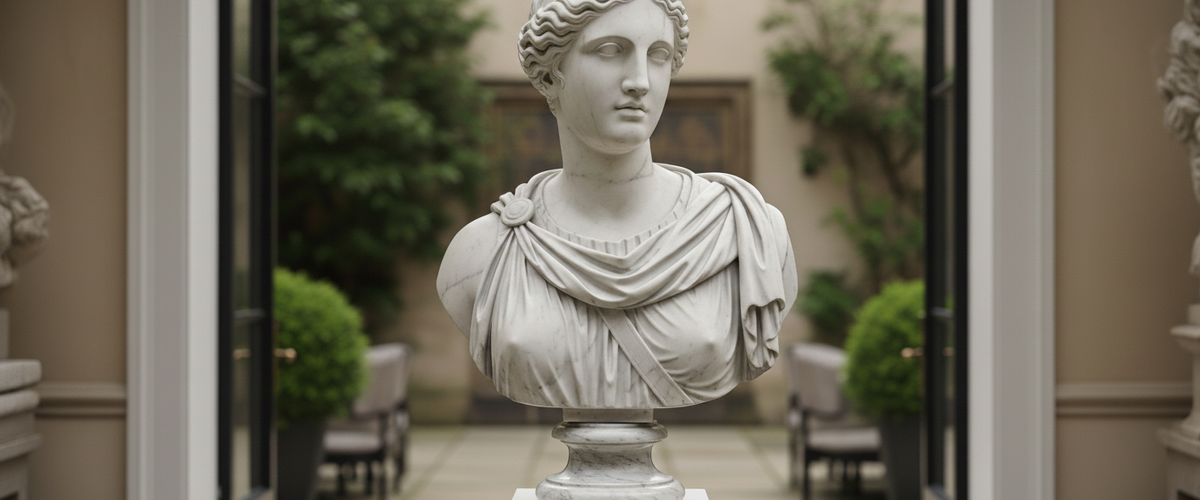

What Is a Marble Bust Sculpture?
A marble bust sculpture is a figurative portrait carving cut from a single block of natural marble, showing the subject from roughly the chest or shoulders up. The form originated in Roman portraiture, was revived through the Renaissance and Neoclassical periods, and remains the standard way sculptors render a recognizable human likeness in stone.
In practice, a bust can portray a specific person (a portrait bust) or an idealized or mythological figure such as Aphrodite, Apollo, or an allegorical head. The stone is almost always a fine-grained marble (Carrara, Statuario, Thassos, Pentelic, Vermont Danby, Colorado Yule) chosen because the grain holds delicate detail (eyelids, lip corners, curls of hair) without chipping. A genuine piece has visible veining, a cool surface temperature, and significant weight: a 60 cm solid marble bust typically lands between 90 and 150 pounds, and a 75 cm piece can reach 250 to 400 pounds.
One distinction matters before buying. A marble bust is carved from a metamorphic stone block. Resin, composite, and cast-marble reproductions are not the same object, even when the silhouette matches; they weigh a fraction as much, do not age the same way, and are not what most collectors mean when they ask about a marble bust sculpture.

Why Collectors Still Buy the Form
A marble bust sculpture is one of the few objects that can carry a room on its own. Put one on a console in a Manhattan entry hall and the eye stops working the walls. Set one in a Napa library and the books read as backdrop. The form is small, the presence is not, and that gap between scale and gravity is what makes buying the right bust harder than buyers expect.
This guide is for collectors, designers, and private clients weighing a serious purchase. We will work through how to read the stone, how to size and place a bust, and what to ask before commissioning. At Giant Sculptures we specialize in large-scale and bespoke stone work, and the same buying logic applies whether the piece sits on a plinth in a foyer or anchors a courtyard niche. The Metropolitan Museum's European Sculpture galleries are a useful free reference for training the eye on what a well-cut bust looks like across centuries.
Key Takeaways
- A marble bust sculpture is a portrait or figurative carving cut from a single block of natural marble, usually shown from the chest or shoulders up.
- Italian marbles such as Carrara and Statuario dominate the high end; Vermont and Colorado marbles, plus French and Greek stones, are also used.
- Scale changes the brief: a 50 cm desk bust and a 95 cm hall bust are different commissions, not the same idea at two sizes.
- Placement is about sightlines, plinth height, and light direction, not just floor space.
- Antique busts trade rarity for condition risk; new commissions trade provenance for control over subject, finish, and base.
- Budget depends on stone, scale, complexity, hand-finishing, plinth, crating, and freight. Ask for a tailored quote rather than guessing from photographs.

Materials, Finishes, and What the Stone Is Telling You
Not all marble is the same stone with a different label. The block decides what the carver can do, how the piece ages, and how it photographs.
Italian Marbles
An Italian marble bust sculpture usually means Carrara (soft gray veining on a cool white field) or Statuario (whiter, with more dramatic veining, prized for portrait work). Sculptors favor these stones because the grain is fine enough to hold eyelids, lip corners, and curls of hair without chipping. Carrara has been quarried since Roman times, which is why so many historical busts share that particular cool white surface.
Other Stones Worth Knowing
Greek Thassos and Pentelic, Vermont Danby, and Colorado Yule are all used in serious bust work. Each carries a slightly different color temperature and translucency. Statuario tends to glow under warm lamplight; Thassos reads brighter and almost chalky. If a client wants an aesthetic marble sculpture bust that photographs cleanly against a dark wall, the stone choice matters as much as the carving.
Finish
Polished marble reflects light and reads luxurious but shows every fingerprint. Honed marble has a matte, slightly chalky surface that suits classical and contemporary interiors equally. Acid-aged or distressed finishes are how new pieces are made to read as antique marble bust sculpture; done well it is convincing, done badly it looks like a film prop. Always ask which finish you are being shown.
Scale: Reading the Room Before You Buy
The single most common mistake we see is buying a bust that is correctly proportioned in isolation but wrong for the room. A 50 cm Apollo on a 110 cm plinth puts the face at roughly eye level for a standing adult, which is what you want in a gallery hang. The same bust on a low console becomes a tabletop object and loses authority. A 90 to 95 cm piece needs a wider plinth, a longer viewing distance, and a wall behind it that can hold the silhouette; for a fragmented, athletic subject at that height, something like the Hercules Marble Torso Bust Sculpture - 95cm shows how much architectural weight a single piece can take on when it crosses the one-metre mark.
Rules of thumb we use when advising clients:
- Desk and shelf busts: 30 to 45 cm (roughly 12 to 18 inches). Read as objects, not focal points.
- Console and console-plus-plinth busts: 50 to 70 cm (20 to 28 inches). The classic library or entry-hall size.
- Hall and gallery busts: 75 to 100 cm (30 to 40 inches). Need their own plinth and a clear sightline.
- Architectural and courtyard busts: over 100 cm. Treated as siting decisions, not furniture decisions.
Weight scales fast. A 75 cm solid marble bust can come in around 250 to 400 pounds (115 to 180 kg) depending on the block. That changes how the piece is craned, floored, and insured. We have shipped pieces to second-floor Hamptons libraries where the structural review took longer than the carving.
Where to Place a Marble Bust Sculpture
For wider placement ideas, Beyond the Vein: Marble Sculptures That Redefine Art and Elegance is useful companion reading before finalising the setting and sightlines.
Placement is about three things: sightline, light, and contrast.
Sightline first. A bust wants to be approached, not glanced at sideways. Entry halls, the turn of a staircase, the end of an enfilade, and the focal wall of a library all work because the viewer arrives facing the piece. Sideboards along a corridor rarely work; the bust ends up in profile to anyone walking past.
Light second. Marble loves raking light from one direction. North light from a tall window is the classical answer. In rooms without it, a single warm picture light angled from above and slightly to one side will model the face properly. Even overhead downlights flatten the carving and make a serious piece look like a copy.
Contrast third. A white Carrara bust against a pale wall disappears. Against a deep green library wall, a smoked oak panel, or a charcoal limewash, it reads. For a sitting-room scheme where the bust needs to feel intimate rather than monumental, a mid-scale classical head such as the Aphrodite Marble Bust Sculpture - 65cm sits comfortably on a console without overwhelming the seating arrangement.
Antique Marble Bust Sculpture vs. New Commission
Antique pieces carry history and, when documented, real provenance value. They also carry condition issues: hairline cracks, lost noses repaired in plaster, sugar weathering on the surface from decades outdoors. Buyers chasing antique marble bust sculpture should budget for a condition report from an independent conservator before purchase. The American Institute for Conservation publishes guidance on choosing one (find-a-conservator directory).
A new commission gives you control. You choose the subject, the stone, the finish, and the base. You can specify a portrait of a family member, a reinterpretation of a classical figure, or a contemporary piece that has never existed before. Lead times for serious hand-carved work run in months, not weeks, but the piece is yours from the block forward. Where a client wants the drapery and complexity of a historical piece without taking on condition risk, a fully hand-finished new work such as the Veiled Madonna Marble Bust Sculpture - 90cm is closer to the right answer than chasing a comparable nineteenth-century original at auction.
Budget, Commissioning, and Delivery
Pricing a marble bust sculpture honestly means refusing to quote from a photograph. The figure depends on:
- Stone choice and block quality (Statuario costs more than standard Carrara, and a block free of structural flaws costs more again).
- Scale and carving complexity (a draped, veiled, or hair-heavy subject takes far more hours than a smooth classical head).
- Finish (honed, polished, or aged).
- Plinth and base (matching marble, granite, painted timber, or steel).
- Crating, freight, and white-glove installation.
We always recommend asking for a tailored quote that breaks these out, rather than a single round number. It also makes it easier to value-engineer: dropping from Statuario to a high-grade Carrara, or simplifying the plinth, can change the figure meaningfully without compromising the carving.
On delivery, expect a serious crate, a freight forwarder used to fine art, and an installation team who will not move the piece on a hand truck. For pieces over about 200 pounds, we plan craning, doorways, floor protection, and final positioning before the crate leaves the studio.
A Quick Buyer's Checklist
- Have you confirmed the stone (Carrara, Statuario, Thassos, other) in writing?
- Do you know the finish: polished, honed, or aged?
- Is the scale right for the plinth and the viewing distance, not just the room?
- Have you planned the light direction before choosing the spot?
- For antiques: do you have an independent condition report?
- For commissions: have you seen the carver's previous work in person or in detailed video?
- Has the quote separated stone, carving, plinth, crating, and freight?
- Is the installation route, including doors and stairs, signed off?
How Giant Sculptures Approaches Bespoke Marble Bust Commissions
Our studio works at scale, which shapes how we approach even a 60 cm bust. We start with the room, not the catalog. Clients send floor plans, elevation photographs, and the wall finishes they are working with, and we work back to a stone, scale, and plinth that fit. For portrait commissions we work from photographs and, where possible, a video sitting; for classical and allegorical subjects we agree the reference (a specific Roman head, a Renaissance treatment, a contemporary reinterpretation) before any stone is cut.
The wider marble sculptures collection is a useful starting point if you want to see range across subjects, scales, and finishes before opening a bespoke brief. Clients who already know they want a portrait head in a different material often look at our bronze busts collection alongside, because the same subject can read very differently in bronze versus marble, and seeing both helps the decision.
A marble bust sculpture, chosen and placed well, outlasts everything else in the room. That is the case for taking the buying process slowly, asking harder questions than feel polite, and treating the piece as a long ownership rather than a transaction.