





































































































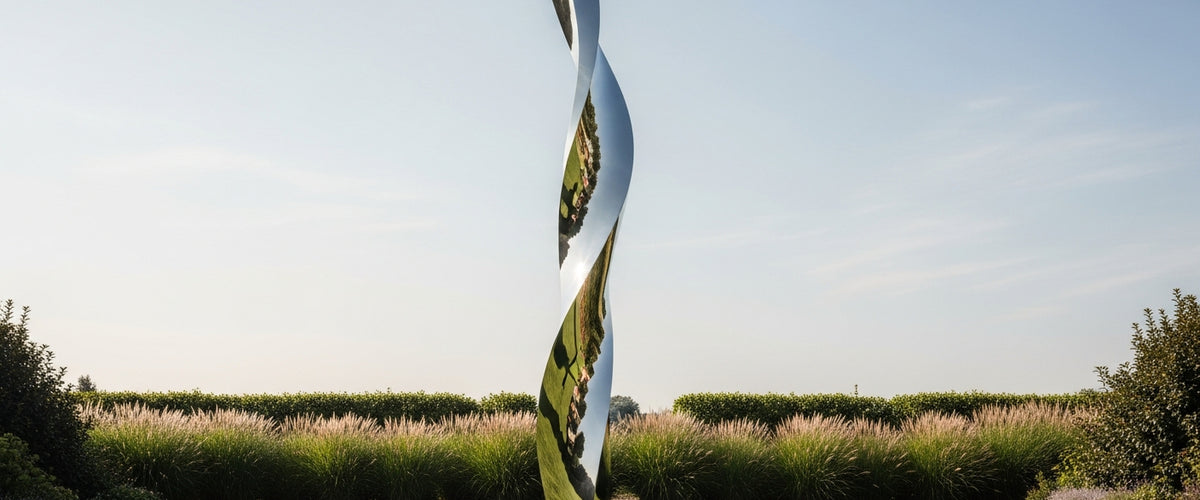

Drop a mirror-polished form onto a lawn and the garden changes. The sculpture stops being a thing on a plinth and starts behaving like a small piece of weather. It catches the sky at noon, the lawn at three, the warm side of a brick wall at sunset. That shifting, almost liquid quality is what makes stainless steel garden sculptures so different from bronze, stone, or Corten, and it is also why so many of them are commissioned badly. Steel rewards good decisions about grade, finish, scale, and planting, and it punishes the lazy ones.
At Giant Sculptures we build large bespoke pieces in stainless, and we spend a lot of time talking buyers out of pieces that will look wrong twelve months in. This guide is the conversation we usually have before a commission begins.

At a glance: stainless steel in the garden
- Grade matters more than shape. 316 for coastal sites, 304 inland.
- Mirror polish reflects the garden; brushed and satin finishes soften it.
- Scale up, not down. Small stainless pieces tend to read as garden ornaments rather than sculpture.
- Plant around it, don't plant against it. Foliage that touches mirror steel will mark it.
- Maintenance is real but light: water spots and fingerprints are the main enemies, not corrosion.

Why mirror-polished steel rewrites a lawn at every hour
Polished stainless is the only sculptural material that effectively disappears into its surroundings while still asserting a strong form. A bronze figure is always bronze. A marble torso is always marble. A mirror-polished sphere or twist becomes the garden, deformed and re-presented. In the morning it carries the cool blue of an east-facing sky. By late afternoon it picks up the gold of low sun. After rain, with droplets clinging to it, it reads almost like glass.
This is also why two identical stainless steel garden sculptures can feel like completely different objects in two different gardens. A formal lawn surrounded by clipped hedging gives a sinuous form a calm, contained reflection. Drop the same form into a loose prairie planting scheme and it fractures into a hundred small colors. Neither is wrong. But you need to know which effect you are buying.
Grade 304 vs 316: the spec that decides if it survives the coast
If you take one piece of technical advice from this article, take this one: ask which grade of stainless your sculpture is fabricated from before you pay a deposit. The two relevant grades are 304 and 316.
304 is the standard architectural stainless. It performs beautifully in inland gardens, in Aspen, in Napa, across most of the Midwest and the South. It resists rust and weathers cleanly for decades. 316 adds molybdenum, which dramatically improves its resistance to chloride attack, the kind you get from salt air and pool chemistry. For homes on Long Island, the California coast, Florida, the Hamptons, or anywhere within roughly a mile of the ocean, 316 is the right answer. So is it for poolside installations. The National Park Service's preservation guidance on outdoor metals is a useful reference if you want to read further into how marine environments accelerate corrosion on lower-grade alloys.
The cost difference between 304 and 316 is rarely the deciding factor in a large bespoke commission; the engineering, fabrication time, and finishing dwarf it. Specifying correctly at the start, on the other hand, decides whether your piece looks new in fifteen years or develops pitting along its welds in three.
Flame, sphere, twist, figurative: which shapes catch light best
Different forms do very different things with reflected light. It is worth understanding this before falling for a maquette.
Curved abstract forms
Twists, ribbons, and tall flame-like sculptures are the workhorses of polished stainless. Their compound curves smear reflections, so the piece never shows you a recognizable image of the garden, just colors and movement. This is usually what people want when they ask for a stainless steel flame garden sculpture or a sculptural focal point at the end of a vista. Where a lawn needs a single tall gesture that smears its surroundings rather than mirrors them cleanly, a ribboned form like the Eternal Twist Abstract Steel Sculpture - 92cm is closer to the right design language than a sphere.
Spheres and geometric solids
A polished sphere is the most demanding form in stainless. It reflects everything around it with optical clarity, so any clutter in the garden, any badly placed shed or unfinished hedge, will appear in the sculpture. Geometric pieces such as the Cubic Geometric Steel Sculpture - 75cm behave similarly: flat faces give you crisp, panel-by-panel reflections. Site them where the surrounding scene deserves to be reflected.
Figurative and naturalistic work
Animal and figurative pieces in stainless are a more recent move, and they are powerful when handled well. A familiar silhouette abstracted by a mirror finish, such as the Crane Contemporary Outdoor Steel Sculpture - 98/158cm, reads as a quiet stylization rather than a gimmick because the bird's outline carries the recognition while the finish carries the surprise.
Illuminated pieces
Integrated LED work resolves the day-night argument: by day, the form reflects; by night, it emits. For client gardens used heavily for evening entertaining, that doubled performance is worth the extra engineering and the additional electrical scoping at install.
Scale rules for large stainless steel pieces in modest gardens
Stainless reads smaller than it is. Because the surface reflects everything around it, the eye half-loses the form against the background. A bronze figure at 5 feet (1.5 m) tall feels assertive; a polished stainless piece at the same height can almost disappear into a planted border. This is the single most common mistake we see buyers make.
Our working rules for large stainless steel garden sculptures:
- On a lawn with open sightlines: aim for at least 6 to 8 feet (1.8 to 2.4 m) tall for a primary focal point. A piece with real vertical presence, such as the Luminous Stag Gold Steel LED Sculpture - 212cm at 212 cm, gives you that scale without resorting to a plinth.
- At the end of a formal axis: the piece should occupy roughly one-third of the visual height of whatever frames it (hedging, pergola, wall).
- In a courtyard or terrace: a smaller piece can work, but raise it on a plinth so it sits at chest or eye height.
- Near a pool: account for the water as a second reflective surface. Two mirrors talking to each other amplify scale, so you can sometimes go slightly smaller than you would on a lawn.
Weight is the other half of the conversation. A 7-foot (2.1 m) hollow-fabricated stainless form can run anywhere from a few hundred to over a thousand pounds (roughly 150 to 500+ kg) depending on wall thickness, internal armature, and base detailing. Foundations and access matter. We will always specify the engineering during commissioning rather than after.
Fingerprints, water spots, and realistic maintenance
For general conservation principles, Canadian Conservation Institute outdoor object care is a useful external reference, though the final care routine should always follow the material and finish specified for the individual commission.
Stainless does not rust in any meaningful sense if specified correctly. What it does do is show marks. Hard water leaves white spots. Fingerprints show on mirror finishes near pathways. Pollen films the surface in spring. None of this is structural; all of it is visible.
A realistic care routine:
- Rinse two to four times a year with clean water and a soft microfiber cloth. Avoid abrasive pads.
- For water spots, use a dedicated stainless cleaner applied in the direction of any brushing or grain. On mirror finishes, work in small circles and buff dry.
- After heavy pollen seasons, a gentle wash with diluted pH-neutral soap removes the film before it bakes on.
- Inspect welds and base fixings annually, particularly on coastal installations.
- Avoid chloride cleaners, wire brushes, and anything that has touched mild steel. Cross-contamination is the only reliable way to introduce rust spots onto stainless.
Brushed and satin finishes hide everyday marks better than mirror polish. If a piece will sit near a busy terrace where guests touch it, consider a satin finish or a mirror finish on the upper portions only.
Pairing stainless with planting: what softens, what fights it
Planting is half the sculpture. Get it right and a stainless piece feels inevitable; get it wrong and it looks like an object dropped onto a lawn.
What works: ornamental grasses (Stipa, Miscanthus, Calamagrostis) move in wind and reflect as soft vertical brushstrokes. Dark evergreen backdrops (yew, holly, hornbeam) give the polished form something quiet to read against. White and pale planting (hydrangeas, anemones, white roses) bounces light into the underside of curved pieces.
What fights it: busy mixed borders directly behind a mirror-polished piece create visual noise in the reflection. Anything with thorns or rigid stems planted too close will scratch the surface in wind. Variegated foliage clashes with the cool color temperature of polished steel.
A practical placement principle: leave roughly the height of the sculpture as clear space around it. A 7-foot (2.1 m) piece wants about 7 feet of breathing room before planting begins. Open-form pieces such as the Eclipse Silver Abstract Steel Sculpture - 44/48cm particularly reward this discipline; crowd them and the reflective play through the negative space is lost.
Commissioning bespoke stainless: what to ask for
Most of our stainless work is bespoke or scaled to site. A few questions worth asking any maker before signing off:
- Which grade of stainless, and why for this location?
- Wall thickness and internal armature?
- How are welds dressed and finished? Are they invisible on the final surface?
- Base detail: pin-fixed, plinth-mounted, or freestanding ballast?
- Finish: mirror, satin, brushed, or a combination?
- What is the realistic lead time for fabrication and finishing at this scale?
Budget for bespoke stainless steel sculpture depends on scale, complexity, engineering, finish, and installation. Rather than quoting bands, we prefer to scope a brief and return a tailored quote. If you are weighing materials more broadly, our stainless steel sculptures collection sits alongside our wider sculptures by material catalog, which is the easiest way to compare how steel reads against bronze, Corten, and stone before committing to a commission.
For wider placement ideas, Outdoor Sculptures Unveiled: Essential FAQs for Stunning Garden Décor is useful companion reading before finalising the setting and sightlines.