






































































































Most garden sculptures fail for one boring reason: they are the wrong size. A piece that looked substantial in a showroom shrinks to a garden ornament the moment it sits under open sky next to a mature oak and a run of lawn. Getting outdoor sculptures for gardens right is mostly a question of scale, material, and where the thing actually stands, and those three decisions are easier to get wrong than any salesperson will tell you.
We ship large-scale and bespoke work to private gardens and commercial grounds across the US and beyond, and the same questions about outdoor sculptures for gardens come up every week. This guide answers them in the order you should be asking.
Scale and backdrop do most of the work: a bronze piece anchoring an open lawn.

At a Glance: What Matters Before You Buy
Scale first. Outdoor space swallows objects. Measure the sightline, not just the plinth.
Material sets the maintenance. Bronze, marble, stainless steel, and Corten all age differently.
Placement is a design decision. A focal point, a surprise around a corner, and a piece framed by a hedge are three different jobs.
Foundations count. Weight and wind load mean footings, not just a nice patch of gravel.
Budget follows the brief. Material, size, complexity, engineering, finishing, and installation all move the number.

What Outdoor Sculptures for Gardens Really Means, and Who They Suit
An outdoor sculpture is any freestanding artwork built to live in weather year-round. That rules out a lot of decorative indoor casting sold as "garden safe." A genuine outdoor piece is specified for UV, rain, frost, and in coastal spots, salt air. It has drainage designed in so water cannot pool and freeze inside it, and it is mounted so wind cannot walk it off its base.
Outdoor sculptures for gardens suit anyone treating the garden as a designed space rather than a backdrop. Homeowners use them to anchor long lawns and terraces. Landscape designers use them to close a vista. Hotels, wineries, and corporate campuses use them to give arriving visitors something to remember. If you have a mature garden and a spot your eye keeps returning to, that spot probably wants a sculpture.

How to Compare Outdoor Sculptures for Gardens Before Buying
Start with the view, not the object. Stand where people will most often see the piece: from the kitchen window, the end of a path, the head of a driveway. That sightline decides everything else about the outdoor sculptures for gardens you shortlist.
Then work through these decision points:
Distance. A sculpture seen from 60 feet (18 m) needs bolder form and larger scale than one you pass at arm's length. Fine detail reads at three feet and vanishes at thirty.
Backdrop. A pale marble figure disappears against a light stone wall and sings against a dark yew hedge. A polished stainless piece does the opposite, catching sky and greenery in its surface.
Style fit. Classical figurative work suits formal, symmetrical gardens. Abstract metalwork tends to sit better in contemporary planting and clean hardscape.
Longevity. Ask how the piece behaves after ten winters, not ten days. That is a material question, covered next.

Materials, Finishes, and Scale Decisions
Material is the single biggest driver of how a garden sculpture looks in year one and year twenty. It is also what separates well-built outdoor sculptures for gardens from indoor casts sold with a hopeful label.
Four finishes that age very differently: bronze, marble, stainless steel, and Corten.
Bronze is the classic outdoor choice for good reason. Cast bronze develops a patina over time, and a well-applied patina is stable and protective rather than a fault. The Metropolitan Museum of Art treats bronze patinas as managed surfaces, maintained rather than left to chance, which is exactly how we treat ours. Bronze reads warm, holds fine modeling, and suits both figurative and abstract work. Browse our bronze garden statues to see how the finish behaves across different forms.
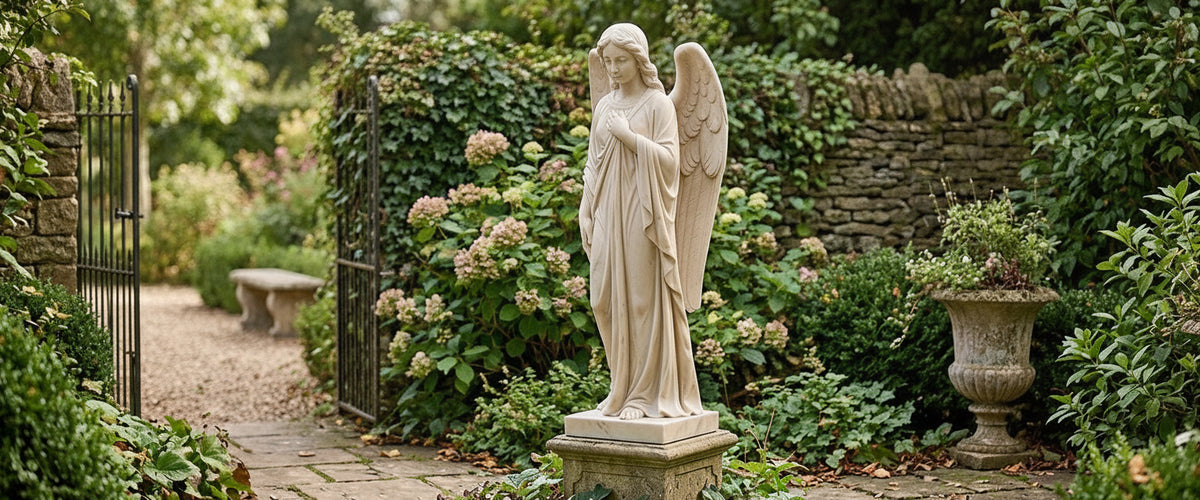
Marble gives you the crisp, luminous quality of classical sculpture. It rewards close viewing, which makes it ideal for terraces, courtyards, and framed alcoves rather than distant lawns. For a formal garden that needs a figure with real standing presence, a full-height piece such as the Life-Size Angel Marble Outdoor Sculpture - 160cm holds its carved detail up close while still reading across a lawn. In hard-freeze climates, marble wants a little more care; sealing and winter attention keep the surface sound.
Stainless steel is the low-maintenance contemporary option. Polished, it mirrors its surroundings; brushed, it stays quietly matte. It shrugs off weather and suits modern architecture and minimalist planting, which makes it a strong pick among outdoor sculptures for gardens built around clean lines.
Corten (weathering steel) forms a stable rust-colored skin that protects the metal beneath. It reads earthy and sculptural, pairs well with grasses and gravel, and needs almost nothing from you once the patina settles.
On scale, the honest rule is this: buy bigger than feels comfortable in the showroom. A 30-inch piece that dominates an indoor plinth can look lost on a lawn. If you are choosing between two sizes for open ground, the larger one is usually right. For an enclosed courtyard or terrace, where the walls do the framing for you, a smaller figurative piece such as the Cherub V3 Angel Marble Outdoor Sculpture - 80cm can hold its own without overwhelming the space.

Where to Place Outdoor Sculptures for Gardens for the Strongest Impact
For wider placement ideas, Bronze Outdoor Garden Statues: How to Choose One That Earns Its Place is useful companion reading before finalizing the setting and sightlines.
Placement turns an object into a moment, and it is where outdoor sculptures for gardens either work hard or sit idle. A few approaches we return to on real projects:
The terminated vista. Set the piece at the far end of a straight path, an allée, or a lawn so the eye travels to it. This is the most reliable way to make a sculpture feel intentional. It wants scale and a clean backdrop.
The reveal. Place a piece just out of sight around a hedge or a bend, so visitors discover it. This works best with figurative or narrative work that rewards a second look.
The water partner. Sculpture and water reinforce each other. Reflection doubles the presence of a piece, and sound softens a hard courtyard. If you are building a feature from scratch, look at how our garden fountains and water features can carry sculptural form.
The threshold. A pair of pieces flanking steps or an entrance frames arrival. Symmetry reads as formality, so this suits classical schemes and grand approaches.
Whatever you choose, check the piece from the three or four positions people actually use, and check it after dark. Uplighting a sculpture changes it completely; a form that reads flat at noon can become the best thing in the garden at night.

Foundations, Weight, and the Part Everyone Forgets
Large sculpture is heavy, and open gardens catch wind. A tall figurative or abstract piece needs a proper footing sized to its weight and wind load, not a paver dropped on soil. We routinely spec concrete foundations with cast-in fixings, and for anything above head height we treat mounting as an engineering task rather than an afterthought. This is the difference between outdoor sculptures for gardens that stand straight for decades and ones that lean after two wet winters.
Site access matters just as much. A one-ton marble figure has to get from the truck to the spot, which can mean crane access, ground protection, or a route planned around gates and flower beds. We would rather solve that on paper before a piece leaves the studio than improvise on the day.

Budget, Commissioning, and Delivery
There is no single price for outdoor sculptures for gardens because there is no single sculpture. Cost is driven by material, size, the complexity of the form, structural engineering, finishing, and installation. A carved marble figure and a fabricated stainless abstract of the same height can sit in very different places on the scale. The sensible move is to describe your site and intent and ask for a tailored quote rather than shopping by headline figure.
On commissioning: a bespoke piece is worth it when nothing in a catalog fits the space, the style, or the story you want the garden to tell. We start from your sightlines, your architecture, and your planting, then develop the form, agree the material and finish, and engineer the mounting for your ground and climate. Delivery timelines depend on material and scale, and international shipping is something we handle regularly, with crating and installation planned as part of the project.

How Giant Sculptures Helps With Bespoke Garden Projects
Giant Sculptures is a bespoke supplier of large-scale outdoor work, and most of what we ship is chosen or made for a specific spot. We can advise on scale against your sightlines, recommend a material suited to your climate and maintenance appetite, and manage foundations, crating, and installation. If you are hunting for the right outdoor sculptures for gardens like yours, our garden statues and large garden statues collections are a good place to see the range of form and scale before you commit.
Buy the piece that earns its place. Measure the view, respect the material, and treat the foundation as seriously as the form. Get those right and a single one of your outdoor sculptures for gardens will do more than another season of planting.