





































































































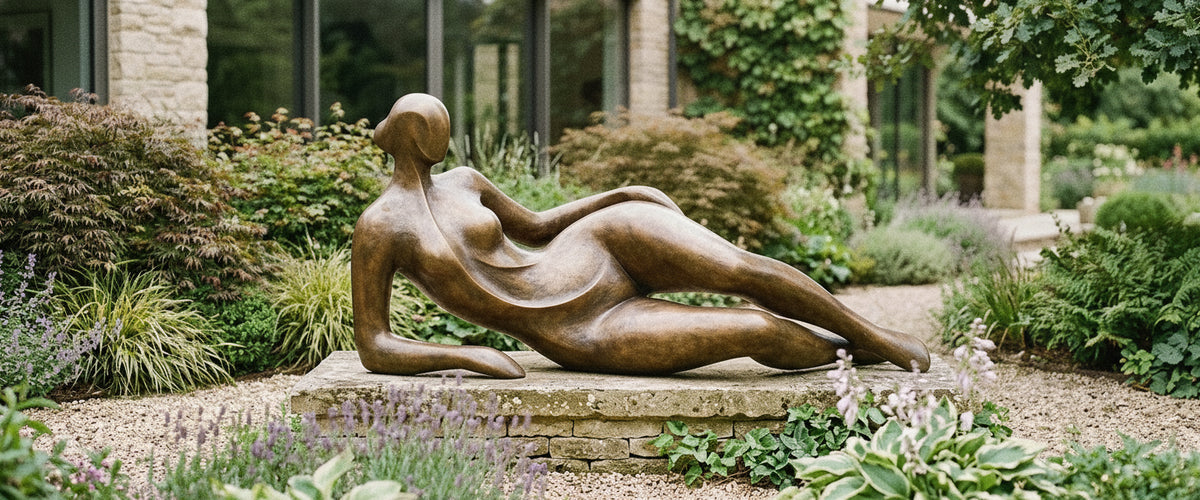

The fastest way to waste money at an outdoor garden sculptures sale is to buy the piece you love in a showroom and drop it into a spot that swallows it whole. Scale looks different against a 40-foot lawn than it does on a plinth in a studio. A bronze that felt commanding at eye level can read as an afterthought once it sits low behind a border of tall grasses. Placement, not the object itself, is where most garden sculpture decisions go wrong.
We ship large-scale bronze and metalwork commissions to gardens across the US, from Napa hillsides to Hamptons lawns, and the same lesson keeps surfacing: buyers underestimate how much the setting rewrites the sculpture. So before you compare finishes at any outdoor garden sculptures sale, get the placement logic straight.

Key Takeaways for an Outdoor Garden Sculptures Sale
Scale up, not down. Open air shrinks everything. A piece that looks large indoors often looks modest outside.
Fix the sightline first. Decide where people will stand and what they see behind the sculpture before you buy.
Pedestal height changes the whole read. A few inches up or down shifts a piece from grounded to commanding.
Backdrop and contrast do half the work. Dark bronze against dark yew disappears; the same bronze against pale stone sings.
Material sets the maintenance clock. Bronze, stainless steel, and Corten each age differently outdoors.

What Outdoor Sculptures for the Garden Look Like in Real Settings
Browsing outdoor garden sculptures for sale online flattens everything to a single studio shot. That is the trap. The reclining abstract figure that fills your screen might sit only a few feet long, which reads beautifully on a terrace edge but vanishes at the far end of a formal lawn. A pair of cantering horses, by contrast, needs room to be believed; crowd them against a fence and the movement dies. This is why an outdoor garden sculptures sale rewards patience over impulse.
Think in terms of the space's job. A courtyard or a walled garden concentrates attention, so a single mid-size piece such as the Large Contemporary Abstract Reclining Figure Bronze Sculpture - 120cm at 120cm (roughly 4 feet) can anchor the whole enclosure without crowding it. A broad, open landscape does the opposite: it demands height, mass, or repetition to hold its own. In that setting the Large Contemporary Cantering Horse Pair Bronze Sculpture - 180cm earns its scale, because two figures moving together read across distance in a way a single small form never will.
Water changes the calculation again. Beside a pool or reflecting pond, a leaping form gains a second life in the surface below it, which is why marine subjects work so hard near water. If you are building around a feature, browse the garden fountains and water features range alongside the sculpture so the two are planned as one composition, not bolted together later. Plenty of outdoor sculptures for garden settings live or die on this pairing.

Scale, Sightlines, and Pedestal Height
Here is the rule we repeat on almost every commission call: the eye judges a sculpture against everything around it, not against a tape measure. A 5-foot (1.5m) bronze looks substantial in a small side garden and almost bashful on a wide terrace framed by mature trees. Before you commit to a size at any outdoor garden sculptures sale, walk your space and mark the intended spot with a stack of boxes or a garden cane taped to the rough height. Stand where guests will actually stand. Look at it from the kitchen window, from the path, from the seating area.
Sightlines matter more than square footage. A sculpture at the end of a straight path becomes a destination; the same piece off to one side becomes a grace note. Decide which role you want before you shop the outdoor garden sculptures sale. If the piece is meant to be the full stop at the end of an axis, err larger and give it a clear backdrop so nothing competes.
Pedestal height is the lever most buyers forget. Raise a figure so its focal point sits near eye level and it engages you directly. Set it lower, closer to the ground, and it feels settled into the garden, more like a creature at rest than a monument. Where the design already carries its own base, the calculation shifts: the Life-Size Classical Seated Mermaid on Rock Bronze Sculpture - 200cm lifts and frames the figure through its integrated rock, so it reads best as a grounded, discovered moment rather than something perched on a tall plinth. When we design bespoke bases, we model the pedestal and the sculpture together, because a few inches decides whether a piece feels commanding or awkward.

Indoor Versus Outdoor Placement: When Each Wins
For wider placement ideas, Abstract Garden Sculptures for Sale: How to Choose a Piece That Holds a Space is useful companion reading before finalizing the setting and sightlines.
Some pieces are happiest under a roof, and pretending otherwise leads to disappointment. Polished stainless steel and high-shine bronze reward controlled indoor light with clean, predictable reflections. Outdoors, that same mirror finish becomes a live surface that changes hour by hour, which can be magnificent or distracting depending on what surrounds it. Weigh both when you shop an outdoor garden sculptures sale.
Outdoor placement wins when the piece is built for it and the setting gives it room to breathe. Bronze developed as an outdoor material for good reason; its patina is a protective layer, and a well-maintained bronze can hold up outdoors for generations. The Getty Conservation Institute's guidance on outdoor bronze notes that a stable patina and regular protective waxing are central to long-term care, which is exactly why we specify foundry-grade patinas and durable coatings on garden commissions.
Indoor placement wins when you want to protect a delicate finish, when frost and standing water are a genuine risk, or when the sculpture is a companion piece meant to be seen up close. Where the intent is intimacy over impact, a tender figurative work such as the Life-Size Contemporary Children Bronze Statue (Companion Piece) - 120cm companion piece can live happily in a garden room or covered loggia where the detail stays crisp and the mood stays close.

Light, Backdrop, and Contrast
Light is the cheapest upgrade you will ever make to a sculpture, and most people ignore it until after installation. Track where the sun falls across the day. A piece that catches low morning or late afternoon light gains depth from raking shadow; the same piece under flat noon light can look inert. If you entertain in the evening, plan discreet uplighting now, controlling glare so the sculpture glows without blinding anyone across the terrace.
Backdrop decides contrast, and contrast decides whether the piece is visible at all. Dark bronze against a dark evergreen hedge is a classic mistake; the silhouette dissolves. Set that same bronze against a pale rendered wall, a birch trunk, or open sky and the form snaps into focus. Reflective stainless steel wants a backdrop with something worth reflecting, whether that is planting, water, or sky. Corten steel, with its warm russet surface, plays beautifully against green and gray but can feel muddy against red brick. Keep this in mind as you compare pieces at an outdoor garden sculptures sale.
For dramatic pieces meant to be seen from a distance, contrast is not optional. A piece with intricate movement, such as the Large Contemporary Dual Dragon Bronze Sculpture - 250cm at 250cm (roughly 8 feet), only reads if the backdrop stays quiet. Place it against a busy mixed border and the sculpture and the planting fight each other. Give it a calm ground and it holds the whole scene.

Common Placement Mistakes We See, and How to Avoid Them
After enough installs you start to see the same errors before the crate is even open. Whether you buy from an outdoor garden sculptures sale or commission from scratch, these are the ones worth guarding against.
Buying too small. The single most common regret. When in doubt, size up; open air is unforgiving. If budget is the constraint, one larger piece beats three small ones scattered around.
Ignoring the winter view. The border that hides the base in July is bare in January. Check what the sculpture sits against across all four seasons.
Skipping the foundation. A heavy bronze needs a proper footing, not a paving slab on soil. Settling and tilt ruin the line and can be dangerous. We spec footings as part of the commission.
Forgetting the approach. People experience a sculpture while walking toward it. If the best view is from a spot nobody stands in, the piece is wasted.
Overcrowding. A figure needs negative space to read. Planting that creeps in over two seasons can strangle the composition.

Commissioning and Buying With Confidence
When a stock piece does not fit the sightline or the scale your garden needs, a bespoke commission solves it. We adjust scale, pose, finish, and base so the sculpture is designed for your specific spot rather than forced into it. That is the advantage of working with a maker geared to large-scale outdoor work: the piece, the pedestal, and the footing are planned as one, whether you found it at an outdoor garden sculptures sale or started with a blank sheet.
Pricing on any sculpture for outdoor garden use depends on material, scale, complexity of the form, engineering, base and installation, and finishing. A large stainless steel piece and a life-size bronze can differ widely even at the same height. Rather than guess from a category page, tell us the setting and the effect you want, and we will prepare a tailored quote. Browse the full garden statues range or the dedicated large garden statues collection to shortlist scale and subject, then bring us the site details. That order of operations, setting first and object second, is how you make an outdoor garden sculptures sale pay off instead of ending in the regret that starts every one of these placement conversations.