




























































































Most garden statues for sale photograph beautifully and disappoint in person. The pose is right, the price feels fair, and then the piece arrives half the size you pictured, or the finish chalks within two summers. Buying outdoor sculpture well is less about taste and more about judgment: what the material will do in your climate, how big it needs to be to hold a space, and whether it looks like it belongs or like it was dropped in from a catalog.
Looking for the full range in this category? Browse our Garden Statues collection for every available finish, size, and configuration.
That gap between screen and reality is what this guide is built to close. We ship large-scale work to private gardens and commercial venues around the world, so the advice below leans on what actually survives outdoors and what reads well from a distance.

At a Glance: Buying Garden Statues That Last
- Material drives longevity. Bronze, stainless steel, Corten and natural stone are the outdoor performers. Skip anything that needs to come inside for winter.
- Scale is the most common mistake. A statue that looks large indoors often looks timid in an open garden. Measure the sight lines, not just the plinth.
- Placement is composition. The best pieces anchor a view, close a path, or reward a walk. Random placement wastes a good sculpture.
- Budget depends on the build. Material, size, complexity, engineering, finishing and installation all move the number. Ask for a tailored quote rather than trusting a flat price.
- Bespoke is closer than you think. Commissioning lets you fix scale, pose and finish to the exact spot, which is often the smarter buy for a signature location.

What Garden Statues for Sale Really Means, and Who It Suits
The phrase covers everything from a small cast figure by a doorway to a life-size bronze that becomes the reason people walk into your garden. When buyers go looking for outdoor sculpture to buy, they usually want one of three things: a focal point for a new landscape scheme, a replacement for something that has aged badly, or a statement piece for a property that deserves better than a garden-center ornament.
The people who get the most from a serious piece tend to be private collectors, homeowners with real garden square footage, landscape designers specifying for clients, and venue owners who need a piece that carries a courtyard or hotel entrance. If your garden is a small city terrace, scale down but do not skimp on material; a compact bronze reads far better than an oversized composite.

How to Compare Your Options Before You Buy
Photographs flatten everything. Before you commit, work through a short set of questions that tell you more than the listing image can.
Read the material honestly
Ask what the piece is actually made of, not just what it looks like. Cast bronze and forged stainless steel are built to live outside permanently. Natural stone and marble weather with grace when the stone is sound. Resin and composite can look convincing in a photo and then fade, crack or chalk under UV and frost. We work almost entirely in bronze, stainless steel, Corten and stone precisely because those materials reward long-term ownership rather than punishing it.
Check the scale against your space, not the room you saw it in
A 5-foot (1.5 m) figure that dominates a showroom can vanish on a wide lawn. Our large bronzes routinely run past 6 to 8 feet (1.8 to 2.4 m), and clients are often surprised how much presence they need outdoors. If you are placing a piece at the end of a long view, err larger than instinct suggests.
Look at how it is finished
On bronze, the patina is the finish and the protection. A hand-applied patina sealed with wax behaves very differently from a sprayed coating. On stainless steel, ask whether it is brushed, mirror-polished or coated, because each reflects light and shows fingerprints and water spots differently.

Materials, Finishes and Scale Decisions
Material is where a purchase is won or lost. Here is how the main options behave once they are living in your garden.
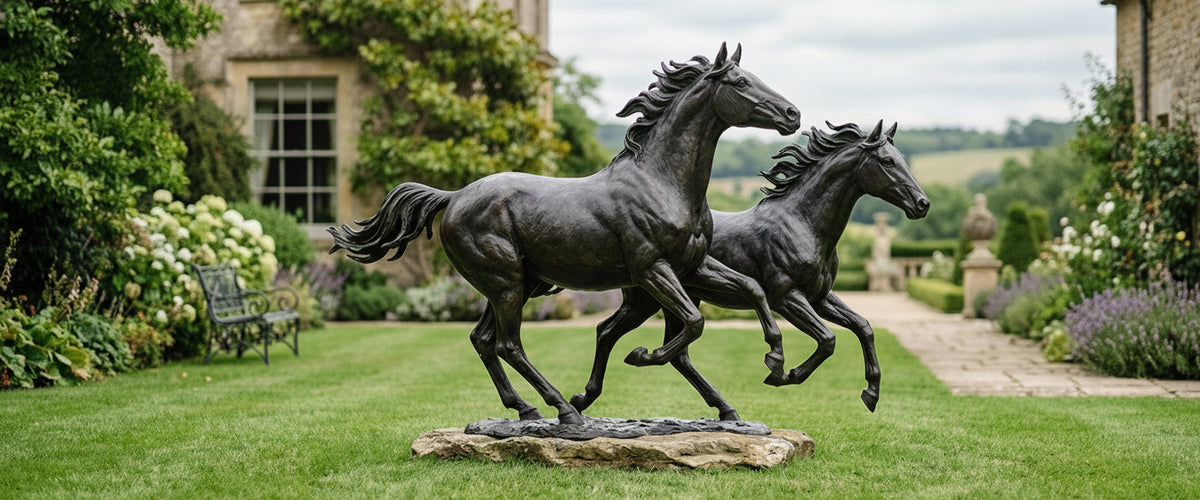
Bronze is the classic for good reason. It develops a patina over years and, cared for, lasts generations outdoors. For a planted bed or a spot beside water, a pair such as the Large Traditional Crane Pair Bronze Sculpture - 150cm creates a small scene rather than a single static object, which draws the eye through the planting. Where you have open ground to fill and want movement rather than a quiet accent, a piece with the sweep of the Large Contemporary Cantering Horse Pair Bronze Sculpture - 180cm holds a big lawn where a single small figure would be lost.
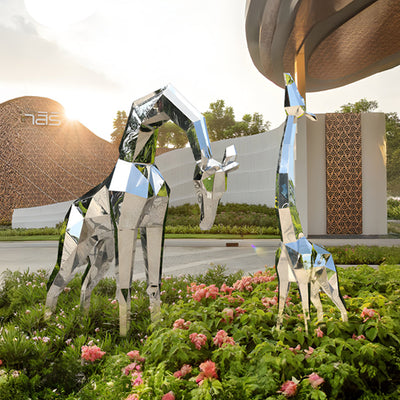
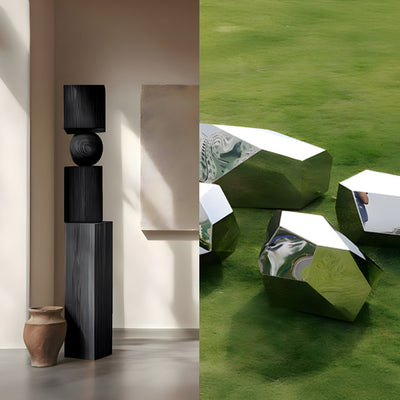
Stainless steel suits contemporary architecture and reflects the sky and planting around it, so it changes through the day. It is a strong choice for modern homes and clean-lined courtyards where a traditional bronze would fight the setting.
Corten steel forms a stable rust-toned surface that reads warm against green planting and gravel. It pairs well with prairie-style gardens and modern landscape schemes.
Stone and marble bring weight and permanence. They belong in formal gardens, classical schemes and against period architecture. The Getty's conservation guidance on outdoor stone is a useful reminder that even durable stone needs the right siting and drainage to age well (Getty Conservation Institute).
On scale, one rule keeps buyers out of trouble: measure the viewing distance. A piece read from across a lawn needs more height and mass than one you pass within arm's reach. When in doubt, mock it up. Cut a cardboard silhouette to size and stand it in the spot for a day.
Where to Place Garden Statues for the Strongest Impact
For wider placement ideas, Bronze Outdoor Garden Statues: How to Choose One That Earns Its Place is useful companion reading before finalising the setting and sightlines.
A good sculpture badly placed looks like an accident. A modest one placed well looks intentional. Placement is composition, and a few reliable moves do most of the work.
- Close a view. Set the piece at the end of a path, axis or lawn so it becomes the natural stopping point for the eye.
- Frame it with planting. A dark hedge behind a bronze makes the form read cleanly. Never lose a statue against a busy background.
- Use water. A leaping form beside a pool or pond gains energy from the reflection. Where the space calls for a dynamic centerpiece rather than a still figure, the Large Contemporary Leaping Dolphins Bronze Sculpture - 300cm is built to sit with water and works hard beside a pool or at the heart of a formal feature. Our garden fountains and water features are worth a look if you want the piece and the water to be a single composition.
- Respect approach and light. Note where morning and evening light lands. Bronze and steel both come alive in low, raking light, so orient the best face toward it.
One lesson from the studio: clients almost always underestimate the base. A statue sitting flat on grass looks unfinished, while the same piece on a stone plinth of the right height reads as deliberate. Budget for the plinth as part of the piece, not an afterthought.
Budget, Commissioning and Delivery
There is no honest flat price for a serious garden statue, and anyone quoting one for large bespoke work is guessing. Cost is driven by material, size, complexity of the form, structural engineering for wind and weight, the finish, and the logistics of getting a heavy object into position. A larger bronze can weigh several hundred pounds (well over 100 kg), which affects crating, freight and the equipment needed on site. The right approach is to describe your space and your intent, then ask for a tailored quote.
Delivery of large sculpture is its own discipline. Think about access before you fall in love with a piece: gate widths, soft ground, overhead cables, and whether a crane or forklift can reach the final spot. We plan installations around exactly these constraints, and it is far easier to solve them before casting than after a crate lands in the driveway.
How Giant Sculptures Helps With Bespoke Projects
Buying off the catalog is the right call for many gardens, and our large garden statues and bronze garden statues collections cover a wide range of subjects and scales. But when a location deserves something specific, commissioning is the smarter route.
As a bespoke sculpture supplier, we can adjust an existing design to your dimensions, develop a new subject entirely, change a patina to suit your planting, or engineer a piece for a demanding site. We have adapted poses to sit correctly on a particular slope and scaled figures up so they held their own against tall architecture. That flexibility is the real advantage of working with a specialist rather than buying a fixed-size ornament and hoping it fits.
Where to Find Unique Garden Statues for Sale
If you want a piece nobody else on your street has, look for a maker who commissions rather than a reseller who only stocks. Unique work comes from bespoke casting, limited editions, and designs you can modify. Start with the subject and the spot, decide on material and scale, then talk to a studio that can build to your brief. That sequence, in that order, is how you end up with outdoor art that looks like it was made for the place, because it was.