
































































































Most of the fiberglass garden sculpture you see at trade shows would not last three winters in a serious Connecticut garden, let alone a windswept Cotswolds estate. The material itself is excellent. The execution is usually where it falls apart. Done properly, a fiberglass garden sculpture can read as cast bronze from ten paces, weigh a fraction of the equivalent stone piece, and sit happily through freeze-thaw cycles for decades. Done badly, the gelcoat chalks within two summers and the seams crack the first time the temperature swings hard.
Looking for the full range in this category? Browse our Garden Statues collection for every available finish, size, and configuration.
This is the guide we wish more buyers had read before they bought their first large garden piece. It is written from the studio side, after years of shipping commissioned work to gardens in Aspen, the Hamptons, Napa, and the wetter side of Surrey.

Quick Answer: Key Takeaways
- Fiberglass is genuinely outdoor-rated when built with marine-grade resin, a UV-stable gelcoat, and a proper internal armature.
- Weight is the headline benefit: a 7 ft (2.1 m) figure might weigh 80 to 120 lb (36 to 54 kg) in fiberglass versus 800 lb plus in bronze or stone.
- Finish quality is everything. A well-applied bronze, verdigris, or stone-effect coating is the difference between a sculpture that ages gracefully and one that looks tired by year three.
- Anchoring and drainage matter more than people think, especially on lawn and exposed terraces.
- Repairs are realistic. Fiberglass is one of the few outdoor sculpture materials a competent local fabricator can patch on site.

Why Fiberglass Earned Its Place in Serious Garden Schemes
For wider placement ideas, Outdoor Sculptures Unveiled: Essential FAQs for Stunning Garden Décor is useful companion reading before finalising the setting and sightlines.
Twenty years ago, fiberglass garden sculpture was largely a theme-park material. That has changed. The same composite technology used in superyacht hulls and wind turbine blades is now standard in studio sculpture, and the gap between a well-finished fiberglass piece and a bronze one has narrowed to the point where most garden visitors cannot tell at conversational distance.
The reasons designers reach for it are practical. You can install a 9 ft (2.7 m) figure on a roof terrace without engineering the slab. You can ship internationally without the freight cost of a tonne of metal. You can place a piece on a soft lawn without sinking a concrete pad the size of a parking bay. For clients who want presence rather than provenance, that calculus is hard to argue with.
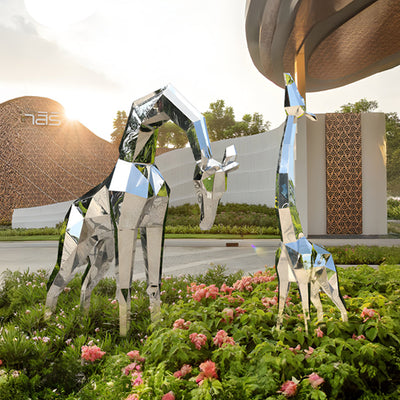
It also opens up forms that would be punishing in stone or bronze. Outstretched arms, thin drapery, leaping animals, anything with a cantilever: fiberglass lets sculptors build silhouettes that would crack or cost a fortune in traditional materials. The fiberglass sculptures collection at Giant Sculptures leans into exactly these forms, because that is where the material earns its keep.

How Resin and Gelcoat Weather Across Climates
The honest answer: it depends entirely on what is under the paint.
A quality outdoor fiberglass sculpture is built in layers. The outer skin is a pigmented gelcoat, typically isophthalic or vinyl ester for UV and water resistance. Behind that sits the structural laminate, usually several layers of chopped strand and woven mat in marine-grade resin. Inside, you should find a stainless or galvanized armature anchored into the base. Skip any of those layers and the piece becomes a weather report.
In a dry, high-UV climate like New Mexico or inland California, the main enemy is sunlight. UV slowly breaks down the resin matrix near the surface, which is why gelcoat formulation matters. Look for pieces finished with automotive-grade two-pack polyurethane topcoats, or at minimum a gelcoat with proven UV inhibitors.
In a wet, freeze-thaw climate (think upstate New York, the Pacific Northwest, most of the UK), water ingress is the killer. Any hairline crack lets moisture into the laminate. It freezes, expands, lifts the gelcoat, and the damage cascades. This is why we will not ship a large fiberglass garden sculpture without drainage holes in the base and sealed seams throughout. It is also why we recommend a soft wax or marine polish once a year on any piece in serious weather.

Scale Tricks: When a Large Fiberglass Piece Reads as Stone or Bronze
A large fiberglass garden sculpture lives or dies on its finish. The substrate is almost irrelevant to the eye; what the visitor reads is the surface.
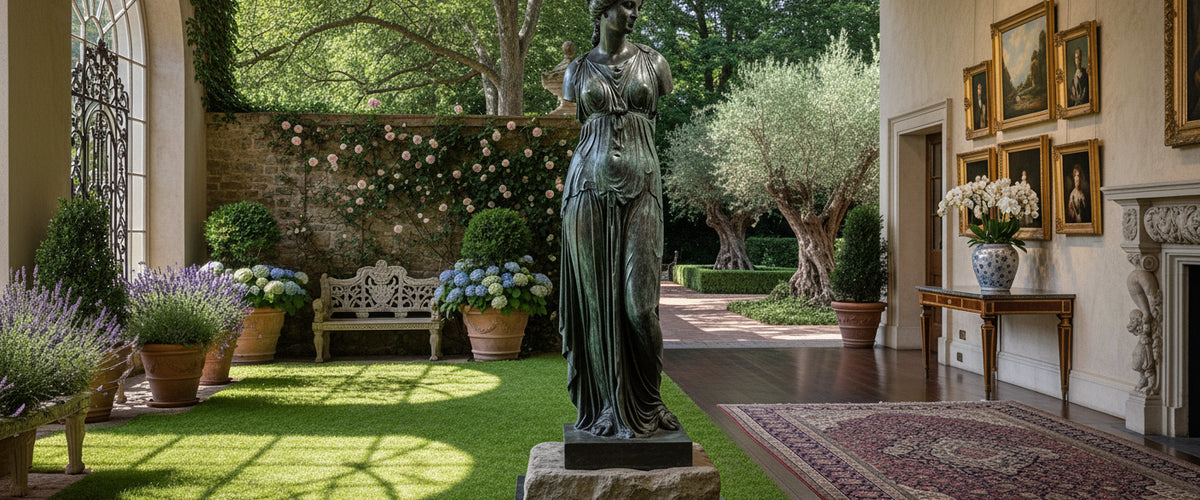
The convincing bronze effect is built up in layers. A dark base, then cold-cast bronze powder suspended in resin or applied as a metallic coat, then a chemical patination to push green, brown, or black tones into the recesses. Done well, the piece will even develop a real verdigris where rain pools, because the bronze powder in the surface oxidizes genuinely. We have had architects tap pieces with a coin to check.
Stone effects work similarly. A textured gelcoat, broken-glaze finishes, and dry-brushed mineral pigments can mimic limestone, travertine, or weathered marble convincingly. The giveaway on cheap pieces is uniformity; real stone is patchy, mossy, slightly inconsistent. A skilled finisher builds that variation in deliberately.
Scale amplifies all of this. At 4 ft (1.2 m), the eye reads detail and the finish has to be flawless. At 9 ft (2.7 m), the silhouette does most of the work and the finish needs to read correctly from 30 ft (9 m) away rather than two. This is one reason the large garden statues collection includes pieces sized specifically for the long sightlines of estate gardens and commercial landscaping, where a smaller sculpture would simply disappear.

Anchoring, Drainage, and Placement
Lightweight is a blessing and a curse. A 100 lb (45 kg) figure looks substantial but will go over in a 60 mph gust if it is not anchored. We have seen it happen, usually after the first autumn storm in a new installation.
On paving or stone, the standard approach is a pair of stainless steel studs cast into the base, dropped into resin-set sockets in the slab. On lawn, the piece needs a concrete pad below grade with anchor points, then the turf is restored around it. Skipping the pad and just spiking into soil is fine for a small ornament; it is not fine for a 7 ft sculpture in a windy garden.
Drainage is the other quiet detail. Any hollow fiberglass sculpture left outside will collect water through condensation alone, even if the base seems sealed. Two or three small weep holes on the underside, protected from upward splash, prevent the slow build-up that eventually freezes and damages the laminate from inside.
Placement-wise, fiberglass behaves well in conditions that would punish other materials. It does not stain stone paving the way bronze can. It does not etch in acid rain like marble. It tolerates pool chlorine and coastal salt air better than most metals. If your site is a Florida poolside or a Cape Cod waterfront, fiberglass is often the right answer rather than the compromise.
Repair, Repaint, and the Long Maintenance Arc
For general conservation principles, Canadian Conservation Institute outdoor object care is a useful external reference, though the final care routine should always follow the material and finish specified for the individual commission.
Here is the honest long view. A bronze sculpture asks almost nothing of you for fifty years and then asks for a conservator. A fiberglass sculpture asks for modest attention every few years and rewards it indefinitely.
The realistic maintenance arc looks like this:
- Year one to three: annual wash with mild soap, soft brush, and a wax or marine polish on metallic finishes. Inspect seams and base.
- Year three to seven: touch-up any chips with matched gelcoat or topcoat. Re-wax. Check anchoring hardware for corrosion.
- Year seven to ten: consider a full topcoat refresh if the piece is in heavy UV. This is a one-day job for a good fabricator and dramatically resets the lifespan.
- Year ten plus: structural inspection. A well-built piece can run thirty years and beyond with periodic recoating.
The repair piece matters. Stone chips are forever. Bronze damage needs a specialist. Fiberglass can be patched, sanded, and recoated by any competent boat repair shop in the country, which is genuinely useful if a piece takes a hit from a mower or a falling branch.
Commissioning a Fiberglass Garden Sculpture for Your Site
The commissioning conversation usually starts with a photograph of the space and a rough idea: a figure, an animal, a couple, an abstract form. From there, the useful questions are about sightlines, prevailing wind, hours of direct sun, and what the piece is meant to do in the garden. Anchor a view? Punctuate a path? Hold the centre of a parterre?
Material specification is where buyers should push for detail. Ask what resin system, what gelcoat, what armature, what anchoring hardware, what topcoat. A maker who answers fluently is a maker who has built outdoor pieces that lasted. A maker who waves the question off has probably not.
Scale modelling is worth the time. We often produce maquettes or to-scale silhouette boards on site before final approval, because a sculpture that looked right in the studio at 6 ft can read as undersized in a 40 ft (12 m) lawn. Bespoke commissions through the wider outdoor sculptures collection are sized to the space rather than to a catalog default for exactly this reason.
Budget conversations are best had once the form, scale, and finish are agreed. Cost on a bespoke fiberglass garden sculpture depends on size, complexity of form, finish specification, internal engineering, installation method, and freight. We quote per project rather than per square foot, because two sculptures of identical height can differ wildly in build hours. A specification call with our studio is usually the fastest way to get a meaningful number.
Choose well, specify properly, anchor it correctly, and a fiberglass garden sculpture will hold its own against bronze and stone neighbours for a very long time. That is the version of this material worth buying.