



















































































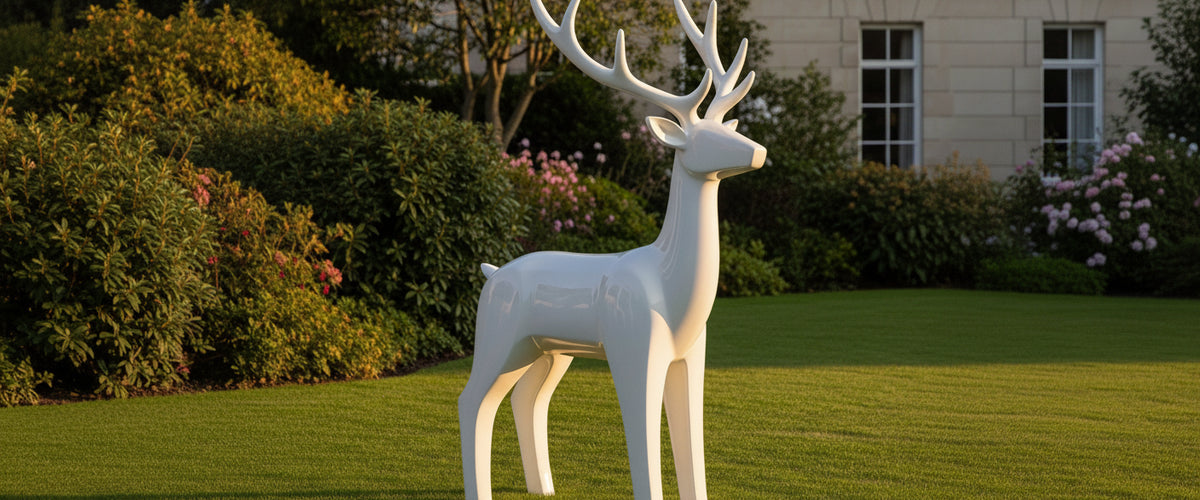

The honest test of a fiberglass garden sculpture is not the day it arrives on the lawn. It is year three, after two summers of UV, a wet autumn, and one hard frost. That is when you find out whether the piece was built properly, sited sensibly, and cared for at all. Most owners we speak to inherit a piece, place it, and never touch it again. Then they wonder why the reds have gone pink and the joint line has opened up a hair.
We sell large work in bronze, stainless steel, Corten and stone because those materials reward patient ownership. Fiberglass, or fiberglass resin sculpture to give it its full name, sits in a different category. Lighter, more affordable to ship, more flexible in form, and genuinely useful for big seasonal or themed installations. It also asks more of the owner over time. This guide explains what to expect, what to do, and when to stop maintaining and start commissioning a replacement.

At a Glance: What Owners of Fiberglass Garden Sculpture Should Know
- Year one is the gelcoat year. The outer layer is doing the heavy lifting; protect it early.
- UV is the main enemy. Reds, oranges and metallic finishes fade first.
- Frost finds the weak joints. Hairline cracks usually trace back to manufacturing seams.
- Hollow large pieces need real anchoring. Wind load on a 7 ft (2.1 m) figure is not trivial.
- Twice-yearly cleaning with mild soap and a soft brush adds years to the finish.
- Refinish if the laminate is sound. Replace if water has reached the glass mat.

Year One: How the Gelcoat Actually Behaves Outdoors
The gelcoat is the pigmented resin layer sprayed into the mold before the glass fibers are laid in. It is the only thing standing between sunlight, rain, and the structural laminate underneath. On a new fiberglass garden sculpture, that gelcoat is at its best. It is glossy, fully cured, and chemically stable. Within the first twelve months outdoors, fine surface chalking begins. You will not see it from across the garden. Run a clean white cloth across a darker area in late summer and you will pick up a faint powdery residue. That is normal oxidation, not failure.
What we recommend for year one is simple. Wash the piece gently in spring and again in autumn. Apply a non-abrasive marine-grade wax or a UV-protective automotive sealant after the second wash. This is the same logic the boatbuilding world has used for decades on gelcoated hulls, and the technical press around composite craft has documented it thoroughly. Skip this step and you are essentially leaving the surface unprotected for the harder years to come.

UV Fade Patterns on Darks, Brights, and Metallic Finishes
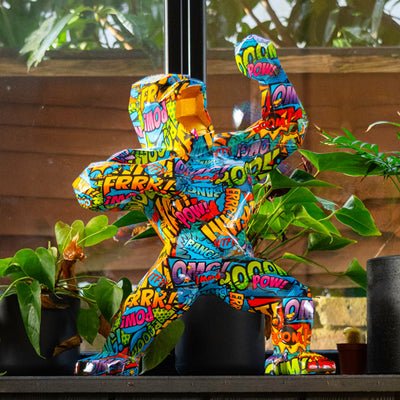
Color holds differently depending on pigment chemistry. In our experience commissioning and shipping fiberglass figures and animal sculptures internationally, the fade order is fairly predictable. Reds and oranges shift first, usually visible by year two on a south-facing position. Deep blues and purples follow. Blacks tend to bronze slightly, going warm rather than gray. Whites and creams are surprisingly stable, though they pick up environmental staining instead.
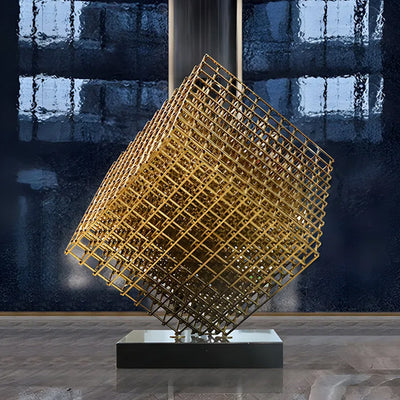
Metallic finishes are their own conversation. A faux-bronze or faux-silver gelcoat is essentially metallic flake suspended in resin. When the resin chalks, the flake dulls. This is why a five-year-old metallic piece can look tired next to a real stainless steel sculpture that has barely changed. If the client wants a metallic appearance to hold for decades, we steer them toward actual metal. If the brief is theatrical, seasonal, or about scale-for-budget, fiberglass earns its place.
For owners who want to slow UV damage on a piece already installed, two practical moves help. First, rotate the sculpture annually if it is freestanding and not anchored, so the same face is not always presented to the sun. Second, consider a UV-inhibiting clear coat reapplied every two to three years. It will not reverse fade, but it slows it considerably.

Frost, Hairline Cracks, and the Joint-Line Question
Fiberglass itself does not freeze and crack the way terracotta or unsealed stone does. The problem is water ingress. Most large fiberglass garden sculpture is built in sections and joined; a life-size horse, for instance, might come out of the mold in four or five parts that are then bonded and faired. Those joint lines are the weak points. If a hairline opens, water gets in, freezes, expands, and widens the crack. Over a few winters this becomes structural.
Inspect joint lines every spring. Run a fingernail along the seam. If it catches, you have a hairline. A competent composites repairer can grind back, re-laminate, and refinish the area before it becomes a problem. Left alone, the same crack at year five is a much bigger job, and at year eight it may have delaminated the surrounding gelcoat entirely.
One client in upstate New York learned this the expensive way with a large animal piece he bought from another supplier. By the time we were asked to advise, water had tracked along three seams and the internal armature was rusting outward through the laminate. The piece was beyond economic repair. Catching it in year two would have cost a fraction.

Anchoring Large Hollow Pieces Without Ruining the Lawn
A 6 to 8 ft (1.8 to 2.4 m) fiberglass figure can weigh as little as 80 to 150 lbs (36 to 68 kg). That sounds reassuring until you calculate wind load on a flat-sided surface in an exposed Hamptons garden or an Aspen ridge property. We have seen pieces walk several feet in a storm, and one tip over into a pool.
There are three reliable anchoring approaches:
- Internal ballast. Sand or concrete ballast cast into the base during manufacture. This is the cleanest solution and should be specified at commission stage.
- Hidden ground plate. A stainless steel plate bedded into a concrete pad below grass level, with threaded studs rising through the sculpture base. Lawn grows back over the edges within a season.
- Plinth mounting. A stone or concrete plinth gives both visual weight and a real mechanical fixing point. This is our default recommendation for any commissioned piece over 5 ft (1.5 m).
Drilling spikes through a hollow fiberglass base into soft ground is not anchoring. It is a placebo. Specify the fixing detail when you commission, not after delivery.
Cleaning Routines That Extend the Finish by a Decade
The maintenance ritual for a fiberglass garden sculpture is not complicated. It is just rarely done.
- Spring wash: Lukewarm water, pH-neutral soap, soft natural-bristle brush. Rinse thoroughly. Never use a pressure washer above a gentle setting; high pressure drives water into seams.
- Algae and biofilm: A diluted solution of oxygen bleach (not chlorine bleach) lifts green film without attacking the gelcoat. Conservation guidance from institutions such as the American Institute for Conservation consistently favors the gentlest effective treatment over aggressive chemical cleaning.
- Autumn wax: A thin coat of marine wax or composite sealant before winter. Pay attention to the top of the head, shoulders, and any upward-facing surfaces; these take the most weather.
- Inspection: Walk around the piece slowly. Look at joint lines, the underside if accessible, and anywhere mounting hardware enters the laminate.
Do this for ten years and a well-made piece will still read as new from ten paces. Skip it and you are on the year-five replacement track.
Custom Fiberglass Sculptures, Animal Pieces, and Seasonal Installations
Where the material genuinely shines is scale-on-budget and complex form. Custom fiberglass sculptures can be molded into shapes that would be ruinously expensive to cast in bronze. Large fiberglass animal sculptures, oversized fruit, abstract forms in the spirit of an Anish Kapoor fiberglass sculpture, and large fiberglass christmas sculptures for hospitality and retail clients all sit naturally in this category. We have shipped seasonal commissions to hotel groups and shopping destinations that needed a 10 ft (3 m) piece on a tight timeline. The material made it possible.
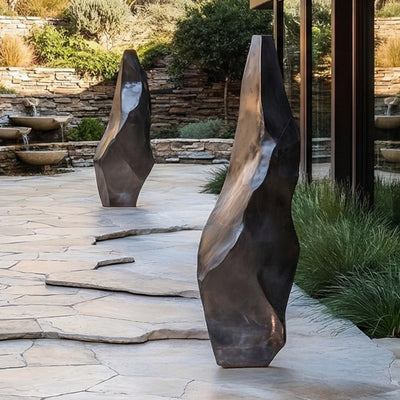
For permanent residential placement in a serious garden, our usual advice is different. Look first at large garden statues in stone, bronze, or Corten, where the material rewards decades of ownership. Use composites deliberately, for the briefs they suit. Browse our fiberglass sculptures for examples of where the medium is the right answer, and our wider outdoor sculptures collection when you want to compare materials side by side before committing.
When to Refinish Versus Replace
For wider placement ideas, Resin Garden Statues & Sculptures: Your Complete Guide to Outdoor Resin Art is useful companion reading before finalising the setting and sightlines.
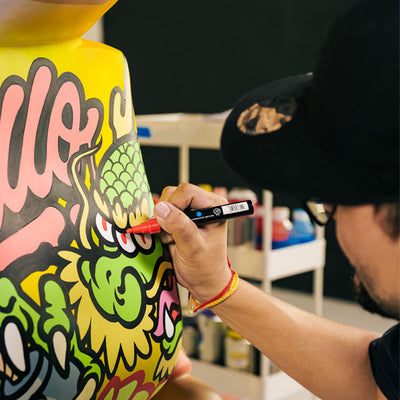
A fiberglass garden sculpture is worth refinishing when the underlying laminate is dry and structurally sound, the joint lines are intact or repairable, and the form is one the client still wants. Refinishing means sanding back the gelcoat, repairing any seam damage, re-spraying with new pigmented gelcoat or a high-grade two-pack automotive system, and re-protecting. Done well it returns the piece to near-new for a fraction of replacement cost.
Replace when water has reached the glass mat (you will see darker patches and a soft feel under pressure), when an internal armature has corroded, or when the gelcoat has chalked through to the laminate across large areas. At that point you are not restoring; you are rebuilding, and a fresh commission is usually the better answer.
The buyers who get the most out of a fiberglass garden sculpture treat it as a serious material that needs serious care, not a maintenance-free plastic. Done that way, a well-made piece earns its place in the garden for a long time. Done the other way, it becomes a cautionary tale at year four. Giant Sculptures is happy to advise on either path, including honest recommendations to move into bronze or stone when the brief is really asking for it.