





































































































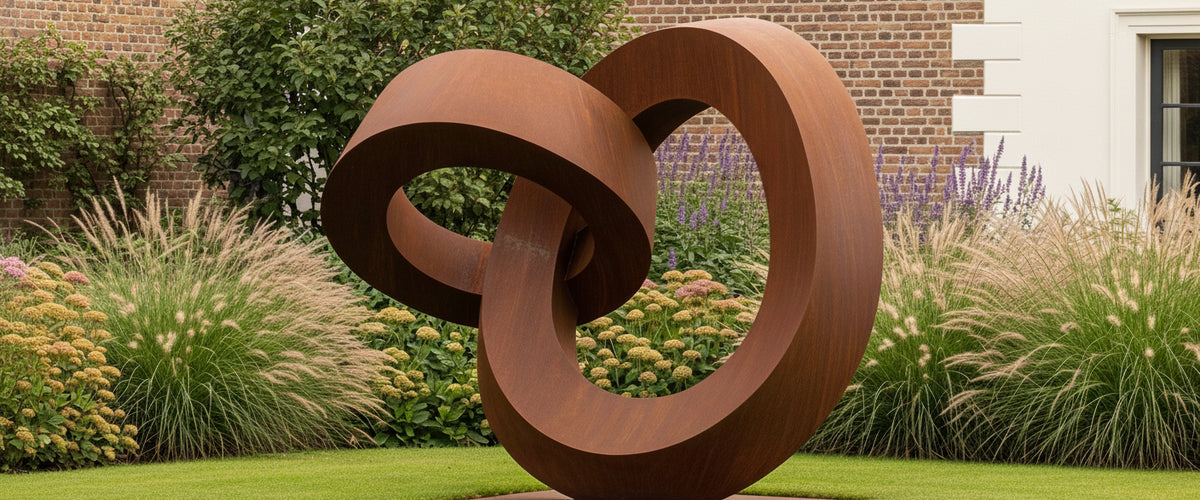

Most gardens cannot carry a contemporary sculpture, and the failures look the same every time: a small abstract on a vast lawn, a tall blade of Corten crammed against a fence, a stainless steel form set down with no clear sightline. Contemporary garden sculptures only work when the piece, the planting, and the architecture agree on what the focal point should be. Get that right and the garden reads as composed. Get it wrong and you have an expensive ornament.
Looking for the full range of contemporary garden sculptures? Browse our Contemporary & Modern Sculptures collection for every available finish, size, and configuration.
At Giant Sculptures we spend a lot of time talking clients out of contemporary garden sculptures that are too small, too busy, or too literal for the site they have. The advice below is what we actually say on calls with collectors in Napa, landscape architects in the Hamptons, and homeowners building new-build estates outside Austin.

At a Glance: What Separates Contemporary from Ornamental
- Form first. Contemporary garden sculptures read as silhouette and volume before they read as subject.
- Material honesty. Corten rusts, stainless reflects, bronze patinates. The finish is part of the design, not a disguise.
- Scale that earns the spot. Bigger than you think; 6 to 10 feet (1.8 to 3 m) is the usual minimum for an open lawn.
- One hero, not three. A contemporary garden prefers a single confident piece over a scatter of smaller ones.
- Site-led commissioning. The strongest results come from work made for the axis, the view, and the architecture it sits beside.

What Makes a Garden Piece Feel Contemporary Rather than Ornamental
Ornamental garden sculpture leans on recognisable subjects: cherubs, urns, classical figures in cast stone. Modern outdoor work leans on abstraction, gesture, and material. The subject can still be figurative; a stylised hare, a pared-back dog, a geometric horse all count as contemporary if the treatment is modern. What matters is restraint. A contemporary garden art sculpture rarely tries to be charming. It tries to hold a corner of the garden with quiet authority.
The clearest tell is how the piece behaves at distance. Walk fifty paces away. If the silhouette still reads, you have a contemporary piece. If it dissolves into surface detail, you have an ornament that happens to be outdoors. That single test has saved more sculpture commissions for contemporary gardens than any mood board.

Corten, Stainless, and Powder-Coated Steel Under Real Weather
Material choice in contemporary metal garden sculptures is half the design decision. Each behaves very differently across a decade of seasons.
Corten Weathering Steel
Corten develops a stable oxide layer that protects the steel underneath, which is why it suits exposed coastal and country sites. Expect the color to shift from orange through to a deep umber over 18 to 36 months depending on rainfall and humidity. The runoff stains pale paving and limestone, so set Corten on gravel, dark stone, or planted ground rather than honed travertine.
Stainless Steel (316 Marine Grade)
Mirror-polished or satin stainless is the material of choice when you want the sculpture to pick up sky, planting, and water. Use 316 grade near salt air; 304 is fine inland. Polished stainless needs an annual wipe-down to keep the reflection clean, especially under trees that drop sap or pollen.
Powder-Coated Steel and Aluminium
Powder coat lets you introduce color: matte black, deep bronze tones, or an architectural off-white. Specify a marine-grade polyester powder over a zinc primer and the finish will hold for 15 years or more in temperate climates. Avoid bright primaries unless the garden is already playing in that register. This is also where contemporary metal garden sculptures can sit comfortably alongside painted joinery on the house.
Bronze for the Long View
Cast bronze remains the default for buyers who want a piece their grandchildren will inherit. A good foundry patina, sealed with conservation wax, will outlast almost any planting scheme around it. Bronze suits figurative modern work well; our dog statues and sculptures collection is a good example of how a familiar subject reads as current when the modelling is loose and the scale is pushed up.

Reading a Garden: Focal Points, Axes, and Negative Space
Before you choose a contemporary garden sculpture, walk the garden with a camera. Photograph it from the kitchen window, from the terrace, from the end of the lawn looking back at the house. The strongest placements almost always sit on an existing axis: the line out from a French door, the center of a parterre, the end of a pleached lime walk. Modern gardens often work harder with negative space than traditional ones, so resist the urge to fill the void. The void is the frame.
One trick we use on site visits: cut a plywood silhouette to the proposed height and width, paint it matte black, and stake it in the chosen position for a week. Live with it. Photograph it morning and evening. Almost every client comes back wanting the piece taller than the mock-up by 12 to 18 inches (30 to 45 cm). Trust that instinct; outdoor work almost always reads smaller than indoors because there is no ceiling to compress the scale.

Lighting a Contemporary Sculpture from Dusk Onwards
Lighting is where most contemporary garden sculptures are quietly let down. Uplighting from a single point flattens the form and creates a harsh shadow on the planting behind. The better approach is two low-output ground lights at roughly 120 degrees apart, both angled to graze rather than blast the surface. For mirror-polished stainless, light the surroundings instead; the sculpture will do the rest by reflection. For Corten, warm 2700K bulbs deepen the oxide tones beautifully. For bronze, a cooler 3000K keeps the patina honest.
Run the cables before the sculpture lands. Retrofitting lighting into a finished bed is the single most common regret we hear from clients a year after install.

Sizing for Small Courtyards Versus Open Country Plots
A 30 by 30 foot (9 by 9 m) Brooklyn courtyard and a 5-acre Connecticut paddock want completely different contemporary garden sculptures, and not just in scale.
For tight urban gardens, look for vertical or columnar work between 5 and 7 feet (1.5 to 2.1 m) tall. The piece should be readable from a single viewpoint, usually the back of the house, and ideally placed against a planted backdrop rather than a fence. Reflection works hard here; a polished stainless form can double the apparent depth of a small space.
For open plots, scale up aggressively. A garden sculpture intended to anchor a meadow or sit at the head of a long lawn often needs to reach 8 to 12 feet (2.4 to 3.6 m) before it stops looking lost. Weight matters too. A piece at this size is typically 600 to 2,000 pounds (270 to 900 kg), which means concrete pad foundations, crane access on install day, and a route from the gate to the spot that can carry the load. We have shipped pieces to homes in Aspen where the install plan was harder to design than the artwork itself.
Commissioning a Piece Tied to the Architecture Around It
The strongest contemporary garden art sculpture is almost always a commission, because it can answer the specific lines of the building behind it. A cantilevered modern house wants a piece with horizontal weight. A traditional shingle-style home with a clipped lawn wants something that resolves the formality without mocking it. A glass pavilion wants a sculpture that looks good from both sides.
When we open a commission file at Giant Sculptures for contemporary garden sculptures, we ask for three things up front: site photographs at different times of day, the architectural drawings if available, and a short brief on what the garden is meant to feel like. From there we develop maquettes, agree material, and engineer the piece for the loads and weather of the actual site. Subject can come from anywhere; we have built everything from a stylised figurative astronaut for a tech founder's lawn to a 9-foot abstract for a vineyard in Sonoma. The constant is that a garden contemporary sculpture is designed for the place, not adapted to it.
If a full commission is more than the project needs, our existing marble sculptures and statues collection includes pieces that read as contemporary garden sculptures in the right setting; pared-back figures, abstract forms, and modern interpretations of classical subjects all sit comfortably in a current garden when the planting around them is restrained.
A Short Checklist Before You Buy
- Mock up the silhouette in plywood and live with it for a week.
- Confirm the install route: gate widths, ground bearing, crane access.
- Specify the foundation; most pieces over 6 feet need a poured pad.
- Plan the lighting cable runs before the bed is finished.
- Agree the patina or finish expectations in writing, with photographs.
- Ask about long-term care: wax intervals for bronze, cleaning cycles for stainless.
- Budget for delivery, install, and a base or plinth as separate line items.
What It Costs and Why We Will Not Quote Until We Have Seen the Site
For wider placement ideas, Outdoor Sculptures Unveiled: Essential FAQs for Stunning Garden Décor is useful companion reading before finalising the setting and sightlines.
Budgets for contemporary garden sculptures vary widely because the inputs vary widely: material, scale, engineering, foundry or fabrication time, finishing, crating, freight, and install. A 4-foot bronze edition is a different conversation from a 10-foot Corten commission with internal armature and lighting. Rather than guess, we quote contemporary garden sculptures against a specific brief; clients tell us the site, the intent, and the scale they have in mind, and we come back with a real number. Anyone quoting before that is guessing.
Contemporary garden sculptures reward patience. The pieces that look effortless in the final photographs are usually the ones that went through three rounds of maquette, a site survey, and an honest conversation about whether the lawn could carry them. That is the part that earns the result.
For general conservation principles, Canadian Conservation Institute outdoor object care is a useful external reference, though the final care routine should always follow the material and finish specified for the individual commission.