






















































































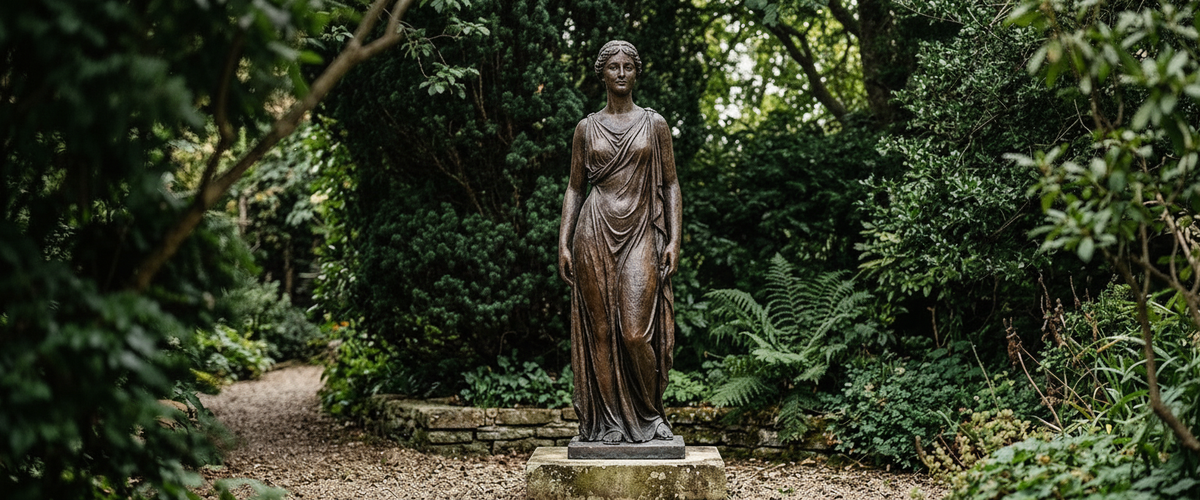

A sculpture that looks perfect in the showroom can turn into a maintenance headache the first winter it spends in a Napa vineyard or a Hamptons garden. The question of the best materials outdoor is less about which metal or stone is objectively finest, and more about which one behaves well in your climate, your sightlines and your budget over ten or twenty years. Get that match right and the piece looks better with age. Get it wrong and you are pressure-washing algae off marble every spring.
We ship large-scale and bespoke work to homes, estates and commercial sites worldwide, so the best materials outdoor conversation comes up on almost every commission. Here is how we think it through.
Bronze, stainless steel and marble each read differently depending on climate and backdrop.

Key Takeaways: Choosing the Best Materials for Outdoor Sculptures
Bronze is the long-game classic: it develops a patina, tolerates most climates, and lasts generations with light care.
Stainless steel (grade 316 for coastal air) suits modern gardens and reflective, sculptural forms.
Corten steel gives a warm rust surface that reads beautifully against green planting and stone.
Marble and stone carry classical weight but need more thought in freeze-thaw climates.
The best materials outdoor depend on climate, scale, backdrop and how close people will stand to the piece.

What the Best Materials Outdoor Look Like in Different Settings
Each of the best materials outdoor reads differently depending on where it stands, and the same piece can feel formal in one garden and industrial in another.
Bronze is the workhorse of serious outdoor sculpture. It handles rain, sun and frost, and its patina can be controlled to run from deep brown to verdigris green. A bronze figure looks equally at home in a Texas courtyard or beside a New England pool. Museums have relied on it for centuries; the surface change is slow and, with occasional waxing, entirely manageable. A well-cast piece needs far less routine attention than most owners expect.
Stainless steel belongs in cleaner, more contemporary settings. Polished, it mirrors the sky and surrounding planting, which makes it a strong choice for a modern NYC roof terrace or a minimalist Aspen entrance. If you are anywhere near salt air, specify grade 316 rather than 304; the difference in corrosion resistance is meaningful. The American Galvanizers Association notes that grade 316 contains molybdenum, which sharply improves resistance to chloride pitting in marine environments (see the Nickel Institute's guidance on stainless steels for coastal and salt corrosion applications). Browse our stainless steel sculptures to see how form and reflection work together at scale.
Corten steel earns its place where you want warmth and texture. The stabilized rust surface sits well against evergreens, gravel and raw stone, which is why it appears so often in Napa and Sonoma landscape schemes. It is not maintenance-free in the first year, since the surface bleeds as it weathers, so keep it off pale paving.
Marble and stone bring classical authority, and remain among the best materials outdoor for formal work. A marble cherub or angel anchors a formal garden in a way no metal can. Where the mood calls for a devotional, statuary presence, a piece such as the Cherub V1 Angel Marble Outdoor Sculpture - 80cm shows how carved marble holds its detail in open light. The caveat is climate: in freeze-thaw regions, water in surface pores expands and can spall the stone over decades. That does not rule marble out, but it does mean sealing, siting and drainage matter.

Scale, Sightlines and Pedestal Height
Material sets the mood; scale decides whether the piece works at all. A sculpture that feels commanding indoors can look apologetic in a wide garden, swallowed by lawn and sky.
The single most useful rule we give clients: judge the piece from where people will actually see it. A statue viewed from a terrace 40 feet (12 m) away needs more mass than one you pass within arm's reach. Life-size rarely reads as life-size outdoors, because open space shrinks everything. The Life-Size Angel Marble Outdoor Sculpture - 160cm works precisely because it is placed where viewers approach it, not stranded in the middle of a large lawn.
Pedestal height and viewing distance change how a piece reads far more than raw size alone.
Pedestal height changes the reading entirely. Lift a figure onto a plinth and it gains formality and presence; set it low among planting and it feels intimate and discovered. For a taller statement, the Guardian Angel Marble Outdoor Sculpture - 180cm already carries enough height to hold a sightline without a large base. Match plinth material to the piece or to the surrounding hard landscaping; a mismatched pedestal is one of the fastest ways to make good sculpture look cheap.

Indoor Versus Outdoor: When Each Wins
Not every material earns its keep outside, so the best materials outdoor for one site can fail on another. Polished marble that would glow in an entrance hall can dull under UV and rain, and a delicate patinated bronze intended for interior light may look flat in full sun.
Outdoor placement wins when the piece needs air, distance and changing light to be understood. Large bronze and stainless forms are made for it; they reward the long approach and the shifting sky. Indoor placement wins for finely detailed, highly polished or more fragile work, and for pieces you want to experience up close in controlled light. If you are torn, we often advise commissioning in a material rated for exterior life so you keep the option open. Marble pieces from our outdoor sculptures collection are specified and finished with weather in mind rather than being interior pieces pushed outside.

Light, Backdrop and Contrast
Where a sculpture sits against its background decides half its impact. A pale marble figure disappears against a white rendered wall and comes alive against dark yew or a slate fence. Dark bronze does the opposite: it needs a lighter backdrop or strong side light to read its form.
Think about the sun's path. A reflective stainless piece facing south will flare at midday and go quiet at dusk; a Corten piece catches low morning and evening light and looks richest then. For evening use, add discreet uplighting rather than flat floodlighting, which erases the modeling you paid for. One commission we shipped to a coastal California garden only came together once the client moved a single uplighter to graze the piece from below; the difference between decent and genuinely good was that one fixture.

Common Placement Mistakes We See in Commissions
For wider placement ideas, Angel Statues for the Garden: A Placement Guide for Serious Buyers is useful companion reading before finalising the setting and sightlines.
Most disappointments trace back to a handful of avoidable errors, even after you have picked one of the best materials outdoor. Here is our field checklist.
Choosing material before climate. Confirm your freeze-thaw exposure and salt-air proximity first, then choose. Marble near the coast without sealing and drainage will age faster than you want.
Underscaling for the space. Measure the viewing distance and size up. Open ground makes everything look smaller.
Ignoring the backdrop. Test the piece against its actual background before you commit to a spot. Pale on pale and dark on dark both kill contrast.
Poor foundations. Large stone and metal are heavy, often several hundred pounds (over 150 kg). A proper footing and, for tall pieces, an engineered fixing are non-negotiable.
Skipping drainage. Standing water at the base stains stone and accelerates corrosion. Set pieces where water runs away, not toward them.
Forgetting the first year. Corten bleeds, new bronze settles into its patina, marble needs its seal checked. Plan for it rather than panicking.
Matching Material to Style: A Quick Buyer's Guide
If your setting is classical or formal, marble and cast stone give you the vocabulary you want; they are the best materials outdoor for that look. A grouping of smaller pieces, such as the Cupid Angel Marble Outdoor Sculpture - 80cm, can frame steps or a fountain without overwhelming a courtyard. For contemporary architecture, lean toward stainless steel or Corten and let the form do the talking. For rugged or naturalistic gardens, Corten and patinated bronze sit comfortably among planting and rock.
Whatever you choose, the durability question is really a maintenance question in disguise. Ask how the material behaves in your specific climate, what routine care it needs, and how it will look in fifteen years, not just on delivery day. People often ask us about the best materials for outdoor sculptures and their weather resistance, and that honest, climate-first assessment is the answer we keep coming back to.
Commissioning With Longevity in Mind
Bespoke work lets you specify the alloy, the stone grade, the patina and the fixing to suit the exact site, which is where a specialist studio earns its keep. When we take on a commission, material, scale and installation are decided together rather than in isolation, because a decision on one forces decisions on the others. Tell us the location, the climate and the sightlines, and ask for a tailored quote; pricing depends on material, size, complexity, engineering, finishing and installation, so a real figure only means something once those are set. Pick from the best materials outdoor for the place, and the sculpture becomes the part of the garden that improves every year.