





































































































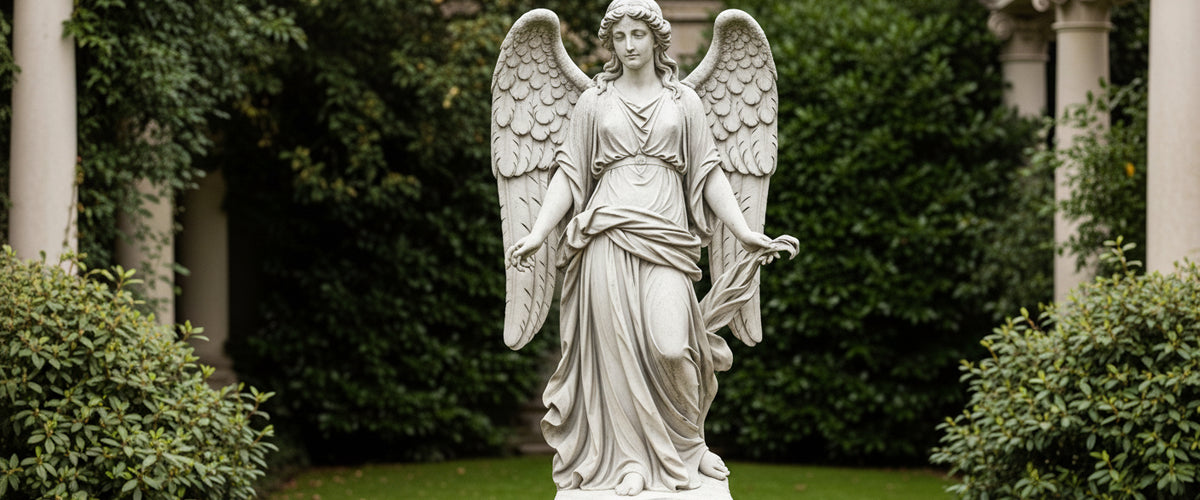

Most angel statues for garden settings fail for one reason: they were chosen on a screen, not measured against a real sightline. The piece arrives, the crate comes off, and suddenly the four-foot marble figure that looked commanding in a product photo reads like a tabletop ornament marooned in a half-acre lawn. Scale, sightline and backdrop decide whether an angel statue for garden use holds its space or apologises for it. The piece itself, however lovely, is the smaller half of the problem.
Looking for the full range in this category? Browse our Garden Statues collection for every available finish, size, and configuration of angel statues for garden buyers who want to compare like for like.
At Giant Sculptures we ship large carved marble and bronze angel statues for garden and estate settings into private gardens and commercial landscapes across the US, from Hamptons hedge gardens to Napa courtyards and Texas memorial estates. The article below is the placement conversation we have with clients before they commit to a piece, distilled into something you can use whether you are buying from us or anyone else.

Key Takeaways
Match the statue's height to the longest viewing distance, not the room it ships from.
Pedestals are a design decision, not an accessory. They change the entire read of the figure.
Outdoor angel sculptures need a backdrop that contrasts with white marble or patinated bronze, not competes with it.
Most placement mistakes are about negative space, not the sculpture itself.
For pieces over 4 ft (1.2 m), plan delivery access, footing and craning before you order.

What Angel Statues for Garden Settings Actually Look Like
An angel reads very differently in a 30 ft (9 m) formal allee than at the end of a courtyard fountain, and differently again tucked into a memorial garden under mature oaks. The same 5 ft 11 in (180 cm) carved marble figure can feel monumental, intimate or simply lost depending on what surrounds it.
In an open lawn with long sightlines (think a Connecticut estate or a Sonoma vineyard terrace), a single life-size or larger angel statue for garden anchoring can give the space a destination. Pieces calibrated to be read from 40 to 60 ft (12 to 18 m) away, rather than held in the hand, are what the space actually wants.
In a walled courtyard or a smaller California patio garden, the same figure becomes overpowering. Here a 2 ft 7 in (80 cm) carved cherub or seated child angel, set at eye level on a low plinth, often does more emotional work than a tall guardian figure. For exactly this kind of intimate setting, a smaller-scaled piece like the Child Garden Child Angel Marble Outdoor Sculpture - 80cm sits closer to the right proportion than scaling down a life-size figure.
For memorial gardens and chapel grounds, which we see often in Texas and the Midwest, a praying or weeping figure reads best when it has its own clearing. A 2 to 3 ft (60 to 90 cm) breathing ring of planting or gravel around the base lets the piece carry its meaning without competing with rose bushes or boxwood. This is one of the few cases where smaller angel statues for garden use beat tall ones outright.

Scale, Sightlines and Pedestal Height
The single most useful number when planning an angel garden statue is the longest sightline to the piece. Walk to where you will most often see it from (the kitchen window, the pool deck, the gate) and measure the distance. As a rough working rule from our studio, the total height of statue plus pedestal should be about one-twelfth to one-fifteenth of that primary viewing distance for the piece to read as intentional rather than incidental.
A 60 ft (18 m) view across a lawn wants somewhere between 4 ft (1.2 m) and 5 ft (1.5 m) of combined height. A 25 ft (7.5 m) courtyard view wants closer to 2 ft (60 cm). Buyers of angel statues for garden placement consistently underestimate this and end up replacing a piece within two years.
Pedestals are where good placement is made or broken. A carved marble figure sitting directly on lawn looks like it was dropped there. The same piece on a 24 in (60 cm) limestone or weathered brick plinth suddenly belongs. We typically recommend pedestal height between 18 and 36 in (45 to 90 cm) for life-size pieces, with the figure's eyeline meeting or just exceeding the viewer's. For a heavy standing piece like the Large Angel Marble Outdoor Sculpture, a low broad plinth tends to flatter the pose; a tall narrow column will make the same figure look unstable.
One commission lesson worth repeating: pedestals also raise the piece above ground splash, irrigation overspray and the worst of the freeze-thaw cycle, which materially extends the life of marble and limestone outdoors. The Smithsonian's guidance on outdoor sculpture conservation makes the same point about ground contact accelerating biological growth and salt damage (Smithsonian Museum Conservation Institute).

Indoor Versus Outdoor: When Each Wins
Plenty of clients ask whether a figure belongs in a foyer, an orangery, or out in weather. The honest answer is that the same piece behaves differently in each.
Indoors, marble angels read as crisp and high-contrast. White Carrara against a dark panelled wall in a Tribeca apartment can be exquisite, and the surface stays clean for decades with almost no intervention. Indoor pieces also let you commission finer detail (delicate fingers, lace edges, feather articulation) without worrying about frost spalling the highlights off in five winters.
Outdoors, the piece becomes part of the weather. Marble develops a slow, soft patina; bronze moves through honey browns to deeper greens depending on rain chemistry; Corten oxidises to a stable rust skin. A garden angel statue genuinely meant to live outside should be cut in close-grained marble (Bianco Carrara C or statuario grades), bronze, or cast stone designed for exterior use. Resin and gypsum composites that look the part in catalogue photos rarely survive a Northeast winter intact, which is why we steer buyers of angel statues for garden display away from them.

Light, Backdrop and Contrast
White marble disappears against a pale stucco wall and a bleached gravel path at midday. Angel statues for garden walls and lawns need a backdrop with tonal contrast: a clipped yew hedge, a copper beech, a slate wall, a dark pool. The same logic in reverse applies to bronze; a dark patinated figure needs a lighter ground to register from distance.
Direction of light matters as much as quantity. East-facing placements give you raking morning light that lifts every carved fold of drapery; south-facing placements at noon flatten the figure into a silhouette. We generally steer clients toward east or northeast orientations for marble pieces in the US Northeast and Midwest, and toward filtered or dappled positions in California and Texas where summer sun will otherwise wash out detail and heat the stone uncomfortably.
For evening reading, two low-wattage ground-level uplights at 30 to 45 degrees from the front, slightly offset, will model the figure properly. A single uplight directly below the chin makes any angel look like a Halloween prop.

Common Placement Mistakes We See in Commissions
For wider placement ideas, Decorating with Animal Garden Sculptures: A Buyer's Guide is useful companion reading before finalising the setting and sightlines.
Five patterns come up again and again on consultations involving angel statues for garden projects:
Centering on a path instead of terminating a view. These figures work as destinations, not speed bumps. Place them at the end of an axis, not halfway down it.
Undersized for the lawn. The most common email we get post-delivery is from buyers of garden statues angels who bought a 3 ft (90 cm) piece for a space that needed 5 ft (1.5 m). Bigger almost always reads better outdoors.
Over-planted bases. Roses, hydrangeas and ornamental grasses creeping up the plinth swallow the silhouette of garden angel statues. Keep a clean apron.
Wrong pose for the setting. An outstretched-wing guardian piece such as the Large Winged Angel Marble Outdoor Sculpture - 180cm, which sits firmly in the angel large garden statue category, needs lateral breathing room of at least 4 ft (1.2 m) clear on each side, while a praying figure can sit comfortably in a tighter niche.
No footing plan. A 180 cm marble piece weighs in the hundreds of pounds. Lawn alone will not hold it level through one wet winter. A concrete pad below the plinth, sized to the figure, is non-negotiable for any serious angel statue for garden installation.
Commissioning and Long-Term Ownership
For larger or more specific angel garden statues (a guardian figure sized to a particular niche, a memorial piece with personalised drapery or symbolism, a paired set flanking an entrance) commissioning is usually the better route than buying off-catalogue. Budget depends on material, scale, complexity, engineering and installation, so we quote per project rather than publish bands. If you want to talk through a specific garden, our angel statues collection is a good starting reference for proportions and finishes before we discuss a bespoke carve of angel statues for garden settings.
Long-term, the maintenance ask on a well-chosen outdoor marble angel statue for garden display is modest: a soft brush and clean water twice a year, an inspection of the plinth and footing after the first winter, and a gentle biocide treatment if biological growth takes hold on shaded faces. Pressure washing is the single fastest way to ruin a carved marble figure; avoid it. The American Institute for Conservation publishes sensible homeowner guidance on outdoor stone care that we recommend to clients (AIC).
Choose the scale honestly, give the piece a backdrop, put it on a proper plinth and a proper pad, and a marble or bronze angel statue for garden settings will outlive everyone reading this. That is the real argument for buying one well rather than buying one twice.