






































































































Marble cuts like firm cheese on a good day and fights you on a bad one. Granite never gives an inch, no matter how sharp the chisel. The stone sculpture materials a studio reaches for are not interchangeable, and the right choice of stone sculpture material depends on the subject, the setting, the budget for tooling time, and how long the piece needs to stand outdoors before anyone touches it again. This guide ranks the four workhorse stone sculpture materials a commissioning buyer is most likely to meet, then walks through tooling, weathering and subject pairing so you can brief a studio properly.
Looking for the full range in this category? Browse our Marble Sculptures & Statues collection for every available finish, size, and configuration.
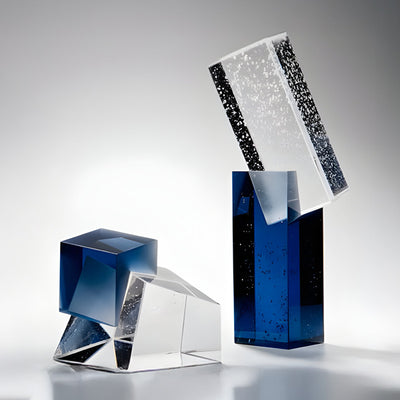
The four workhorse stone sculpture materials, shown as raw blocks before carving.

Key Takeaways
Marble reads best for figurative work and skin; it carves cleanly but stains and sugars outdoors over decades.
Limestone is the architectural choice among stone sculpture materials: warm, forgiving, slightly absorbent, often the right call for garden monuments and limestone carving.
Alabaster is an interior stone; translucent, soft, and ruined by rain. An alabaster sculpture belongs indoors.
Granite is the long-game material: brutal to carve, almost indifferent to weather, ideal for monumental and memorial work, which is why a granite sculpture often outlives the client who paid for it.
Subtractive stone carving (removing material) is not the only route. Many large stone pieces today are roughed out by CNC then hand-finished in the studio.

Marble, Limestone, Alabaster, Granite: A Working Ranking
If you asked ten classical carvers to rank the stone sculpture materials in front of them, most would put marble first for prestige, limestone first for value, alabaster first for intimate interior pieces, and granite first for anything that has to outlast its owner by several generations. The order shifts with the brief.
Marble is calcium carbonate, recrystallized under heat and pressure, with a Mohs hardness around 3 to 4. It takes a polish, holds fine detail, and lets light penetrate a millimeter or two below the surface, which is why a marble sculpture looks alive rather than mineral. Limestone is the sedimentary parent; softer, often fossiliferous, and warmer in color, and it accepts limestone carving with less resistance than any of the harder stones. Alabaster (gypsum or, more rarely, calcite) sits at Mohs 2, so soft a fingernail can mark it. Granite is an igneous beast at Mohs 6 to 7, full of quartz, feldspar and mica that blunt steel tools on contact.
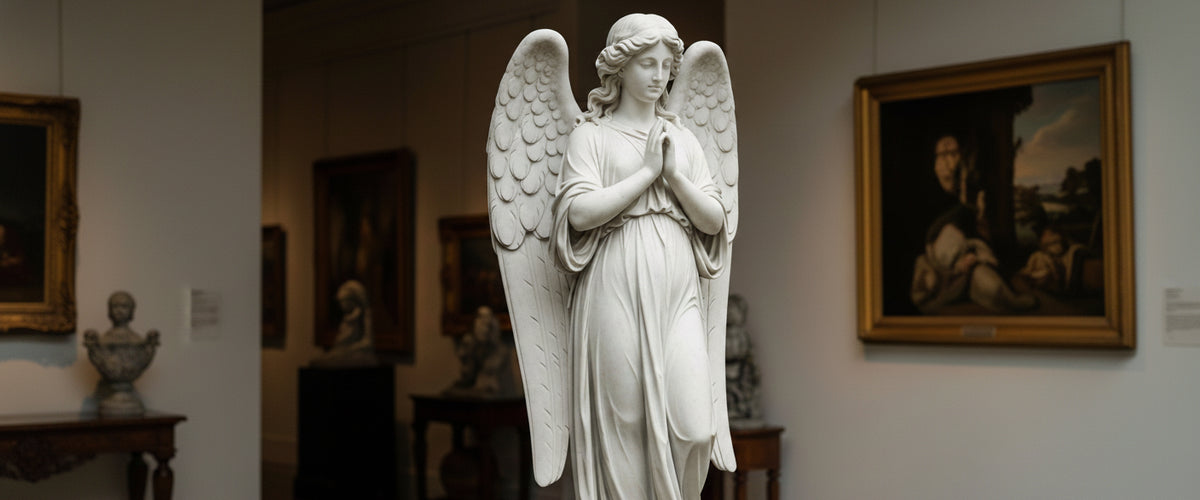
For a 4 ft (1.2 m) garden angel destined for a Napa estate, marble or a high-grade limestone is usually the right call. For a 7 ft (2.1 m) memorial figure on an exposed coastal site in the Hamptons, granite earns its keep as an outdoor stone sculpture. Where the commission calls for figurative warmth and a clearly devotional reading, a carved marble piece such as the Angel Headstone Marble Outdoor Sculpture is closer to the right design language than anything cast or cut in darker, harder stone.
Grain, Hardness and Translucency: What Each Stone Can Actually Do
Grain decides how fine the detail can go. Carrara marble has a tight, even crystal structure, which is why Michelangelo could carve veins on the back of a hand without the stone crumbling. Coarser marbles like Pentelic or some Portuguese varieties will fracture if you push fingertip detail too far. Limestone grain varies wildly: French Massangis is dense and reliable, while some American limestones are full of shell fragments that pluck out under the chisel and leave pits.
Hardness sets the tooling budget. Doubling a stone's hardness does not double the carving time; it can quadruple it. A figure that takes 400 studio hours in Carrara marble might take 1,500 in granite, and the tools used are different at every stage. That cost differential is the single biggest reason a granite sculpture tends to be simpler in form than marble work.
Translucency is the marble secret. Hold a slab of good Carrara to the light and you will see a faint glow about 1/8 in (3 mm) deep. That sub-surface scatter is what gives carved skin its softness. Limestone is opaque. Alabaster is the opposite extreme: a thin alabaster panel will glow like a lampshade, which is why it was the favored stone for medieval altar lighting and is still used for translucent interior pieces today.
Quarry Origin: Why Carrara Still Wins Certain Commissions
Stone is geography. Carrara, in the Apuan Alps, has been quarried continuously for over two thousand years, and the upper beds still produce statuario blocks with the tight white crystal structure carvers want for figurative work. The Getty Conservation Institute has documented how quarry bed matters as much as quarry name: two blocks cut a hundred yards apart can behave very differently under the chisel.
Pentelic marble from Attica reads slightly warmer and was the stone of the Parthenon. Thassos from northern Greece is the whitest white you can buy and almost sugar-bright in sunlight. Portuguese Estremoz is a strong commercial alternative for larger blocks. For limestone, French Burgundy stones (Massangis, Buxy) and Indiana limestone from the US Midwest are the two benchmarks for large architectural work. For granite, the Nordic quarries (Swedish Bohus, Finnish Baltic Brown) and Indian Galaxy black are reliable for monumental commissions.
For buyers comparing stone sculpture materials, quarry origin matters for three reasons: color consistency across blocks, predictable weathering, and provenance documentation if the piece is ever resold or appraised. A studio that cannot tell you the quarry is a studio cutting corners.
Tooling: What Soft Stone Forgives and Hard Stone Punishes
Alabaster forgives almost everything. You can rough it with a rasp, refine it with sandpaper, and finish it with a damp cloth. A misjudged cut can usually be blended back, which is part of why an alabaster sculpture is often the first commission a new carver takes on. Limestone is similarly forgiving; mistakes get sponged smooth and the stone reads as deliberately textured.
Marble punishes carelessness. A wrong angle on a point chisel can pop a chip half an inch deep into a face you were two days from finishing. There is no glueing it back invisibly. Carvers working a marble sculpture move slowly on purpose, often switching to claw chisels and rifflers a long time before the eye thinks the form is ready.
Granite punishes everything. You do not carve granite with a hammer and chisel in any meaningful production sense; you use carbide tooling, pneumatic hammers, diamond saws, and increasingly, robotic roughing. The romantic idea that an artist creates a sculpture by taking away material, chip by chip, is still true in spirit but the tools have changed. Most modern granite commissions are blocked out by machine and hand-finished for the final 15 percent. That final 15 percent is where the studio earns its fee.
Different stone sculpture materials demand entirely different tool kits, from soft alabaster rasps to carbide for granite.
Weathering: Twenty Years Outdoors
Indoors, all four stone sculpture materials are stable. Outdoors, they diverge fast. Marble sugars, which is the carver's term for surface crystals loosening under freeze-thaw and acid rain. After twenty years in a wet climate, fine marble detail softens visibly. Polish dulls in five to ten. The US National Park Service technical guidance on stone statuary covers the chemistry in useful detail for anyone planning a long-term outdoor stone sculpture.
Limestone weathers more gracefully because it is supposed to. It develops a patina, darkens in sheltered hollows, and lightens on rain-washed surfaces, which actually accentuates carved form. A well-cut limestone garden figure can look better at year thirty than at year one.
Alabaster does not survive outdoors. Rain dissolves it. Keep it inside, away from direct sun and damp walls.
Granite is essentially inert. It will hold a polish for a century with occasional cleaning, which is why memorial work and civic monuments default to it. For a long-horizon outdoor placement where the silhouette needs to read the same in 2040 as it does on installation day, a dense dark-stone form like the Black Stone Bear Sculpture - 135cm makes more sense than a softer marble figure that will visibly soften in detail over the same period.
Matching Stone to Subject: Figure, Abstract, Monument
Figurative work, especially the human body, wants marble or fine limestone. Skin, drapery, hair: all of these depend on subtle tonal shift and crisp undercut, and a marble sculpture in good Carrara marble delivers both. Students often ask about the original material of the Minute Man sculpture by Daniel Chester French, expecting stone; in fact the Minute Man sculpture by Daniel Chester French original material was bronze, cast from a plaster model rather than carved. The Minute Man sculpture by Daniel Chester French original intended material was also bronze from the start, because granite would have been too unforgiving for the action pose and marble would not have lasted outdoors in New England weather. The lesson holds: match material to setting and pose, not to prestige.
Abstract work has more freedom. Smooth biomorphic forms suit alabaster indoors and polished granite outdoors. Sharp geometric work suits limestone or honed granite. The materials of sculpture by Nicholas Penny, published by Yale, remains the best single reference on how material choice has historically driven sculptural style. Readers searching for the materials of sculpture by Nicholas Penny free online will find substantial Google Books previews and university library copies, but no legitimate full free edition; even so, it is worth tracking down before commissioning a serious piece.
Monuments and memorials default to a granite sculpture for longevity and to marble where the brief demands warmth and figurative reading. For garden ornaments in the classical and Asian traditions, harder volcanic and granitic stones do the work; a carved lantern such as the Japanese Pagoda Stone Lantern - 80cm shows why that material choice has stayed consistent for centuries, since the form needs to read clearly through moss, frost and decades of weather without losing its outline.
Buyer Checklist Before Commissioning
Site survey first. Indoor, sheltered outdoor, or fully exposed? This eliminates two stone sculpture materials before you even start.
Confirm quarry, not just stone type. "Marble" is not specific enough. "Statuario from Carrara, upper bed" is.
Ask how much is hand-finished. CNC roughing is normal and fine. The question is what happens after. Remember that an artist creates a sculpture by taking away material in the carving tradition, so the subtractive hours after the machine work are where character emerges.
Plan the base and fixing. A 5 ft (1.5 m) granite figure can weigh 1,500 lb (680 kg) or more. Concrete pad, dowel pins, and crane access need to be agreed before carving starts.
Budget realistically. Stone, scale, complexity, engineering, transport and installation all drive cost. We quote per commission rather than per material because the variables are too entangled to price generically.
Plan for cleaning. Marble wants pH-neutral wash every few years. Granite tolerates more. Limestone wants soft brushing only.
Giant Sculptures works with clients across the US and internationally on bespoke commissions in all four stone sculpture materials, from marble memorial figures to large granite garden pieces. If you have a site, a subject, and a rough sense of scale, that is enough for us to start a serious conversation about which stone is actually right for the work.
For wider placement ideas, What Is a Figurative Marble Sculpture? a Collector's Guide to Form, Stone and Placement is useful companion reading before finalising the setting and sightlines.