






































































































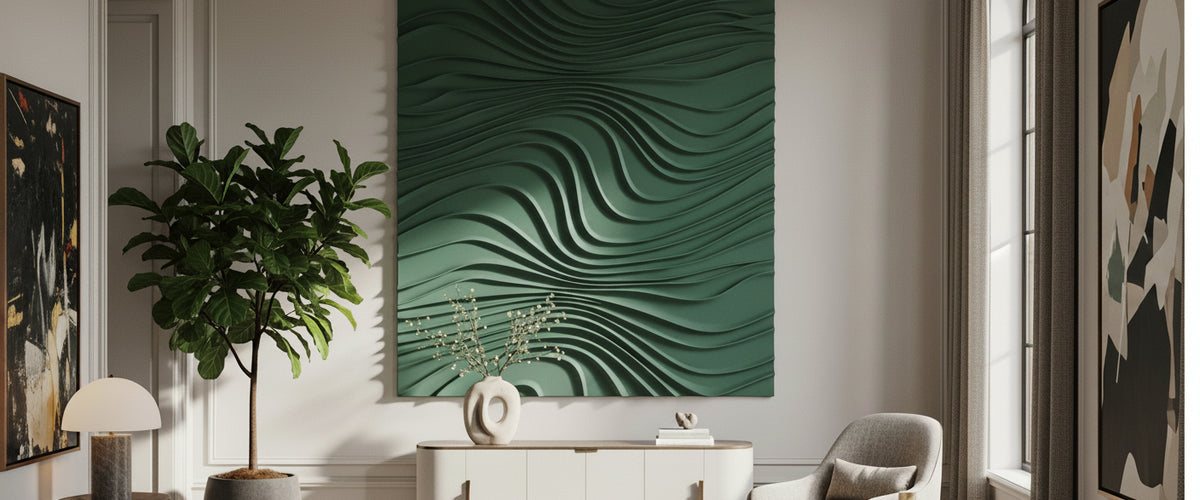

Most offices get wall art wrong by buying too small, too safe, and too late in the fit-out. A 24-inch canvas floating above a 12-foot reception desk reads like an afterthought, and clients pick up on it before they sit down. Good office wall art is sized to the architecture, chosen for the light it has to live in, and selected before the furniture order goes in. Done well, it sets the tone of every meeting that happens in front of it.
This guide is written for the people actually signing off the purchase: founders furnishing a new HQ in Austin or Manhattan, design firms specifying for a client in San Francisco, hotel groups dressing executive floors, and private offices in homes from the Hamptons to Napa. We make large-scale and bespoke pieces at Giant Sculptures, so the advice here leans toward statement work that holds a room rather than decorative filler.

At a Glance: Office Wall Art Decisions That Matter
- Scale first. The piece should cover roughly two-thirds of the wall behind a desk, sofa, or boardroom table.
- Material decides longevity. Wood, metal, and resin-faced relief all age differently under HVAC, sunlight, and cleaning crews.
- Light it on purpose. Most office ceilings have flat downlights. Plan accent lighting before the art arrives, not after.
- Commission when stock falls short. Bespoke is the right call for non-standard wall widths, brand color matching, or pieces over 8 feet (2.4 m).
- Budget covers more than the object. Crating, freight, install, and hanging hardware are line items, not afterthoughts.

What Office Wall Art Really Means in a Working Space
Office wall art covers everything from framed prints and photography to three-dimensional reliefs, sculpted panels, and full bespoke installations. In a corporate context the function is layered. The piece has to look considered on a Tuesday morning conference call, photograph well for press, survive a cleaning rota, and still feel current three or four years in. That is a heavier brief than residential art and it is why so many offices end up with bland wall art for office walls that the staff stop noticing within a week.
The buyers who get the best results treat art as part of the architecture. They commission or specify alongside the joinery, not after the desks land. That is also how Don Draper office art works in Mad Men, for what it is worth: the Rothko on the wall is plotted into the office before the scene plays out around it. Same logic applies in a real fit-out.

How to Compare Office Wall Art Options Before Buying
Start with the wall, not the piece. Measure the full width and height of the wall, then mark out the furniture in front of it. A boardroom credenza, a reception desk, a lounge sofa: each one sets a different anchor line. Your art should sit centered on that anchor, with breathing room above the furniture and below the ceiling line.
Next, sort candidates against four practical criteria:
- Visual weight. Dense, high-contrast work reads from a distance. Soft tonal work needs closer viewing range and better light.
- Depth. Flat framed work is easy but quiet. Three-dimensional reliefs throw shadow and read as architecture, which is often what an office needs.
- Brand alignment. A law firm's reception and a software company's lounge call for different visual registers. Be honest about which you are.
- Maintenance load. Polished metal shows fingerprints. Open-grain wood collects dust. Moss panels need humidity control. Match the piece to who will look after it.

Materials, Finishes and Scale for Wall Art for Office Interiors
Material choice is where most office art projects either land well or quietly disappoint. The four categories worth knowing:
Wood and Wood-Framed Relief
Warm, tactile, and forgiving under variable office lighting. Carved or layered wood pieces give shadow play without feeling industrial. Where the brief calls for something that sits between joinery and art, a register that suits law, finance, and family-office interiors, a wood-framed sculpted surface like the Vanterra I Black & White Flow Framed 3D Wall Art is closer to the right language than a flat canvas. Browse more options in our wood wall art collection.
Metal and Mixed Metal
Stainless steel, brushed aluminum, and powder-coated steel hold up to commercial cleaning and read well under cooler office lighting. Metal pieces tend to photograph crisply, which matters if your reception is going to appear in press, recruitment material, or investor decks. Our metal wall art collection covers most of the range.
Sculpted Composite Relief
For wider placement ideas, Office Art Psychology: How Wall Decor Affects Productivity is useful companion reading before finalising the setting and sightlines.
Resin-faced and composite reliefs let us produce pieces that would be impossible to carve at the same scale in solid material. They take color cleanly, which is why a single form often exists across a tonal range. The Vaultis archway series is a useful illustration: the Vaultis Ivory & Sand Archway 3D Wall Art With Metal Balls reading classical and calm in a law-firm reception, where the same shape in Vaultis Teal & Sand Archway 3D Wall Art With Metal Balls shifts the room toward a coastal hospitality register without changing the underlying piece. For a boardroom-scale anchor in a contour-led organic language rather than an archway, a sculpted panel such as the Terracore Deep Green Contour Relief Abstract 3D Wall Art carries enough physical depth to hold its own under standard ceiling downlights.
Botanical and Moss Panels
Preserved moss and botanical wall art has become a fixture of wellness-led office design. Preserved (not living) moss is the practical choice for most offices, since it does not need watering and behaves predictably in air-conditioned environments.
On scale: for reception walls, plan a piece between 5 and 8 feet (1.5 to 2.4 m) wide. For boardrooms, match the length of the table or credenza. For private offices, aim for two-thirds of the wall behind the desk. Under-scaling is the single most common mistake we see.

Where to Place Office Wall Art for Maximum Impact
Placement is a decision, not a default. The strongest positions for office wall art, in order:
- The wall directly behind reception. First impression, photographed constantly, and visible from the elevator lobby.
- The boardroom feature wall. Behind the head of the table or opposite the screen wall, never both.
- The corridor terminus. A long corridor that ends on a piece of art reads as intentional. A corridor that ends on a fire extinguisher reads as a building.
- Executive office, desk-facing wall. The wall the occupant sees during work, not the one behind their head.
- Breakout and lounge zones. Where staff and visitors linger, and where inspirational wall art for office settings genuinely earns its name.
Lighting matters more than people expect. Cool 4000K downlights flatten warm-toned wood and over-saturate pure white finishes. If you cannot change the ceiling lighting, choose work that reads well under cool light: cooler grays, blues, and metal finishes. If you can specify lighting, add a warm 2700K to 3000K wall washer or picture light positioned 12 to 18 inches (30 to 45 cm) off the wall.

Budget, Commissioning and Delivery for Art in Offices
Budget for office art depends on material, scale, complexity, engineering, crating, and installation, so any honest answer comes through a tailored quote rather than a number on a webpage. What we can say is what drives the figure up or down: overall size, the depth of three-dimensional relief, color matching to brand standards, custom mounting hardware for steel or concrete walls, and freight to anywhere outside metro hubs.
On the US tax question, art purchased for a business premises is generally treated differently from art purchased as personal property, and rules around depreciation and deduction shift by jurisdiction and by whether the work is considered a fixed asset or decoration. Talk to your accountant before assuming you can write off art for your office; the IRS depreciation guidance is the right starting point for US-based buyers.
Commissioning is the route to take when stock pieces will not work. Typical reasons we open a bespoke project: a wall that is 14 feet (4.3 m) wide and has no off-the-shelf piece that fills it, a brand palette that needs to be matched exactly, a logo or motif that has to be integrated without looking corporate, or a multi-site rollout where one design needs to scale across several offices. We have shipped commissioned reliefs into corporate lobbies in New York, private offices in Dallas, and members' clubs in London, and the projects that go smoothest are the ones briefed at the architectural drawing stage.
How Giant Sculptures Approaches Bespoke Office Art
We work with designers, architects, and direct clients on bespoke wall art and sculpture for offices, hospitality, and private interiors. The studio handles design development, material selection, finishing, crating, and freight, and we coordinate with installers in most US cities. For pieces over roughly 6 feet (1.8 m) we recommend a specialist install rather than a general handyman; the wall fixings, the lifting method, and the leveling all matter on work that size.
If you are early in a project, start with the office art collection and the broader 3D wall art range to set a visual direction, then come to us with the wall dimensions, the lighting, and a sense of the brand register. From there we can either point you at stock or open a commission.
Office Wall Art Buyer Checklist
- Wall measured, with furniture anchor lines marked.
- Lighting type and color temperature confirmed.
- Material chosen against cleaning and HVAC realities.
- Scale set to roughly two-thirds of the host wall or feature.
- Lead time confirmed against fit-out program, not move-in date.
- Installation method and fixings specified before delivery.
- Accountant consulted on tax treatment if relevant.
Get those seven right and the piece on the wall will do its job for years, not weeks.
For general conservation principles, V&A sculpture techniques is a useful external reference, though the final care routine should always follow the material and finish specified for the individual commission.