































































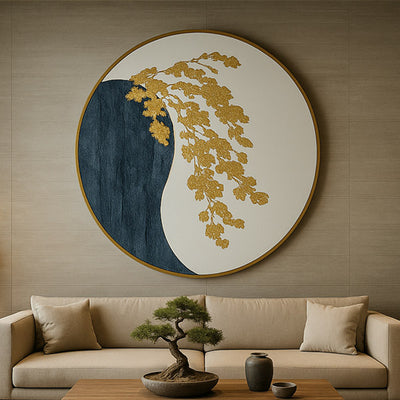



























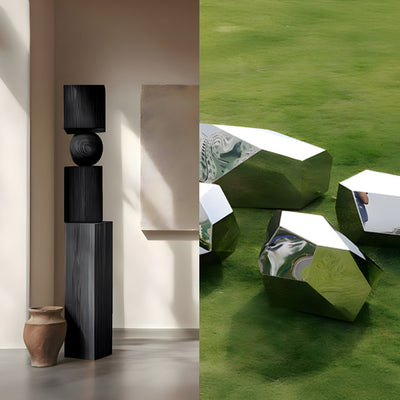


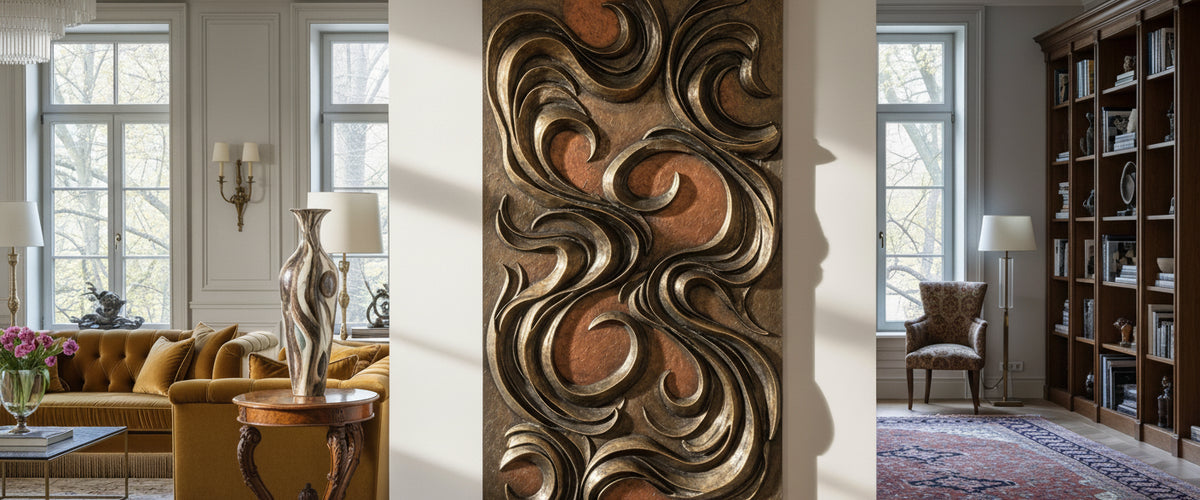

Walk into most great rooms in California, a double-height loft in Tribeca, or a hillside build in Aspen, and the wall behind the sofa is usually the problem. It's vast, blank, and quietly humiliating the small canvas someone hung at eye level. This is exactly where metal wall art earns its keep. Done well, it carries scale, light, and texture in a way paint and print simply cannot. Done badly, it looks like an airport gift shop. This guide is about the difference.

Key takeaways before you buy
- Scale first. Metal wall art decor should occupy roughly two-thirds of the wall or furniture line beneath it. Smaller looks accidental.
- Finish drives mood. Brushed and polished read modern, patinated reads collected, painted reads graphic.
- Indoor and outdoor are different products. Corten, marine-grade stainless and properly powder-coated steel belong outside. Decorative interior pieces usually don't.
- Fixings are not an afterthought. A large metal wall art panel needs studs, masonry anchors, or a French cleat rated well above the piece's weight.
- Bespoke beats compromise. If the wall is unusual, commission the piece to fit it rather than forcing a stock size.

Why metal wall art reads better than canvas at scale
Canvas and print flatten as they get bigger. The eye registers a rectangle, then loses interest. Metal does the opposite. Because it catches and bounces light across its surface, a large metal wall art piece changes throughout the day, the same way a bronze sculpture does in a courtyard. Morning light raises the texture, evening lamplight pools in the recesses, and the piece never quite looks the same twice.
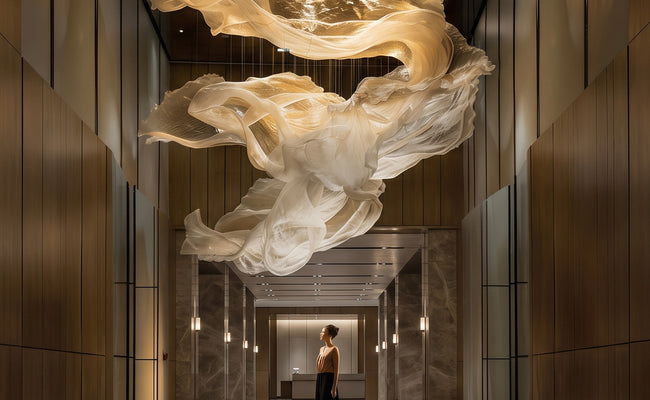
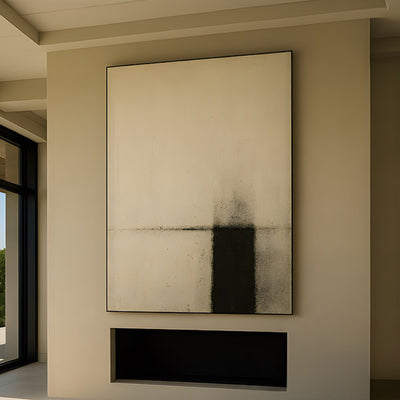
That shifting quality is why metal works so well on tall ceiling wall decor problems, the 14 to 20 ft (4.3 to 6.1 m) walls that defeat almost everything else. A flat print at that height looks like a postage stamp. A sculpted, layered metal panel reads as architecture. It is closer in spirit to a wall-mounted sculpture than to a picture.

Brushed, polished, patinated, painted: what each finish does to a room
Finish is the single biggest decision after size. Get it wrong and the piece fights the room.
- Brushed stainless or aluminum. Quiet, directional, modern. Sits beautifully against pale plaster and warm timber. Forgiving in bright daylight because it diffuses reflections.
- Polished or mirror-finished metal. High drama, high maintenance. Best in controlled interiors where fingerprints and dust can be managed. Striking above a console in an entry hall.
- Patinated and oxidized. Bronze patinas, blackened steel, oil-rubbed surfaces. These age beautifully and pair naturally with stone, leather, and collected art. The right choice for a collector's house.
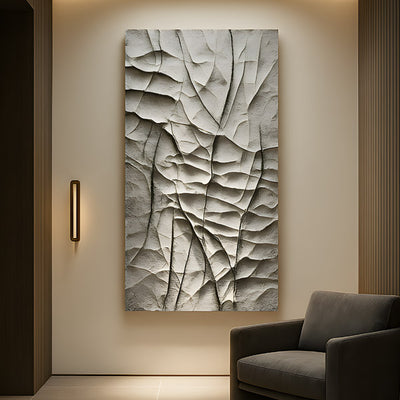
- Painted and metallic-flow finishes. Layered pigments over sculpted metal give you the depth of metal with the color story of a painting. Where a room already carries strong stone or warm timber and needs a focal piece to tie it together, a deep patinated panel like the Metallura Bronze Metallic Flow Abstract 3D Wall Art reads warmer than a brushed stainless equivalent and sits more comfortably alongside leather and oak.
- Corten and weathered steel. An outdoor language. Rust-stabilized, sculptural, and entirely happy in rain.
If the architecture is loud, choose a quieter finish and let scale do the work. Where the architecture is restrained and the wall needs the artwork to do the heavy lifting, a heavily textured, geological surface such as the Terranica Metallic Crust Textured Abstract Metal Wall Art carries a room more convincingly than a smoother, flatter panel of the same dimensions.

Indoor vs outdoor metal pieces
This is where most buyers go wrong. Interior abstract metal wall art is generally made with thin gauge metals, decorative paints, and adhesives that were never designed for UV, salt air, or freeze-thaw cycles. Hang it on a covered loggia in Napa and it might survive a season. Hang it on an exposed wall in the Hamptons and it will not.
For genuine outdoor metal wall art and large exterior metal wall art, you want one of three things: Corten steel that is allowed to develop its protective oxide layer, marine-grade 316 stainless that resists chloride pitting, or steel and aluminum finished with an architectural powder coat applied over a properly prepared substrate. The American Institute for Conservation has good general guidance on outdoor metals and the realities of weathering, worth reading before you commit to a coastal install (see culturalheritage.org).
For exterior metal wall art on a serious scale, most of our clients commission. Stock sizes rarely suit a specific elevation, and the engineering for wind load on a large panel matters. The Outdoor Wall Art & Decor collection is a useful place to settle on a visual language before scoping a bespoke version sized to the wall.
Sizing for the wall you actually have
Photographers shoot wall art with a wide lens and clever staging. The piece always looks larger online than it will in your room. Measure properly before you fall in love.
- Measure the full wall width and height in feet and inches.
- Identify the anchor line: the top of a sofa, console, fireplace, or headboard.
- The piece should cover roughly 60 to 75 percent of that anchor's width.
- The bottom of the artwork should sit 6 to 12 in (15 to 30 cm) above the anchor.
- On a tall wall with no furniture below, center the piece on the visual mid-line of the room, not the geometric center of the wall.
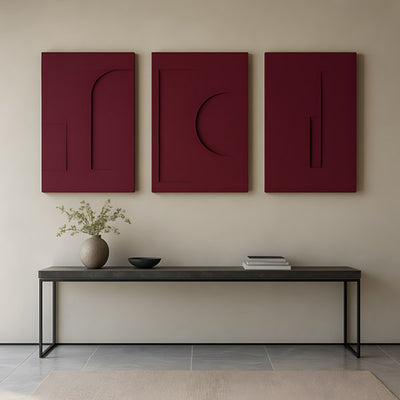
For double-height spaces, think in terms of vertical mass. A single tall composition usually beats a grid. On a narrower stair wall where a horizontal rectangle would feel squeezed, a vertically oriented disc composition like the Aurivista Blue & Silver Abstract Circle Panel 3D Metal Wall Art holds the vertical axis without crowding the flanking walls.
Hanging heavy metal: fixings, studs, and a panic-free install
How to hang metal wall art depends almost entirely on two things: weight and wall type. Anything over about 20 lb (9 kg) should not be trusted to a single drywall anchor.
- Drywall with studs. Locate studs with a quality detector. Drive lag screws or heavy-duty anchors into the studs themselves. A French cleat spanning two studs is the cleanest solution for large pieces.
- Masonry, brick, or concrete. Use sleeve anchors or rated masonry bolts. Pre-drill with a hammer drill and the correct bit. Do not use plastic plugs for heavy metal.
- Plaster over lath. Treat as fragile. Spread the load with a timber batten screwed through to studs, then mount the cleat on the batten.
- Exterior masonry. Use stainless fixings only. Galvanized will streak the wall over time.
Always over-spec the fixing rating. If the piece weighs 40 lb (18 kg), hang it from fixings rated for at least 120 lb (54 kg). For very large or sculpted panels, two installers and a laser level are not optional. If you are asking how do you hang metal wall art at 12 ft (3.7 m) up a stairwell, the honest answer is: hire a professional installer, and ask the supplier for the exact hanging hardware and back-of-piece diagram before you order.
Pairing metal wall art with sculpture, lighting, and timber
The strongest interiors treat wall art metal wall art compositions as part of a sculptural family rather than as a standalone picture. A few principles that consistently work:
- Echo the finish, not the form. A bronze-patinated wall piece pairs well with a bronze figurative sculpture across the room. Repeating the material reads intentional. Repeating the shape reads matchy.
- Light it deliberately. Sculpted metal needs raking light to reveal its texture. A picture light is rarely enough. Consider a recessed wall washer or an adjustable spot set at a steep angle.
- Warm it with timber. White oak, walnut, and reclaimed beams soften the coolness of stainless and aluminum. Useful in modern builds that risk feeling clinical.
- Give it negative space. A large metal wall art panel needs breathing room. Resist the urge to flank it with sconces, shelves, and accessories.
For collectors building a coherent scheme, it is worth looking at the full Metal Wall Art and Wall Sculptures collections side by side. The dialog between a flat-mounted panel and a dimensional wall sculpture is often what makes a room feel curated rather than decorated.
When to commission rather than buy off the shelf
Commission a bespoke piece when the wall is genuinely unusual, when the room demands a specific palette, or when you want the work to relate to other sculpture you already own. Budget for bespoke depends on material, scale, complexity, engineering, finish, and installation, so rather than quote ranges that mean nothing, we prefer to scope the project and return a tailored figure. As a bespoke sculpture supplier, Giant Sculptures handles the engineering and finishing as part of the commission, which matters when a piece needs to survive a Texas summer or a Lake Tahoe winter.
A short pre-purchase checklist
- Measured the wall and marked the proposed footprint in painter's tape.
- Confirmed indoor or outdoor rating with the supplier in writing.
- Identified the wall substrate and chosen the correct fixings.
- Planned the lighting before, not after, install.
- Asked about lead time, crating, and on-site installation support.
Get those five right and a serious metal wall art piece will outlast the sofa, the rug, the paint scheme, and probably the next renovation too.
For wider placement ideas, Metallic Marvels: Abstract Sculptures That Shine in Gold and Silver is useful companion reading before finalising the setting and sightlines.
For general conservation principles, Canadian Conservation Institute outdoor object care is a useful external reference, though the final care routine should always follow the material and finish specified for the individual commission.