





































































































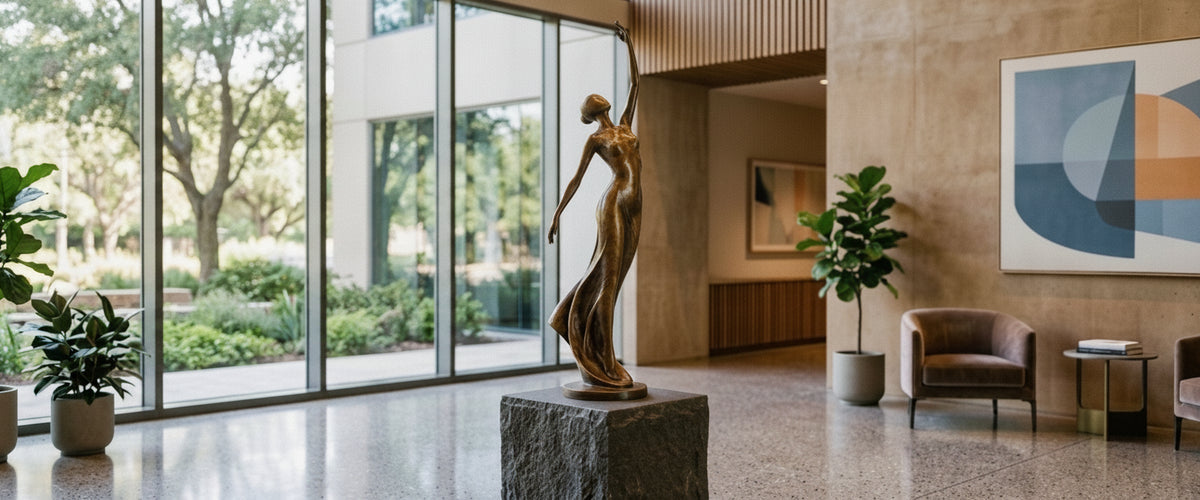

A blank reception wall and a lobby corner that swallows every plant you put in it are quietly telling visitors something about your business, and it is rarely flattering. Office sculptures change that conversation. Get the piece right and it reads as confidence and longevity before anyone shakes a hand. Get it wrong and you have an expensive coat stand. This guide is for the people making that call: facilities directors, design leads, founders furnishing a first proper headquarters, and collectors who want the boardroom to look like the boardroom of a company that plans to be here in fifty years.
We ship large-scale and bespoke work to commercial spaces across the US, from tech campuses in California to law offices in NYC, and the same questions come up every time. What material survives a busy lobby? How big is too big? Where does it actually go? Let us work through it.
A reception piece placed on the primary sightline from the entrance.

Key Takeaways for Choosing Office Sculptures
Match the piece to the room's job. Reception wants presence; a boardroom wants restraint; a desk wants a small, considered object.
Material drives longevity and mood. Bronze and stainless steel handle high-traffic interiors for decades with light care.
Scale is the most common mistake. People buy too small far more often than too large.
Placement beats price. A modest piece on the right sightline outperforms a grand one hidden in a corner.
Bespoke is worth it when brand identity, exact dimensions, or a specific narrative matter.

What Office Sculptures Mean, and Who They Suit
Office sculptures cover a wide span, from a monumental bronze anchoring an atrium to a small cast figure sitting on a founder's desk. The category is less about one object type and more about intent: sculpture chosen to shape how a workplace feels and how it is read by clients, staff, and anyone passing through the glass.
They suit businesses that treat their space as part of their reputation. A private equity office in Texas, a design studio, a hotel group, a law firm that wants gravitas without another oil portrait. The common thread is a desire for something with weight, literal and figurative, that will not date the way a trend-led furniture choice does. If your interior is likely to be rethought in three years, a sculpture is one of the few elements that can survive the redesign and still belong.
How to Compare Office Sculptures Before You Buy
Start with the room's job, not the object you like on a screen. A reception needs a piece that holds a sightline from the front door. A boardroom needs something that reads well over long meetings without stealing focus from the table. A corridor or breakout space can take something playful.
Then run each candidate through four filters:
Sightline. Where will people first see it, and from how far? A piece meant to be read at forty feet needs different mass than one viewed at arm's length.
Traffic and touch. Will people brush past it, lean on it, photograph next to it? That rules some finishes out fast.
Maintenance appetite. Be honest about who cleans it and how often. Polished stainless shows fingerprints; patinated bronze forgives them.
Narrative fit. Does the subject say something true about the business, or is it decoration for its own sake? Both are valid, but know which you are buying.
A quick studio lesson: the client who agonizes over form and ignores the sightline almost always calls back to say the piece looks smaller than expected. Nine times out of ten it was placed off the main axis. The sculpture was fine. The position was the problem.
Materials, Finishes, and Scale Decisions
Material is where mood and longevity are decided together. For office interiors, the reliable workhorses are bronze and stainless steel.
Bronze is the classic choice for a reason. It carries authority, takes fine detail, and a patinated surface hides the wear that a busy building inflicts. Bronze has been used for durable public and civic work for millennia, and conservation guidance from institutions like the Getty Conservation Institute reflects how stable it is when looked after. For a firm that wants a figurative or narrative piece with a sense of history, bronze rarely disappoints.
Stainless steel reads modern and clean, and mirror-polished work throws light around an atrium beautifully. The trade-off is fingerprints and the need for regular wiping in high-touch zones. Brushed or satin finishes are more forgiving and still feel contemporary. If your brand language is minimal and architectural, stainless usually wins.
Stone and marble bring quiet permanence and suit boardrooms and executive floors where you want calm, not sparkle. They are heavier, which matters for upper-floor placement and loading.
On scale, the honest rule is that offices under-buy. A piece that looks large in a photographer's studio can vanish in a double-height lobby. As a rough starting point, a floor-standing reception piece often needs to reach at least chest to head height on an average adult to hold its own, and monumental atrium work runs far beyond that. Where a company has a genuine double-height atrium and the ambition to match, a full-height bronze such as the Monumental Classical Military Officer Riding Horse Bronze Sculpture - 350cm (roughly 11.5 feet) is the sort of anchor that reads from every level; drop the same form into a standard-height reception and it fights the room. Measure the ceiling, the sightline distance, and the floor footprint before you fall for anything.
Monumental work reads from multiple levels in a genuine double-height atrium.
At the other end sits the office desk sculpture: a small, resolved object that a founder or partner lives with daily. Here, detail and finish matter more than mass, and a single well-cast piece beats a shelf of ornaments. A considered desk sculpture is one of the few personal signals people notice in a video call without you saying a word.
Where to Place Office Sculptures for the Strongest Impact
For wider placement ideas, Inspirational Wall Art for Office Walls: What Sculptors Weigh Before They Say Yes is useful companion reading before finalising the setting and sightlines.
Placement is the cheapest upgrade you will ever make. The same piece can look commanding or apologetic depending on where it lands.
Reception and lobby. Put the piece on the primary sightline from the entrance, not tucked beside the desk. Give it breathing room; a sculpture crowded by furniture reads as clutter. Raised plinths help small-to-medium work compete with tall ceilings.
Boardroom. Choose restraint. A sculpture here should reward a long second look during a slow meeting, not dominate the first glance. Off to one side, catching side light, tends to work better than dead center.
Atrium and stairwell. These take scale and reward pieces read from multiple levels. A form that changes as you climb the stairs earns its keep, which is exactly where a monumental equestrian bronze like the 350cm military officer on horseback comes into its own rather than in a low-ceilinged room.
Executive office and desk. Smaller and more personal. This is where a compact figurative bronze or a small abstract works, chosen because the owner actually likes it, not because a designer specified it.
Outdoor courtyards and entrances. If your campus has a forecourt, weathering steel (Corten) and bronze both suit exterior life and shift the whole first impression of arrival.
Budget, Commissioning, and Delivery
There is no honest flat price for office sculpture, and anyone quoting one blind is guessing. Cost tracks material, scale, complexity of form, engineering (especially for tall or cantilevered work), finishing, and installation. A polished stainless piece with an internal armature and a mirror finish is a different job from a modest patinated bust. The sensible move is to describe your space, sightlines, and intent, then request a tailored quote so the number reflects the actual piece rather than a catalog average.
A few things that reliably affect budget and timeline:
Engineering and fixing. Anything tall or top-heavy needs proper base and floor-loading calculations, particularly above ground level.
Access. Lobbies with revolving doors, tight lift shafts, or mezzanine placement change the logistics and sometimes the fabrication approach.
Finish specification. Custom patina colors and high-polish mirror work add hand-finishing hours.
Lead time. Bespoke commissions take real time; original casting and fabrication are not off-the-shelf. Plan around your fit-out schedule, not the other way around.
How Giant Sculptures Helps With Bespoke Office Projects
Most of the office work we ship is not picked off a page; it is shaped to a specific reception, atrium, or executive floor. As a supplier of large-scale and bespoke sculpture, Giant Sculptures works from your brief: the sightlines, the ceiling height, the brand story you want the piece to carry, and the practical constraints of getting it through the door and fixing it safely.
That covers scaling an existing form up or down to suit your space, developing an original design around a brand narrative, choosing between bronze, stainless steel, stone, or weathering steel for the environment, and coordinating the engineering and installation so the finished piece stands exactly as intended. If you are furnishing a headquarters and want one anchor piece that still looks right in a decade, that is the conversation to start with a quote request and a photo or plan of the space.
Frequently Asked Questions
Is there a Frederick Remington sculpture in the Oval Office? A Remington bronze, most often The Bronco Buster, has been displayed in the Oval Office under several administrations, though what sits there changes with each president's choices. It is a good example of how one figurative bronze can define the character of a working room; the same principle applies to a boardroom or reception.
What is the face sculpture in the Perry Mason office? Set-dressing pieces in film and television are usually chosen by a production's art department rather than being a single famous named work, so there is no reliable canonical answer. The takeaway for real offices is more useful: a single strong face or bust on a sideline shelf can carry a room's whole mood, which is why executives often choose one resolved desk or credenza piece over a scatter of smaller objects.
What is the best material for an office lobby sculpture? For high-traffic interiors, bronze and stainless steel are the safest long-term bets. Bronze suits figurative and traditional briefs; stainless suits clean, modern spaces. Both handle years of public exposure with light maintenance.
How big should an office sculpture be? Bigger than you think, in most lobbies. Measure the sightline distance and ceiling height first. Floor-standing reception pieces usually need real vertical presence to hold the space, while desk pieces are chosen for detail rather than scale.