





































































































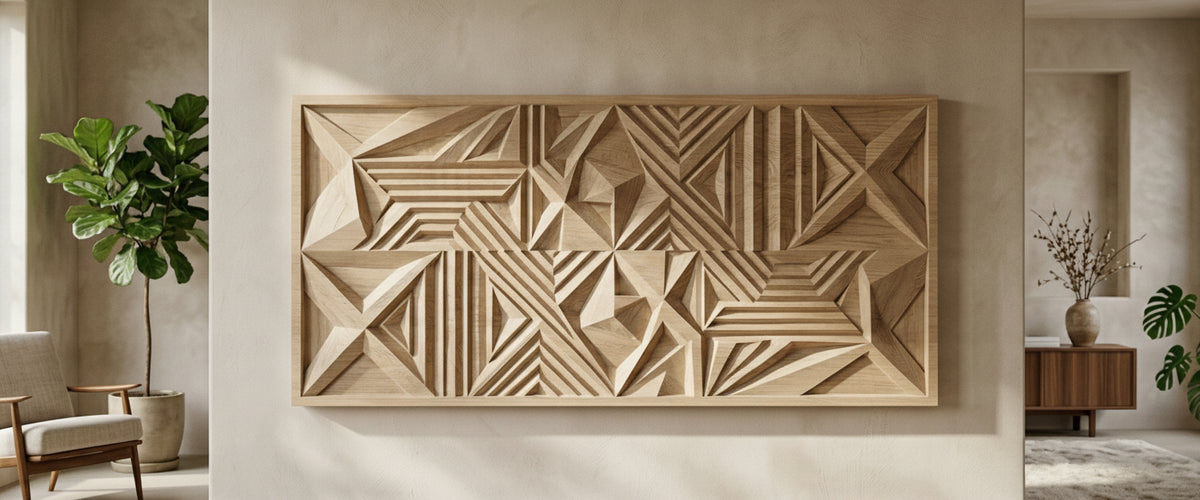

Most wooden wall art fails the room before it ever leaves the crate. The piece itself is fine. The wall is the problem: too short, too busy, lit from the wrong angle, or hung at a height borrowed from a hallway gallery instead of a living space. A carved oak relief that looks architectural in a Napa great room can look like a coaster above a Manhattan console if the proportions are off by a foot. This guide is about getting the wall right before the wooden wall art arrives, with specific advice for carved wood wall art, geometric wood wall art, reclaimed wood wall art, and the handmade wood wall art we ship into US homes, hospitality projects and outdoor terraces every month.

Quick Answer: What Makes Wooden Wall Art Work
Scale: the piece should occupy roughly two-thirds of the wall or the furniture line beneath it.
Height: center the visual mass at eye level for a standing viewer, around 57 to 60 inches (145 to 152 cm) from the floor.
Light: relief carvings need raking light from one side, not flat downlight, to read three-dimensionally.
Backdrop: matte, mid-tone walls flatter wood grain; high-gloss paint or busy wallpaper fights it.
Anchors: anything over about 15 lb (7 kg) needs studs, toggles or a French cleat, not picture hooks.
Scale and tonal pairing: a carved oak panel sized to the sofa line below it.

What Wooden Wall Art Actually Looks Like in Different Rooms
Wooden wall art reads differently depending on what surrounds it. In a Texas ranch-modern living room with limestone walls and a long horizontal sectional, a single large carved panel of bleached oak or ash sits like a quiet sculpture, picking up the warm undertones of the stone. The same panel above a black lacquered console in a Tribeca loft suddenly looks graphic, almost industrial, because the dark backdrop turns the carved shadows into hard line work.
Geometric wood wall art tends to win in rooms that are otherwise calm. Where the rest of the palette has been deliberately stripped back, a single saturated note like the Orbitale Mustard & White Geometry Wood Carving 3D Wall Art can carry a media room or primary bedroom without crowding it. On a cooler scheme, the Orbitale Cream & Blue Round Wood Carving 3D Wall Art version makes the case for a circular format above a console, where a rectangle would simply repeat the line of the furniture. Reclaimed wood wall art behaves in the opposite direction: it adds texture and history, so it earns its place in newer architecture, lofts with bare concrete, or pool houses that need some weight.
Outdoors, the rules shift. Direct UV, humidity swings and salt air will move and bleach untreated timber. For covered loggias, shaded courtyards and patio walls in the Hamptons or Aspen, treated hardwoods can perform well for years. For fully exposed walls, we usually steer clients toward Corten or cast bronze relief work from our broader outdoor wall art range, with timber reserved for sheltered positions.

Scale, Sightlines and Hanging Height
Scale is the single decision that separates a piece of wooden wall art that looks commissioned from one that looks bought. As a rule, the artwork should fill 60 to 75 percent of the width of the furniture line below it, or the wall width if it floats alone. Above a 96-inch (244 cm) sofa, that means a piece roughly 58 to 72 inches (147 to 183 cm) wide. Under-scaling is the mistake we see most often, particularly with clients who default to the dimensions they used in a previous, smaller home.
Hanging height matters just as much. Gallery convention puts the center of the work at 57 to 60 inches (145 to 152 cm) from the floor. That figure is for standing rooms: entryways, hallways, bars. In a living room where everyone is seated, drop the center two or three inches so the piece reads correctly from the sofa. Above a console or credenza, leave a gap of 6 to 10 inches (15 to 25 cm) between the top of the furniture and the bottom of the artwork. Closer than that and the wall feels crowded; further and the two stop talking to each other.
Sightlines decide the rest. Walk the route a guest takes from the front door. If the piece is the first thing they see from 30 feet away, it needs to read at distance: bold relief, strong silhouette, a single carved gesture. On a tall stairwell or double-height entry where the eye travels vertically, a vertical format such as the Lineaform Vertical Arch Wood Carving 3D Wall Art answers the proportions of the wall better than a horizontal panel ever will. If a piece of wooden wall art only reveals itself when someone is six feet away in a quiet study, fine detail and surface texture earn their place; the Solveta Grey Spiral Wood Relief 3D Wall Art is a good example of a relief that rewards close looking and loses something across a long open-plan room.
Raking light from 30 to 45 degrees pulls the carving forward after dark.
Indoor Versus Outdoor: When Each Wins
Indoor walls are where timber does its best work. Stable humidity, no UV, no freeze-thaw, no wind load. You can specify finer carving, lighter species, and finishes that would not survive a season outside. Dining rooms, primary bedrooms, stairwells with double-height walls, and hospitality lobbies are all natural homes for carved wood wall art decor.
Outdoor placement of wooden wall art is more demanding. Even shaded walls see large temperature swings, and any south or west exposure in California, Arizona or Florida will bleach and check the surface within a year or two without protection. The American Institute for Conservation publishes useful general guidance on caring for wood objects and the conditions that cause damage (culturalheritage.org). If a client is set on timber outdoors, we will specify a dense hardwood, a marine-grade finish, and a position that avoids direct rain runoff. For fully exposed terraces and garden walls, metal relief work from our wall art and wall decor range is almost always the better commission.
Light, Backdrop and Contrast
Wooden wall art with relief work lives or dies on lighting. Flat, even downlight kills the shadow play that makes carved panels three-dimensional. What you want is raking light: a directional source set 30 to 45 degrees off the wall plane, ideally on a dimmer. A single adjustable track head or a wall washer aimed across the surface, not straight onto it, will pull the carving forward and give the piece depth after dark. For 3D pieces, this is the difference between sculpture and silhouette.
Backdrop choice does similar work in daylight. A matte, mid-tone wall in warm white, clay, plaster pink or soft gray will flatter almost any wood tone. High-gloss paint fights the surface texture by adding its own reflections. Patterned wallpaper behind a carved panel of wooden wall art is almost always a mistake; the eye cannot decide where to land. If the wall is already a feature, treat the artwork as quiet relief, not a second focal point.
Contrast between the timber and the wall is the final lever for wood wall art decor. Light wood on a dark wall reads graphic and modern, useful in entertaining spaces. Dark wood on a pale wall reads classical and grounded, better suited to libraries, dining rooms and primary suites. Tonal pairings (oak on oatmeal, walnut on putty) read calm and considered, which is why we see them specified so often in high-end residential schemes. A piece like the Grida Soft White Wood Carving 3D Wall Art works hard in this tonal register; the carving carries the composition while the color stays quiet.
Placement Mistakes We See Most Often
For wider placement ideas, Outdoor Metal Wall Art: A Placement Guide for Walls That Actually Earn It is useful companion reading before finalising the setting and sightlines.
Five recurring errors with wooden wall art, from commissions we have shipped and installations we have visited:
Hung too high. Clients copy gallery walls and end up with the center of the piece at 65 inches or more. The artwork floats away from the furniture and the room.
Under-scaled for the wall. A 30-inch panel on an 11-foot wall reads like a postage stamp. If the wall is generous, the wood art wall has to be too, or the wall should be left empty.
Wrong light source. Recessed downlights directly above the piece flatten the carving. Move the light off-axis, or add a dedicated picture light angled across the surface.
Competing finishes. A carved panel above a heavily veined marble fireplace or busy tile splashback puts two surfaces in a fight for attention; one needs to be calmed.
Ignoring weight. Larger carved panels of wooden wall art can weigh 20 to 60 lb (9 to 27 kg). A standard picture hook is not the answer. Mark studs, use a French cleat, and on plaster or masonry use rated anchors.
How to Hang Heavy Wooden Wall Art Safely
For any wooden wall art above about 15 lb (7 kg), we recommend a French cleat system: a beveled strip fixed to the wall, a matching strip on the back of the panel, the two hooking together. The load is spread along the full width of the piece, the artwork sits flat against the wall, and small horizontal adjustments are easy. On drywall, the cleat must be screwed into studs or into rated toggle anchors; on brick or plaster, into properly drilled and plugged fixings. For very heavy commissioned pieces of wooden wall art decor, we ship cleats pre-fitted and include an installation diagram with the crate.
Commissioning a Piece That Fits the Room
If no off-the-shelf wooden wall art fits the wall, the proportions of the room, or the palette of the scheme, this is where a bespoke commission earns its budget. At Giant Sculptures we work with designers and private clients on carved panels sized to the specific wall, finished to match adjacent joinery or stone, and engineered for the fixings the building can take. Budget depends on scale, species, carving complexity, finishing and installation, so we quote each commission individually rather than work from a list price. Browse the wood wall art collection for a sense of range and finish, then send measurements and a couple of photos of the wall; we can usually advise on scale and orientation within a day.