





































































































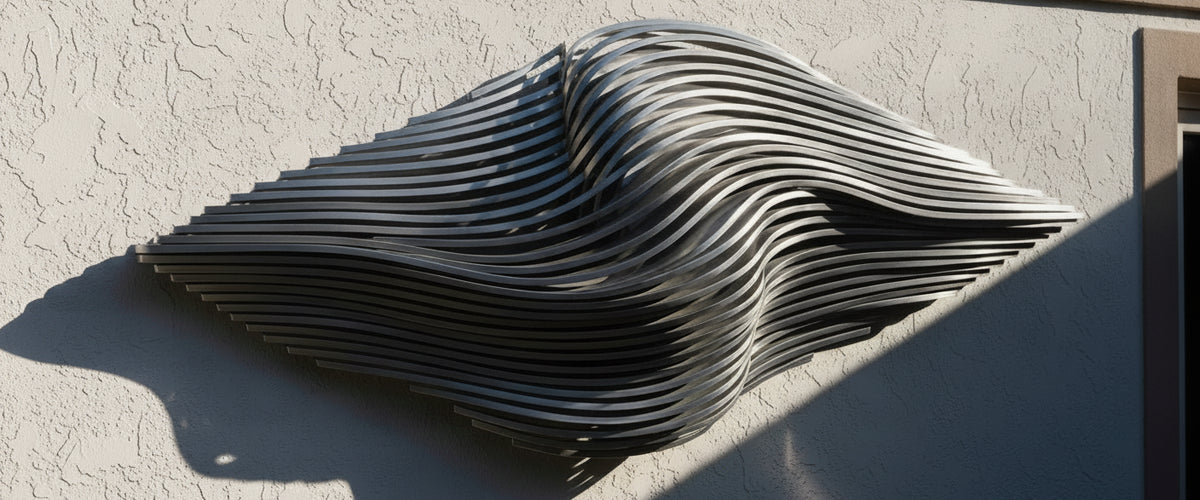

Most outdoor metal wall art fails for the same reason: the wall is wrong, the height is wrong, or the piece is two sizes too small for the elevation it sits on. The metal itself is usually fine. The decision around it is where buyers lose the picture. After years of shipping commissioned panels to courtyards in Napa, pool walls in Scottsdale, and double-height entry foyers in Greenwich, the pattern is consistent. Get the placement logic right and a single sculptural panel can carry an entire facade. Get it wrong and even a beautifully fabricated piece reads like an afterthought.
This guide is for buyers, interior designers, landscape architects and venue owners weighing up large metal wall art for a real project. It covers how a piece reads in different settings, the scale and sightline decisions that change everything, indoor versus outdoor trade-offs, and the placement mistakes we see most often in commissions.

Quick Answer: What to Decide Before You Buy
- Viewing distance first. Measure the closest and furthest point people will see the piece from. That sets minimum width.
- Wall area, not wall width. Aim for the artwork to occupy roughly 55 to 75 percent of the visible wall field, not the whole wall and not a postage stamp.
- Center on the sightline, not the wall. Hang to the eye line of the dominant approach, not the geometric middle of the masonry.
- Material has to match exposure. Coastal, freeze-thaw and full-sun sites all behave differently. Stainless, Corten, powder-coated aluminum and bronze each have a job.
- Light decides contrast. Backlit, raking and frontal light produce three completely different pieces from the same panel.

What Outdoor Metal Wall Art Actually Looks Like in Different Settings
Outdoor metal wall art behaves very differently from a framed canvas. The surface catches weather, shadows shift through the day, and the piece is usually competing with planting, pool reflections or architectural detail. A flow-form abstract panel on a stucco pool wall in Texas reads as movement and shadow. The same piece on a slate feature wall in a Hamptons garden reads as silhouette and silver against gray. Knowing which effect you want is the brief.
For garden walls and pool surrounds, larger abstract pieces with depth and relief tend to outperform flatter graphic work. A layered fin composition like the Waverno Blue and Green Flow Metal 3D Wall Art throws real shadow across a flat stucco wall, which is what keeps the piece alive in flat midday light. Where the backdrop is warmer, a Corten return or a terracotta courtyard wall, a tonally matched panel such as the Waverno Ember & Graphite Flow Metal 3D Wall Art pulls the wall together rather than fighting it.
For commercial venues, restaurants, boutique hotels, lobby exteriors, we usually push clients toward bespoke. The minute a piece is visible from a street or porte cochere, the panel needs to be tuned to its specific elevation. Off-the-shelf rarely sits right on a 14-foot exterior wall.

Scale, Sightlines and Mounting Height
The single most common mistake in metal wall art decor is undersizing. A 30-inch panel on a 16-foot garden wall disappears. As a working rule, measure the full visible field (the area framed by edges, copings, planting or adjacent windows) and let the artwork take roughly two thirds of that field horizontally. If the wall is exceptionally tall, lean into vertical compositions rather than scaling a horizontal piece up beyond its natural proportion.
Mounting height is the second trap. Indoors, the gallery convention of centering art at 57 to 60 inches works because viewers are close. Outside, viewers are usually further away and often looking up from a lower terrace or down from a balcony. The center of the piece should sit on the dominant sightline, the eye line of where people actually stand when they first see it. For a piece visible from a sunken patio, that often means hanging higher than instinct suggests. For a piece beside a swimming pool seen from loungers, lower.
Sightline also includes approach. A driveway approach gives you a long lead-in and rewards larger, simpler silhouettes. A garden path that turns a corner rewards depth and relief, because the piece reveals itself in stages as you walk past it.

Indoor Versus Outdoor: When Each Wins
Plenty of buyers ask whether they should put an exterior metal wall art piece indoors instead, in a double-height stairwell, say, or above a long sideboard. The honest answer is that the rules are different and the material brief changes.
Exterior placement wins when the architecture has a blank wall that needs an event. Pool houses, garden boundary walls, courtyard returns, entry facades, hotel terraces. The piece anchors the space and gives the eye somewhere to land. The metal needs to be specified for the climate: marine-grade stainless near salt air, Corten where you want the rust patina to develop intentionally, powder-coated aluminum where color stability matters more than weight, bronze where you want a piece that will outlive the building.
Indoor wins when you want intricate detail or a finish that would not survive UV and rain. Brushed brass, polished steel mirror finishes, and mixed-media compositions belong inside, where lighting can be controlled and the surface stays clean. Where the brief calls for a softer, more atmospheric reading inside, a layered acrylic and metal panel like the Horizon Jade Mist Mountain Acrylic 3D Wall Art is closer to the right design language than a heavier exterior-grade sculpture. If the brief is a sheltered loggia or covered terrace, you have a hybrid zone and either category can work, provided fixings are stainless and the back of the piece can breathe.
For browsing live inventory across both categories, our metal wall art collection and the dedicated outdoor wall art collection separate pieces by where they are actually engineered to live.

Light, Backdrop and Contrast
The same panel can look like three different sculptures depending on how it is lit. We brief clients to think about three light states for any exterior placement.
Daylight. What does the piece do at noon, when the sun is overhead and shadow is minimal? Pieces with deep relief and three-dimensional flow keep working in this light. Flat, graphic pieces can flatten out. This is where 3D outdoor metal wall art earns its place outside.
Raking light. Low morning and evening sun is when relief work sings. Shadows lengthen across the surface and the piece becomes a different object. If a wall faces east or west, this is your peak hour and the artwork should be chosen to exploit it.
Night. A piece without dedicated lighting disappears after dusk. For exterior installs we always recommend a discreet uplight or grazing wall wash, positioned to skim across the surface rather than hit it head-on. The Illuminating Engineering Society publishes useful guidance on outdoor architectural lighting angles if you are briefing a lighting designer at the same time.
Backdrop matters as much as light. A pale stucco wall flatters dark patinated bronze and Corten. A dark slate or charcoal wall flatters polished or brushed stainless. Brick is forgiving of warm tones and unforgiving of cool ones. If the backdrop is fixed, choose the metal finish to contrast it. If the artwork is fixed, consider repainting or refacing the wall before install. Buyers rarely think of the wall as part of the artwork budget, but it is.

Common Mistakes We See in Commissions
A short list of the patterns we keep correcting at the briefing stage:
- Buying for the photo, not the room. A piece that looks great on a white studio backdrop in a product shot can vanish on textured stone or competing brickwork. Always test against your actual wall material.
- Hanging too high on tall walls. The reflex is to center vertically. On a 12-foot wall this puts the piece above the natural sightline. Drop it.
- Ignoring wind load. Large exterior panels need engineered fixings, especially on exposed elevations. This is a structural decision, not a hardware decision.
- Picking the wrong metal for the climate. Mild steel near a coast will weep rust within a season. Specify the alloy for the site.
- One piece doing two jobs. Trying to make a single panel work for both an outdoor terrace seen from the garden and an indoor dining room seen through glass usually pleases neither. Commission two related pieces instead.
Commissioning a Bespoke Outdoor Piece
When a buyer comes to us for a bespoke large metal wall art commission, the brief we work back from is the wall, not the artwork. We ask for elevation photos at different times of day, dimensions of the visible field, the dominant approach, the climate, the existing materials palette, and what the wall is competing with (planting, pool, view beyond). From there we work up concepts in scale, agree on metal, finish and fixings, and engineer the piece for the specific site.
Pricing for bespoke outdoor metal wall art varies considerably with scale, material, depth of relief, finish complexity, structural engineering and installation. Rather than guess at a range, we prefer to scope a piece against your actual wall and return a tailored quote. The same square footage in marine-grade stainless versus powder-coated aluminum versus patinated bronze produces three different numbers and three very different ownership horizons. Bronze and stainless are essentially generational; powder-coated aluminum is excellent value with a clear refinishing cycle. The American Institute for Conservation has useful background on how outdoor metals weather over time, which is worth reading if you are choosing between materials for a long-term install.
A Buyer Checklist Before You Commit
- Measured the visible wall field, not just the wall width.
- Confirmed the dominant viewing sightline and approach.
- Chosen a metal and finish suited to the climate and exposure.
- Specified stainless fixings and confirmed wind-load engineering for larger panels.
- Planned at least one dedicated light source for after dark.
- Checked the artwork against the actual wall backdrop, not a neutral render.
- Allowed clearance behind the piece for the back face to breathe.
- Briefed your bespoke supplier with elevation photos at morning, noon and dusk.
Get those eight right and a piece of outdoor metal wall art becomes the thing guests remember about the house. Get them wrong and you have an expensive panel doing the work of a small one. The metalwork is the easy bit. The placement is the brief.
For wider placement ideas, Outdoor Metal Wall Art: A Specialist's Guide to Scale, Light and Placement is useful companion reading before finalising the setting and sightlines.