





































































































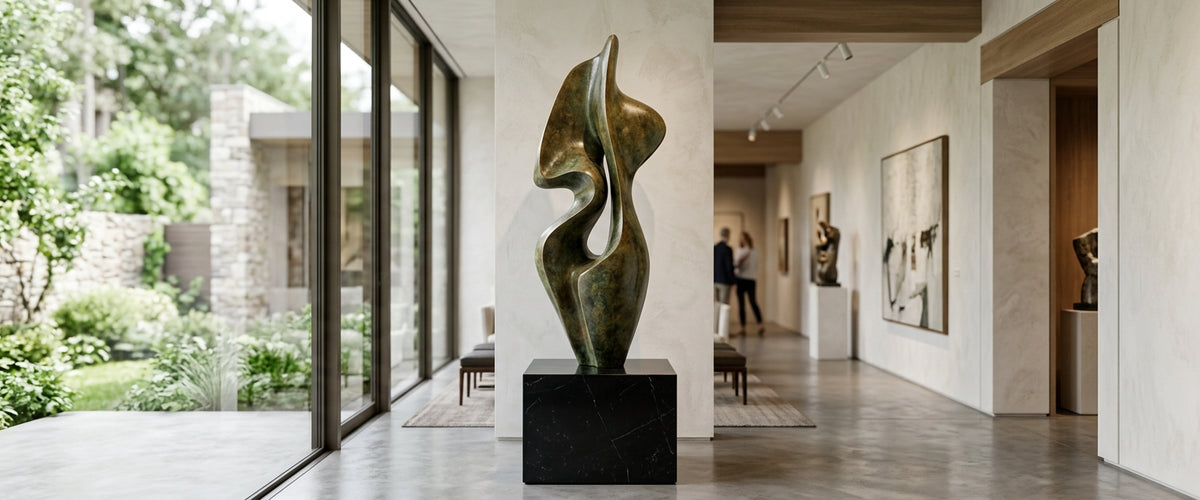

The same abstract sculpture can look commanding in one room and apologetic in another, and the piece never changed. Placement did. Buyers spend weeks choosing form, finish, and patina, then drop the result into a corner with no sightline and wonder why it feels smaller than the photo promised. Abstract Art sculptures reward planning more than almost any other category we ship, because there is no obvious front, no narrative pose to anchor the eye, and no built-in scale cue like a human figure. Get the setting right and abstract art sculptures pull a room together. Get it wrong and they read as furniture.
This guide walks through the choices that actually move the needle: scale and sightlines, pedestal height, indoor versus outdoor logic, and the light and backdrop decisions that decide impact. It draws on commissions we have shipped and the corrections we have watched clients make after the crate is open.
A tall bronze form anchors a double-height entry the way a chandelier might.

Key Takeaways
Scale beats everything. Abstract art sculptures need room to breathe; crowding kills the effect faster than wrong color.
Sightlines are the brief. Decide where people first see the work, then orient and light it for that view.
Pedestal height changes the read. A few inches up or down shifts a sculpture from incidental to deliberate.
Material follows location. Bronze, stainless steel, and Corten earn their keep outdoors; marble and finished wood prefer interiors.
Budget depends on the work. Material, scale, engineering, finishing, and installation all drive cost, so request a tailored quote rather than guessing.

What Abstract Art Sculptures Look Like in Real Rooms and Gardens
So, what is abstract Sculptures? It trades recognizable subject matter for form, mass, line, and surface. Instead of a horse or a figure, you read curve against void, weight against lift, polished plane against rough edge. That openness is the appeal and the risk. A representational piece tells you where to stand. Abstract art sculptures ask the room to do that work, which is why placement carries so much weight.
In a double-height entry, a tall bronze organic form does the job a chandelier might: it holds the vertical volume and gives arriving guests something to walk toward. In a low-ceilinged apartment, the same logic fails, and a compact piece on a console or a wall-height plinth reads far better. Where a living room needs a single anchoring form rather than monumental drama, a piece such as the Bronze Abstract Organic Form Metal Sculpture - 135cm sits in the right register, though the same object can look stranded in a room that simply needed more height. The ceiling and the sightline decide it, not the sculpture.
Outdoors, the calculus shifts again. A garden swallows scale. What feels generous indoors can vanish against a tree line or an open lot. This is why our monumental abstract art sculptures run large on purpose; for a lawn that would reduce a tabletop piece to a garden ornament, a form on the order of the Monumental Modern Abstract Arch Bronze Sculpture - 370cm holds the open space instead of being lost in it.

Scale, Sightlines, and Pedestal Height
Start with the first view. Where does someone see the sculpture before they reach it? From a staircase, through a doorway, across a pool deck, from the curb? That first sightline is the real composition, and the piece should be sized and turned for it.
For interiors, a rough working rule: freestanding abstract art sculptures want the surrounding negative space to read as deliberate, not leftover. If the only spot leaves less than a couple of feet of clearance on the open sides, the room is telling you to go smaller or move it. Abstract work needs air to register its silhouette.
Pedestal height is the lever most buyers underestimate. Raising a piece so its visual center sits near standing eye level, roughly 56 to 62 inches (about 142 to 157 cm), makes it read as intentional and lets the form turn as you walk past. Drop it to coffee-table height and it becomes an object you look down on, which flattens the silhouette. Where the base needs to be part of the design rather than an afterthought, the Gold Abstract Fluted Ribbon Sculpture on Black Marble Pedestal - 168cm shows how a grounding plinth lifts the metal into the eye line and finishes the composition.
On commissions, we will often ask for a photo of the space with a person standing in the intended spot. It sounds basic. It catches more scale errors than any measurement sheet, because it shows the sculpture against a human cue rather than a floor plan.
A grounding plinth lifts the form into the eye line and finishes the composition.

Indoor Versus Outdoor: When Each Wins
Material decides most of this. Bronze and stainless steel handle weather, UV, and temperature swings without drama, which is why they dominate our outdoor abstract art sculptures. Corten steel is built to develop a stable rust-toned surface and suits naturalistic garden settings where you want the work to settle into the planting rather than fight it. The Smithsonian American Art Museum's conservation guidance on outdoor bronze is a useful reminder that even durable metals need a maintenance rhythm once they live outside, not a one-time install and walk away (americanart.si.edu).
Interiors open up softer materials. Marble and polished stone read as luxurious under controlled light and never see frost or acid rain. Where a hallway niche or study shelf needs presence without monumental scale, a piece like the Grey Marble Abstract Stone Resin Sculpture - 35/50/80cm gives that range of options for an interior setting. Finished wood belongs indoors too, where it stays dry and stable.
An abstract wood sculpture is its own pleasure. The grain becomes part of the composition, and the way metal and timber play off each other, permanence against warmth, is the appeal of a piece like the Twin Flame Bronze Abstract Wood Sculpture - 150cm. Keep raw or oiled wood out of direct outdoor exposure unless it has been specifically engineered for it; otherwise you are signing up for cracking and movement.
The honest summary: if a piece will face real weather, choose metal or stone built for it. If it lives inside, the material field opens and you can chase texture and warmth without worrying about the forecast.
Light, Backdrop, and Contrast
Light is what turns mass into drama. Abstract art sculptures depend on the play of highlight and shadow across their surfaces, so flat, even lighting is the enemy; it erases the very curves you paid for. Angle a light source so it rakes across the form and the silhouette comes alive. The practical version is simple: light from the side and slightly above, not straight on.
Backdrop matters as much as the fixture. A polished bronze or gilded form needs a quieter wall behind it; a busy gallery wall or a patterned drape will compete and lose. Dark, matte backgrounds make pale marble and bright metal jump forward. Pale walls flatter darker patinas and Corten. The goal is contrast between the piece and what sits behind it, so the eye separates form from setting instantly.
Outdoors, your backdrop is planting, sky, or architecture. A reflective stainless or gold finish reads against dark evergreens or a stone wall far better than against a busy flower bed. Set against a clean hedge or open sky, a form on the scale of the Monumental Modern Abstract Biomorphic Bronze Sculpture - 340cm gets the contrast it needs to hold its scale.
Placement Mistakes We See, and How to Avoid Them
For wider placement ideas, Abstract Sculpture: A Buyer's Guide to Form, Scale and Placement is useful companion reading before finalising the setting and sightlines for abstract art sculptures.
Pushing the piece against a wall. Abstract work usually reads in the round. Pull it forward so people can move around it, even by a foot.
Buying for the corner. Corners hide silhouettes. If a corner is the only option, choose a piece designed with a clear primary face, such as a relief or a strongly directional form.
Ignoring the base. A great sculpture on the wrong plinth looks unfinished. Match base height and material to the room and the piece, not whatever pedestal is on hand.
Lighting it flat. Overhead recessed cans alone will dull most abstract art sculptures. Add a raking source.
Underscaling outdoors. Gardens eat size. When in doubt, go bigger; a grouping such as the Monumental Modern Trio of Abstract Geometric Figures Bronze Sculpture - 250cm reads as a deliberate composition rather than a stray object.
Forgetting load and footing. A heavy bronze or marble piece needs proper footing indoors and a footing pad outdoors. Plan the structure before delivery, not after.
If you want to compare some of the best abstract sculptures ever made alongside contemporary forms and finishes before committing, our abstract Sculptures collection shows the range across materials and scales, and the bronze Abstract Sculptures grouping is the place to start for outdoor-ready abstract art sculptures. Many of the famous abstract sculptures that anchor public plazas succeed for exactly the reasons above: generous scale, a considered sightline, and a backdrop that lets the form stand apart.
Commissioning for a Specific Space
When nothing off the shelf fits the sightline, scale, or material you need, a bespoke commission solves it. Giant Sculptures works as a bespoke supplier of abstract art sculptures on exactly this kind of problem: large-scale abstract forms engineered for a known location, finished to suit the backdrop, and built to last outdoors or in. We size to the first view, specify the base, and account for footing and weight before anything is cast or fabricated. Because cost tracks material, scale, engineering, finishing, and installation, the sensible move with abstract art sculptures is to share the space and the brief and ask for a tailored quote rather than working from a guess.