






































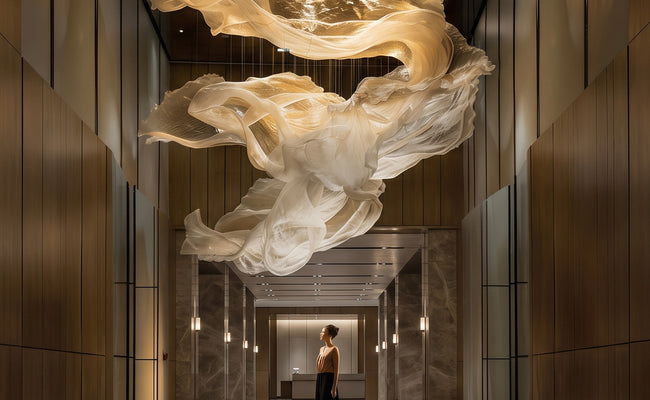





























































A blank reception wall is the first thing a visitor reads, and most of them read it as an afterthought. The fix is rarely more decoration. It is the right piece, at the right size, hung where the eye actually lands. Good wall art for office spaces does quiet work: it steadies a long corridor, gives a boardroom a focal point, and tells anyone walking in that the company cares about detail. Get the scale or the height wrong and even a fine piece looks lost.
Looking for the full range in this category? Browse our Wall Art and Wall Decor collection for every available finish, size, and configuration.
We commission and ship large statement pieces, so most of the offices we work with are not trying to fill a wall with posters. They want one or two pieces that hold a room. When you treat wall art for office settings as one big statement rather than filler, the rules change.

Key Takeaways
Scale beats quantity. One well-sized piece reads stronger than a cluster of small frames.
Hang to the sightline, not the ceiling. Center height depends on whether people stand or sit in that space.
Match the material to the traffic. Reception and outdoor courtyards need durable finishes; private offices allow softer work.
Light and backdrop decide impact as much as the piece itself.
Budget depends on material, scale, finishing, and install, so request a tailored quote rather than guessing.

What Wall Art for Office Spaces Actually Looks Like Room by Room
Office wall art is not one category, and good wall art for office use shifts by room. A reception in a tech campus, a partner's corner office in a city tower, and a shaded courtyard at a winery office all ask for different things.
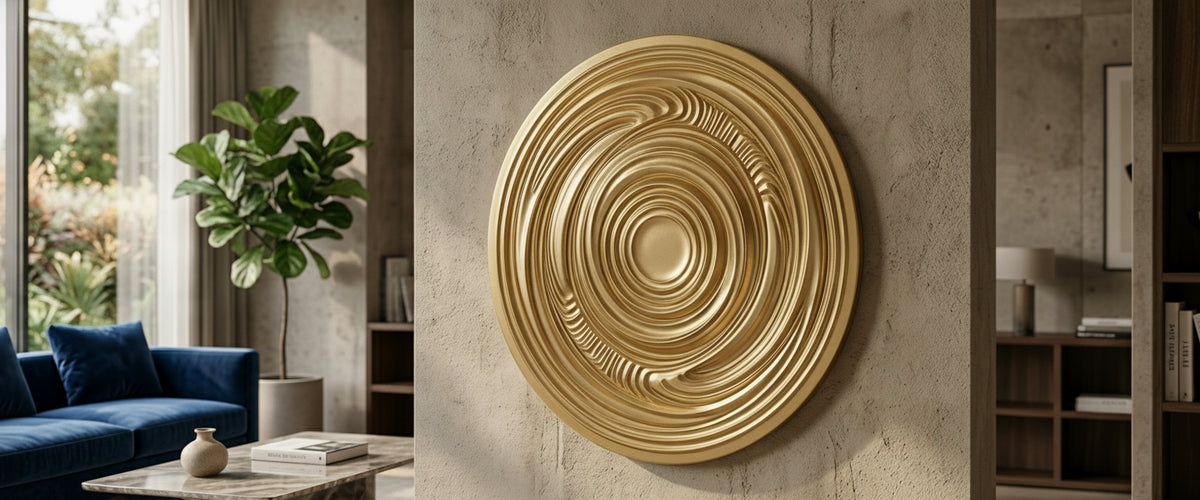
Reception and lobby walls carry the heaviest visual load. They are seen from a distance, often across a polished floor, so they reward bold relief, metal, or a large textured panel that holds up under bright overhead light. Where a reception needs a single circular focal point that reads cleanly from across the room without crowding a logo or signage, a piece like the Astryn Gold Orbit round textured 3D wall art is closer to the right design language than a wide rectangular panel.
Boardrooms want calmer work that survives long meetings without competing for attention. For the wall behind a head seat, where light from a window grazes the surface and changes through the day, a layered carved panel such as the Deralin Charcoal Flow abstract 3D carving wall art brings depth and shadow play without pulling focus from the table. This is wall art for office boardrooms at its most useful: present, never loud.
Private and home office wall art has more freedom. There is no foot traffic, the viewing distance is short, and the piece sits in your peripheral vision for hours. That favors texture and warmth over scale. Modern office wall art here can be quieter and more personal, the kind of carved or color-led panel you actually want to look at on a long call.

Scale, Sightlines, and Hanging Height: The Choices That Change How a Piece Reads
The most common reason a piece looks wrong is not the piece. It is the size relative to the wall and the height it sits at. Even strong wall art for office walls fails when the size is off.
As a working rule, a single piece should fill roughly two thirds to three quarters of the usable wall width above a console, sofa, or sideboard. Go smaller and it floats; go edge to edge and it feels like wallpaper. For a big reception wall with nothing beneath it, you have room to push scale hard, and large is usually the safer mistake.
Hanging height is where offices slip up. Galleries hang to a center line around 57 to 60 inches (145 to 152 cm) from the floor because that suits a standing viewer. That logic holds in a lobby or corridor. In a boardroom or a private office where people are seated for most of the day, drop the center a few inches so the piece sits comfortably in a seated eye line. Hang to the room's real behavior, not a default number.
Sightlines matter as much as height. Walk the approach a visitor takes. If the wall is first seen from forty feet away down a corridor, the piece needs to register at that distance, which means bolder relief and stronger contrast. If it is only seen up close beside a desk, fine surface detail rewards the short view. Good wall art for office corridors is chosen for the distance it is read from.

Indoor Versus Outdoor: When Each Placement Wins
For wider placement ideas, 3d Metal Wall Art: A Buyer's Guide to Scale, Finish, and Placement is useful companion reading before finalizing the setting and sightlines.
Plenty of premium offices have an outdoor wall worth using: a courtyard, a terrace off the executive floor, a shaded entrance under a canopy. Outdoor wall art for office entrances wins when you want the piece to greet people before they enter, or when the indoor walls are already busy with glass and branding.
Material is the deciding factor outside. Wood and acrylic relief panels belong indoors. For an exposed wall or a courtyard that takes weather, we steer clients toward metalwork built for it: stainless steel, or weathering steel where you want that warm rusted patina. Corten develops a stable oxidized surface that protects the steel beneath, which is why it is used in public art and architecture for long outdoor life. The US National Park Service has documented how that protective patina forms and behaves over time, and it is worth understanding before you commit a piece to an exposed wall (nps.gov).
Indoor placement wins for control. You decide the light, the backdrop, and the climate, so softer materials and finer carving last and look their best. Most of our office commissions stay indoors for exactly that reason, which is why so much wall art for office interiors is carved relief rather than metal.
Light, Backdrop, and Contrast
A piece can be perfectly scaled and still fall flat because the wall fights it. Three things decide impact here, and they apply to any wall art for office spaces.
Contrast against the wall. A taupe carved panel on a beige wall disappears. The same panel on a charcoal or deep green wall comes alive. If you cannot repaint, choose a piece that contrasts the wall you have. A pale relief like the Deralin Taupe Grid abstract 3D carving wall art needs a darker or cooler backdrop to read its full depth, so it suits a feature wall rather than a pale corridor.
Light direction. Relief and 3D carving live or die on raking light. Light that hits the surface from the side throws shadow into every groove and makes the texture do its job. Flat, head-on light flattens the same piece. Where you can, position a piece so a window or a directional fixture catches it from an angle. The Illuminating Engineering Society publishes guidance on lighting artwork that is worth a glance if you are specifying fixtures for a new fit-out (ies.org).
Backdrop clutter. Give the piece breathing room. A textured panel sitting between a fire extinguisher, a wall clock, and a noticeboard never wins. Clear the wall and let your wall art for office stand alone.
Placement Mistakes We See in Commissions, and How to Avoid Them
Buying too small for the wall. The single most frequent fix. When clients send photos, the piece they like is usually a size too small. Measure the wall, mark the footprint in painter's tape, and stand back before you commit.
Hanging too high. A reception piece floating near the ceiling looks stranded. Bring it down into the eye line.
Ignoring the approach. Choosing a delicate surface for a wall first seen from across a lobby. From distance it reads as a blank rectangle.
Reaching for stickers. Office wall art stickers and vinyl decals look fine in a launch photo and tired within a year. For a space meant to signal permanence, a physical relief or metal piece holds its value and its look far longer.
Forgetting the fixing. A large panel needs proper anchors into stud or masonry, not drywall plugs. Tell us the wall build when you order so the fixing kit suits it.
How to Choose Office Wall Art: A Short Decision Path
Name the room's job. Greet visitors, calm a boardroom, or personalize a private office. Each points to a different scale and material for your wall art for office.
Measure the wall and the viewing distance. Both decide size and surface detail.
Check the light. Directional light favors deep relief; flat light favors color and contrast.
Match material to traffic and climate. Wood and acrylic indoors; steel or Corten for exposed walls.
Decide one strong piece or a considered pair. Resist the cluster of small frames in a premium setting.
Commissioning a Bespoke Office Piece
When a stock size or color will not sit right on a specific wall, a commission solves it. We work with clients on bespoke dimensions, finishes, and color so a professional office wall art piece fits the architecture rather than fighting it. That matters most in receptions with unusual proportions, double-height lobbies, or outdoor walls that need a weatherproof material from the start. Tell us the wall, the light, and how the room is used, and we will steer scale and material from there. A commissioned piece of wall art for office use should answer the room, not the catalog.
Browse the wider office art range to see what suits a workplace, or compare finishes across the metal wall art and wood wall art collections before you commission. Giant Sculptures builds large-scale, durable wall art for office buildings, venues, and homes worldwide.