





































































































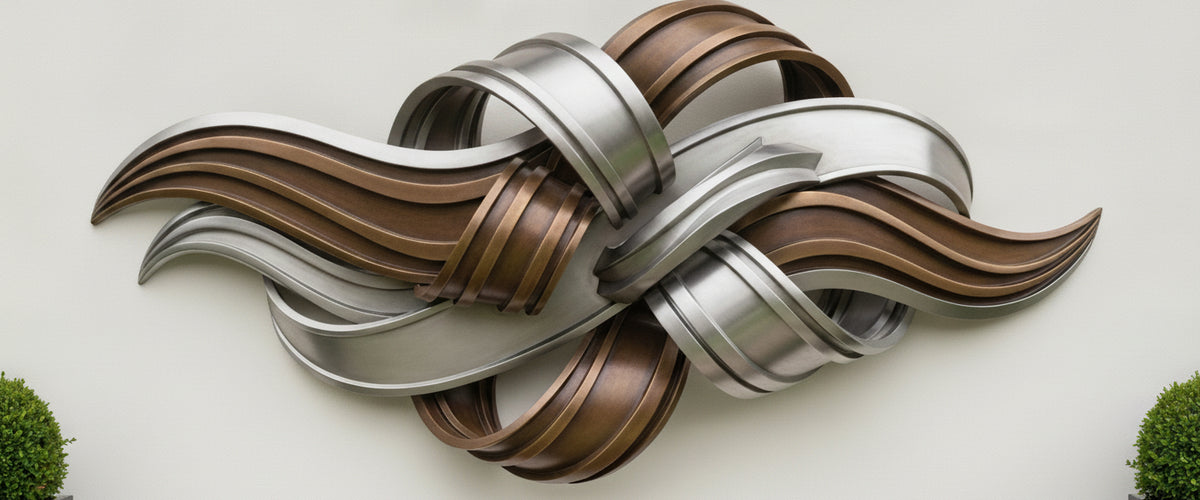

A flat canvas cannot hold a double-height wall. Stretch one over 12 feet (3.7 m) of plaster and it reads as a poster, not a statement. This is the gap that 3D metal wall art was built to fill: relief, shadow, and weight on a surface that would otherwise swallow paintings whole. Done well, a sculptural 3D metal wall piece changes character through the day as the light moves across it. Done badly, a 3D metal wall panel looks like a hotel lobby afterthought.
Most of the briefs that land in our studio at Giant Sculptures start with the same problem. A great room in Aspen, a stairwell in a Manhattan townhouse, a long gallery hallway in a Napa winery, all of them with a wall that needs presence rather than decoration. Below is the working logic we use with clients, designers, and architects when they are choosing or commissioning 3D wall sculptures in metal.

Key Takeaways
Material drives mood. Brushed stainless reads modern; patinated bronze reads collected; Corten reads architectural.
Scale is non-negotiable. A 3D wall sculpture should cover roughly 60 to 75 percent of the visual field it anchors.
Relief depth matters as much as width. Anything under 2 in (5 cm) of projection reads flat from across a room.
Lighting is part of the artwork. Grazing light from above turns ridges into drawn lines on a 3D metal wall piece.
Bespoke is often the right call for walls over 8 ft (2.4 m) wide, where stock sizes look stranded.

What 3D Metal Wall Art Actually Is and Who It Suits
The phrase 3D metal wall art covers more ground than buyers expect. At one end sit hammered or laser-cut panels with shallow relief, layered to suggest depth. At the other sit fully sculptural wall reliefs, where forms project 6 in (15 cm) or more from the substrate and cast real shadows. Both are legitimately 3D wall sculptures and both qualify as 3D metal wall art sculpture. They behave very differently in a room.
Shallow 3D metal wall pieces work in corridors, dining rooms, and offices where viewing distance is short and you want texture rather than drama. Deep-relief wall 3D sculpture earns its keep in double-height entries, stair landings, and commercial lobbies, where the viewer is far enough away that shadow becomes the drawing. If you are buying a 3D metal wall work for a Texas ranch entry with a 20 ft (6 m) ceiling, shallow relief will disappear. If you are buying for a study in a Brooklyn brownstone, deep relief will feel claustrophobic.
The audience splits the same way. Residential buyers tend toward flowing, abstract forms (waves, botanicals, geological strata). Hospitality and corporate clients lean toward geometric, repeated-module wall 3D sculpture art that scales to monumental size without becoming literal.

Materials, Finishes, and the Decisions That Actually Matter
Stainless Steel
Brushed 316 stainless is the workhorse of contemporary sculptural metalwork and a sensible default for any 3D metal wall commission. It resists corrosion in coastal homes, takes mirror or satin finishes cleanly, and lights beautifully under warm LEDs. Mirror-polished stainless throws color back into a room from artwork, rugs, and sky. Brushed stainless absorbs and softens it. For a Hamptons living room with a lot of glass, brushed almost always wins; mirror finishes can create unwanted hotspots when low sun hits.
Bronze and Brass
Cast or fabricated bronze gives 3D wall sculptures the weight and patination history of traditional sculpture. Brass reads warmer and more decorative. Both develop a living surface over time, which collectors love and contract specifiers sometimes do not. If the bronze 3D metal wall piece is going into a hospitality setting where finish needs to look identical in year ten, we lacquer; if it is going into a private home where age is part of the appeal, we leave it open.
Corten (Weathering Steel)
Corten is the right answer for covered outdoor walls, pool houses, and indoor-outdoor great rooms. A Corten 3D metal wall relief settles into the architecture rather than competing with it. The rust patina stabilizes after roughly 18 to 24 months of weathering, then holds. Useful technical background on the alloy's behavior is published by the ASTM standards body for anyone specifying it in a commercial project.
Painted and Layered Metal
Powder-coated and hand-painted steel is where most flowing, color-driven 3D wall sculpture lives. Layered ribbons of cut steel let a single piece carry both palette and relief, which is useful in rooms where the wall is the main source of color. A flowing painted composition like Waverno Blue & Green Flow covers a wide field without competing with furniture below it, while the Waverno Ember & Graphite Flow Metal 3D Wall Art version sits closer to the right register for darker, more architectural interiors where a quieter palette has to do the heavy lifting.
Mixed Media
Some of the most interesting recent commissions blend metal with resin, acrylic, or stone. Where the brief calls for optical depth rather than physical weight, an acrylic-and-metal piece such as Horizon Jade Mist Mountain Acrylic 3D Wall Art extends the 3D wall sculpture art's visual reach without crowding rooms already busy with millwork.

Getting Scale Right (This Is Where Most Buyers Slip)
The single most common mistake we see is buyers ordering a 36 in (91 cm) 3D metal wall sculpture for a wall that wants a 72 in (183 cm) piece. The math is simple. Measure the wall you want to anchor. The artwork should occupy roughly 60 to 75 percent of the width of the visual field, where the visual field is the wall minus any flanking furniture, doorways, or windows.
For a sofa wall, the piece should be roughly two-thirds the width of the sofa, hung so the visual center sits 57 to 60 in (145 to 152 cm) off the floor. For a stairwell, work from the landing eye line, not the floor. For a double-height entry, the bottom edge of the piece should not drop below 8 ft (2.4 m) or it crowds the door.
Depth is the second variable. Anything under 2 in (5 cm) of relief reads as a painting from across a room. For walls viewed from 20 ft (6 m) or more, we recommend at least 4 to 6 in (10 to 15 cm) of projection on a 3D metal wall piece. Pieces in the 3D wall art collection are tagged with projection depth for exactly this reason.

Where 3D Wall Sculptures Earn Their Keep
Five placements consistently work harder than the rest for a 3D metal wall installation:
Stair landings. The viewer approaches from below, so deep relief reads dramatically. Use vertical compositions.
Double-height entries. A single monumental piece beats three medium ones every time. Commission to fill the wall properly.
Behind a long dining table. Horizontal compositions in matte finishes; you do not want reflections during dinner.
Indoor pool surrounds and spa walls. Stainless or sealed bronze handles humidity; avoid raw steel.
Hospitality lobbies and tasting rooms. Modular wall 3D sculpture systems let you scale to any wall and reconfigure later.
One detail that gets missed: lighting plan. A 3D metal wall sculpture lit only by ambient room light loses two-thirds of its depth. We specify a grazing wash from above, usually 12 to 18 in (30 to 46 cm) off the wall plane, warm enough to flatter the metal (around 2700 to 3000 K for bronze and brass, 3000 to 3500 K for stainless). The Illuminating Engineering Society publishes good baseline guidance on grazing angles for textured surfaces.

Budget, Commissioning, and Delivery
Budget for a 3D metal wall commission depends on material, scale, complexity, engineering, finishing, and installation. A 4 ft (1.2 m) shallow-relief stainless piece is a very different commission from a 14 ft (4.3 m) deep-relief bronze installation with concealed cleat mounting and a custom lighting spec. Rather than quote ranges that mislead, we build a written proposal once we have the wall dimensions, material preference, and site photos.
For bespoke commissions, the working timeline runs roughly: brief and concept sketches, scaled maquette or rendered visual, material samples, fabrication, finishing, crating, and freight. Large pieces ship in custom crates with mounting hardware and an installation drawing. Wall substrate matters: a 200 lb (91 kg) bronze relief cannot hang on drywall with toggle bolts. We always ask for substrate details (stud spacing, masonry, steel backing) before sign-off on a 3D metal wall project.
Common Buyer Mistakes
Ordering a 3D metal wall piece by price band rather than wall dimensions.
Forgetting to plan lighting at the same time as the artwork.
Choosing mirror-polished stainless for a sun-flooded room.
Hanging the piece too high; ceiling height does not change eye line.
Specifying outdoor-grade finishes for covered patios where Corten would have been simpler.
Ignoring substrate; drywall is not a structural plan.
How Giant Sculptures Approaches Bespoke 3D Wall Projects
Most of our 3D metal wall commissions begin with a single photo of the wall, taken straight-on with something for scale (a chair, a person, a door). From there we work through material, relief depth, finish, and lighting before any fabrication begins. We have shipped bronze reliefs to private homes in California and Florida, stainless pieces to corporate lobbies, and Corten installations to vineyards and resorts. The studio's strength sits in large-format work where stock product runs out of room.
If you are exploring options, the metal wall art collection is the right place to see how 3D metal wall finishes behave at different scales, and the broader wall sculptures collection shows how relief reads across materials. For anything over 8 ft (2.4 m) wide, ask us about a bespoke quote rather than scaling a stock piece up.
For wider placement ideas, Metal Wall Art: A Buyer's Guide to Scale, Finish and Placement is useful companion reading before finalising the setting and sightlines for your 3D metal wall piece.