






















































































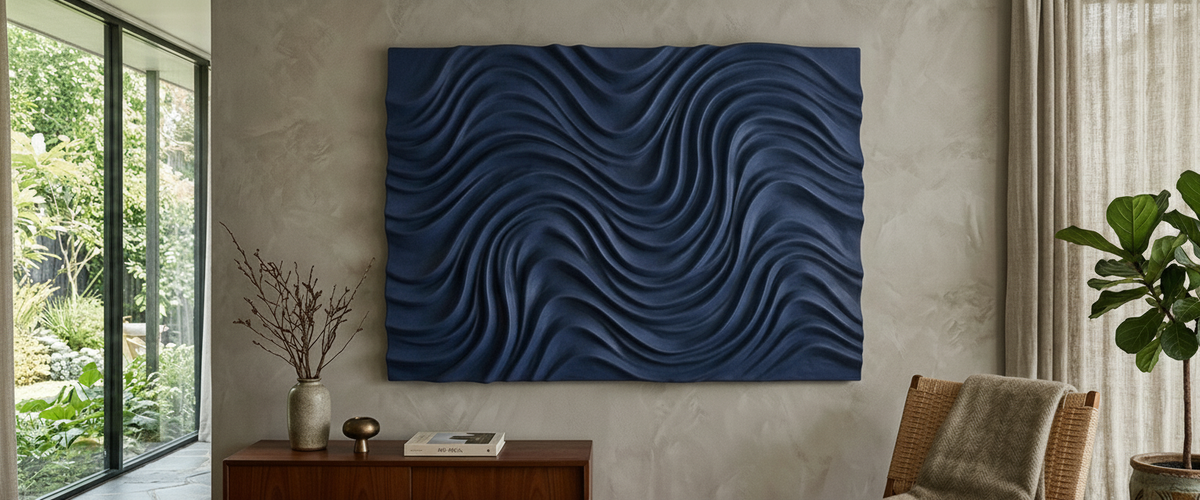

Walk into most corporate lobbies and the art is hung too high, too small, and lit like an afterthought. The piece is fine. The placement is the problem. Choosing wall art for office spaces is less about the artwork in isolation and more about how it sits against the wall, the light, and the line of sight people actually use when they walk in. Get those right and a single sculptural panel can anchor a whole reception. Get them wrong and even a strong piece reads like a hotel print.
Looking for the full range in this category? Browse our Wall Art and Wall Decor collection for every available finish, size, and configuration.
We ship large-scale and bespoke work to commercial fit-outs and home studios on both sides of the Atlantic, and the same placement errors keep surfacing with wall art for office projects. So here is the practical version, written for buyers, designers, and facilities teams who want the piece to do real work.

Key Takeaways
Hang to the room, not the wall. Center height should suit standing eye level in lobbies and seated eye level in meeting rooms.
Scale up before you scale down. Most office walls swallow art that looks generous in a showroom.
Backdrop and contrast decide impact. A navy ceramic panel disappears on a charcoal wall and sings on warm plaster.
3D and metal wall art outperform flat prints on camera because the relief catches directional light and adds depth to video calls and photos.
Budget depends on material, scale, and finishing, so request a tailored quote rather than guessing from a size alone.

What Wall Art for Office Spaces Actually Looks Like in Different Rooms
Wall art for office use is not one category. A reception lobby wants a hero piece that registers from 20 feet (6 m) away. A meeting room wants something that holds attention without competing with the people in the chairs. A home office wall art piece needs to frame well behind your head on a video call and still feel personal when the camera is off.
Reception and lobby walls take the boldest sculptural work. This is where relief panels and metal pieces earn their place, because the surface texture reads across distance. For a wall that needs to register on approach, a relief panel such as the Elysian 3D Ceramic Wall Art in organic navy blue is built for that job; the organic ridges throw soft shadow lines that keep the wall alive as foot traffic moves past.
Open-plan working areas reward calmer, rhythmic pieces. A grid-based acrylic panel like the Haloid I Bubble Grid Acrylic 3D Wall Art brings pattern and light play without shouting, which matters when people sit near it all day. For executive offices and boardrooms, metallic abstracts add warmth and a sense of permanence; the Astrid Azure Flow Gold Abstract Wall Art works well behind a credenza where it catches lamp light in the evening. This is professional office wall art doing real work for the room.
Some clients ask about office wall art stickers for breakout zones or stairwells. They have a place for quick, low-commitment graphics. But they are not the same conversation as a sculptural statement piece, and they will not hold a reception wall. If the wall matters, give it weight rather than treating wall art for office spaces as filler.

Scale, Sightlines, and Pedestal Height: The Choices That Change How a Piece Reads
The single most common fault we fix is height. Gallery convention puts the center of a work at roughly 57 to 60 inches (145 to 152 cm), which suits standing viewers. That number is a starting point, not a rule. In a meeting room where everyone is seated, drop the center so it sits comfortably for eyes at desk height. In a double-height lobby, you can lift a large piece and let the architecture carry it, as long as the bottom edge still relates to a human standing nearby.
Scale is the second trap. A panel that looks generous in a studio shot can look apologetic on a 14-foot (4.3 m) reception wall. A working guide for wall art for office settings: the piece, or the grouping, should fill roughly two thirds to three quarters of the available wall width above any furniture. When in doubt, size up. We have rarely had a client tell us a commissioned piece arrived too large for the wall; we hear the opposite more often.
Sightlines decide everything else. Stand where your visitors will stand. Sit where your clients will sit on a call. The piece should land in that natural line of view, not float in dead space above a door. For modern office wall art that needs to read on video, the sweet spot is usually just above and to one side of the seated head, so the relief reads without halo-ing the speaker.

Indoor Versus Outdoor Placement: When Each Wins
For wider placement ideas, 3d Metal Wall Art: A Buyer's Guide to Scale, Finish, and Placement is useful companion reading before finalizing the setting and sightlines.
Most office wall art lives indoors, but commercial campuses, courtyards, and entrance plazas increasingly carry exterior wall-mounted work. The decision is mainly about material. Ceramic and acrylic 3D panels are indoor pieces; they are made for controlled light and stable conditions. Push them outside and you invite UV fade, thermal stress, and water ingress behind the mount.
Outdoor wall installations call for metal built for the weather. Powder-coated aluminum, marine-grade stainless steel, and Corten all handle exterior exposure when specified and sealed correctly. Corten in particular suits campus entrances and landscaped courtyards because its weathered patina reads as intentional and ages without constant care. If your project spans an indoor lobby and an outdoor arrival wall, treat them as two separate material briefs rather than trying to make one piece of wall art for office grounds serve both.
For a home office that opens onto a garden in the Hamptons or a deck in Aspen, you can blur the line: an interior metal piece visible through glass, with a weatherproof companion outside. That visual link between inside and out does more for the room than a single larger piece ever would.
Light, Backdrop, and Contrast: The Details That Decide Visual Impact
Texture needs raking light. A flat front-light flattens a relief panel; a light angled across the surface brings the ridges and shadows to life. This is why 3D and metal wall art reward a little lighting thought, while flat prints are more forgiving. Adjustable track or wall-grazing fixtures give you control over wall art for office interiors, and the Illuminating Engineering Society publishes guidance on lighting levels and glare that is worth a look before you commit fittings (ies.org).
Backdrop contrast is the quiet decider. A navy ceramic panel vanishes on a dark accent wall and reads beautifully on warm off-white plaster. A gold-toned metal abstract loses its glow on a beige wall and sharpens on deep charcoal or forest green. Before you choose the artwork, look hard at the wall color behind it. If the wall and the piece sit in the same value range, the work will read as a smudge from across the room.
Finish matters for glare too. High-gloss acrylic pieces like the Bounce Orange & Mint Panel With Glossy Orange Balls Acrylic 3D Wall Art look superb under controlled light but can bounce window glare in a sun-facing meeting room. Place glossy work where you control the light and keep matte or textured finishes for walls fighting direct sun.
Common Placement Mistakes We See in Commissions
A few patterns repeat across the wall art for office projects we ship:
Hung too high. Art floating a foot above where the eye wants it. Drop it.
Undersized for the wall. A single small panel marooned on a wide reception wall. Group it or size up.
Wrong wall entirely. The strongest wall is often the one you see on approach, not the one behind the desk.
No backdrop contrast. Tonal artwork on a tonal wall reads flat.
Lighting left to chance. Relief work installed under flat ambient light loses half its depth.
Ignoring the camera. Home and hybrid offices need the piece to frame well on video, not just in person.
How to Choose and Arrange Wall Art for Office Spaces: A Buyer's Checklist
Run through this before you commit to wall art for office spaces:
Define the room's job. Lobby hero, calm working backdrop, or video-call frame. Each points to a different scale and finish.
Measure the wall and the furniture line. Aim to fill two thirds to three quarters of the usable width.
Set the center height for the viewer. Standing for lobbies, seated for meeting and home offices.
Check backdrop value. Make sure the artwork and wall sit in different tonal ranges.
Plan the light. Raking light for texture, controlled light for gloss.
Match material to environment. Indoor ceramic and acrylic; exterior metal, stainless, or Corten.
Decide single piece or grouping. Wide walls often read better as a deliberate cluster than one lonely panel.
Request a tailored quote. Cost tracks material, scale, complexity, and finishing, so brief us properly and we will price it properly.
To build an arrangement of wall art for office walls, lay it out on the floor first. Treat the group as one shape, keep consistent gaps of roughly 2 to 3 inches (5 to 8 cm) between pieces, and anchor the cluster to the furniture below it rather than centering it on the whole wall. Where you need a textured piece with enough presence to anchor the cluster while quieter pieces step out from it, the Bloomark Blue Floral Abstract Texture 3D Wall Art sits comfortably in that role.
Where Giant Sculptures Fits
We are a bespoke sculpture supplier, so most of what we ship is built to a brief rather than pulled off a shelf. For clients buying wall art for office settings, that usually means matching scale to a specific wall, tuning a finish to the lighting, or commissioning a metal piece that ties a lobby to a courtyard outside. If you want a starting point, our Office Art collection gathers pieces of wall art for office settings, and the Metal Wall Art collection is the place to look when the wall faces weather or needs a harder edge. Tell us the room, the wall dimensions, and the light, and we will steer you toward the right work office wall art, the right material, and the right size.