





































































































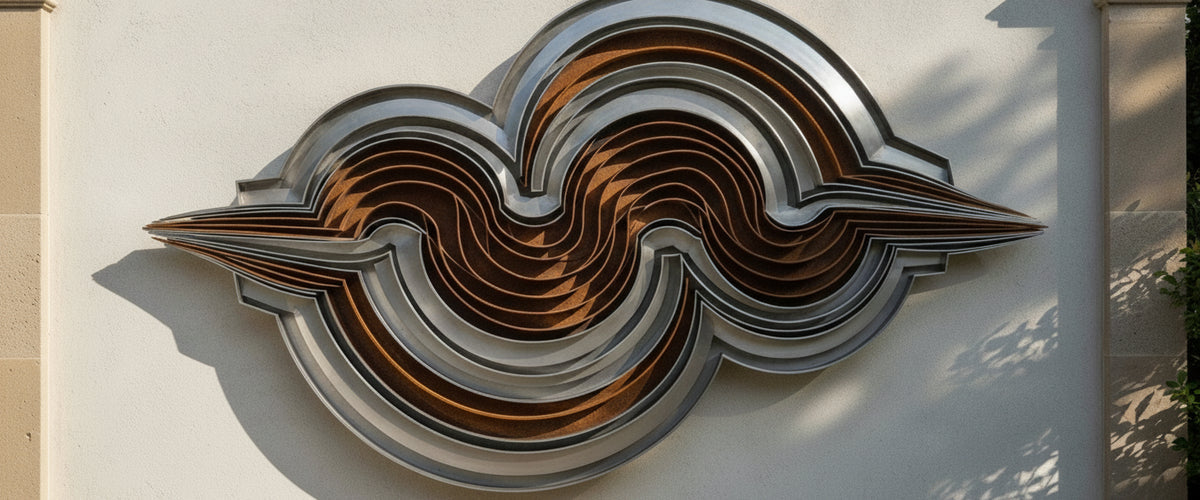

Most outdoor metal wall art fails for one reason: it was bought for a wall, not for a sightline. The piece arrives, the contractor fixes it dead-center on the stucco, and the owner spends the next three summers wondering why it looks smaller, flatter and less interesting than it did in the studio shot. That gap, between how a wall sculpture reads in a catalog and how it reads on a real elevation, is the entire job of placement for any outdoor metal wall art.
We make and ship large bespoke wall pieces from the Giant Sculptures studio for private homes, hotels and commercial lobbies, and the patterns repeat. So before you commit to a piece of outdoor metal wall art, or sign off on a commission, it is worth slowing down on the four decisions that actually move the needle for outdoor metal wall art: scale, height, backdrop and finish.
A wall piece sized to the visible field, not the full elevation.

Key Takeaways
Outdoor metal wall art should be sized to the wall's visible field, not the wall's full dimensions.
Eye level is rarely the right center line outdoors; sightline distance matters more.
Stainless steel, Corten and powder-coated aluminum each read very differently in natural light.
The backdrop wall does half the work; texture and color decide whether the piece sings or disappears.
Most commission mistakes come from skipping a full-scale paper or vinyl mockup before fabrication.

What Exterior Wall Sculpture Actually Looks Like in Real Settings
The outdoor metal wall art category covers a wide field. At one end you have flat silhouette pieces, laser-cut from steel or aluminum, mounted close to the wall and read almost like a drawing. At the other end you have deep relief work and sculptural metal panels with 6 to 12 inches (15 to 30 cm) of depth, where the shadow on the wall behind becomes part of the composition. The wider metal wall art range covers both ends of that spectrum.
In a Napa courtyard, a large abstract metal wall piece on a lime-washed wall behaves like a moving drawing as the sun tracks across it. In a Manhattan terrace, a tight stainless composition above the outdoor kitchen reads as jewelry, sharp, bright, deliberately small against the skyline. In a Texas ranch breezeway, a 9 ft (2.7 m) wide Corten panel becomes the architecture: the wall is just its mount.
Indoors, the same piece can flip register entirely. A flowing painted-metal work reads as a calm horizon over a sofa, where outside on a pool wall it competes with sky and water and needs the depth and reflectivity to hold its own. Both can work. They are not the same brief.
Scale and Sightline: The Choices That Change How the Piece Reads
The single most common mistake we see in client photos is undersized outdoor metal wall art on oversized walls. A 36 inch (91 cm) piece on a 22 ft (6.7 m) exterior elevation looks like a postage stamp from the lounger. Outside, you are almost always viewing from farther away than you would indoors, so the piece has to fight more sky and more peripheral noise.
A working rule from the studio: measure the visible field, meaning the wall area a guest actually sees from the main seating or arrival point, then size the artwork to roughly 55 to 70 percent of that field's width. For a feature wall behind a pool, the visible field is usually narrower than the wall itself because planting, pergolas and water cut off the edges.
Height is the second lever for outdoor metal wall art. Indoors, we hang to a 57 to 60 inch (145 to 152 cm) center line because viewers stand close. Outside, viewers sit, swim, or walk past at 12 to 30 ft (3.7 to 9 m). The center should rise. A large abstract metal wall art panel above a sunken lounge often wants its center at 72 to 84 inches (183 to 213 cm) off the deck, because the eyeline from a reclined chair is lower than you think and the piece needs sky around it, not above it.
Indoor Versus Outdoor Placement: When Each Wins
For wider placement ideas, Bring the Outdoors In: Transform Your Walls with Nature-Inspired 3D Art is useful companion reading before finalising the setting and sightlines for your outdoor metal wall art.
Some metal wall art decor is built for either environment; plenty is not. Composite-backed 3D pieces with internal MDF or unsealed timber will warp on an exterior wall by the second wet season. Powder-coated mild steel with cut edges left raw will bleed rust streaks down a render wall within a year. If you want true exterior metal wall art, the piece needs marine-grade fasteners, sealed edges, and a finish system rated for UV and salt where relevant.
Indoor placement wins when the piece is delicate, highly polished, or color-dependent. Mirror-polished stainless reads beautifully under controlled gallery light; outside, it picks up sky reflections that can wash out the form. Painted gradients and acrylic-faced works hold their color better behind glass than under direct sun. A piece like the Horizon Jade Mist Mountain Acrylic 3D Wall Art is engineered for an interior wall, where its translucency is the whole point and direct sun would degrade the layered acrylic over time.
Outdoor placement wins when the piece has real depth, a finish that genuinely improves with weather, or a silhouette strong enough to read against sky. Corten patinas through its first 18 months and then stabilizes; the Getty Conservation Institute's research on metal corrosion is a good primer if you want to understand what is happening at the surface of outdoor metal wall art. Bronze develops a living patina that no indoor environment can match. Stainless and aluminum, properly finished, can shrug off decades on a coastal wall.
Corten and bronze finishes reward west-facing walls and warm evening light.
Light, Backdrop and Contrast
Outdoor metal wall art is really light sculpture. The metal is the instrument; the sun is the player. Before you choose a piece, spend a day photographing the intended wall at 9 am, noon, 3 pm and 7 pm. A wall that is gorgeous at noon can be a black void by 7 pm, which means a dark patinated piece will vanish exactly when guests are out on the terrace.
North-facing walls (in the northern hemisphere) get soft, even light all day. They suit highly reflective, dimensional work because there is no harsh shadow to flatten the form. A cool-toned flowing piece such as the Waverno Blue & Green Flow Metal 3D Wall Art handles that diffused light well, where its layered curves still pick up enough variation to feel sculptural rather than flat. South-facing walls get strong directional light; they reward deep relief and bold silhouettes because the cast shadow does half the storytelling. East walls peak in the morning and suit pieces seen at breakfast. West walls peak at cocktails and reward warm finishes like brass, bronze and Corten; in that warmer light, something like the Waverno Ember & Graphite Flow Metal 3D Wall Art is closer to the right tonal register than a cooler stainless composition would be.
Backdrop matters as much as orientation for outdoor metal wall art. A pale limewash or smooth stucco wall is a clean canvas; almost anything reads well. Stacked stone, brick, and heavily textured render fight with detailed work; choose a bolder, simpler silhouette such as a circular silhouette piece or a single sweeping form. For a textured stone wall in a Hamptons garden, a clean shape like the Black Circular Lighthouse Silhouette Resin & Metal Wall Art - 71cm punches through the noise where a busier composition would muddy into the stone.
Common Placement Mistakes in Commissions
After years of commissioning conversations about outdoor metal wall art, the same handful of issues come up. They are easy to avoid if you know to look for them.
Hanging dead-center on the wall instead of dead-center on the visible field. Center the piece to where it is seen from, not to the masonry.
Choosing finish off a phone screen. Brushed, satin, mirror and powder-coat all behave radically differently in real sun. Ask for finish samples and tape them to the actual wall for 48 hours.
Forgetting the standoff gap. A piece of outdoor metal wall art needs 1 to 2 inches (25 to 50 mm) of standoff for airflow and shadow. Flush-mounting kills the depth and traps moisture.
Underspecifying fixings. A 6 ft (1.8 m) wide panel in a coastal location needs A4/316 stainless fixings, not whatever was in the contractor's van. Substrate matters too; ICF, lime render and timber clad walls each need different anchors.
Skipping the full-size mockup. Before any bespoke commission goes into fabrication, we recommend taping a paper or vinyl outline at full scale on the wall and living with it for a week. Heights and proportions that look right on a drawing often shift once you see them at 1:1.
Ignoring night lighting. An uplight from below transforms a deep-relief piece; a wash from the side flattens it. Decide the lighting before you decide the finish.
A Quick Buyer's Checklist
Measure the visible field, not the wall.
Confirm orientation and shoot the wall at four times of day.
Match material to environment: Corten or bronze for patina; sealed stainless or marine-grade aluminum for coastal; powder-coated steel for inland.
Request finish samples on the actual wall before sign-off.
Specify standoff brackets and corrosion-rated fixings for the substrate.
Mock up the silhouette at full size in tape or vinyl.
Plan night lighting in the same conversation as the artwork, not after.
Commissioning a Bespoke Piece
For most of the outdoor metal wall art projects we ship, the right answer is not the catalog piece exactly as photographed; it is a version sized to the wall, finished to the orientation, and engineered to the substrate. Bespoke commissions through Giant Sculptures begin with the wall, not the artwork. Send elevation photos, measurements, the substrate type, the orientation and a few reference images of pieces you like, and we work backward from there.
Budget on a commission depends on scale, material, depth, finish complexity, engineering and installation access. A flat laser-cut silhouette in mild steel is a very different proposition from a deep, multi-layer stainless composition that has to be crated, shipped and rigged into place. Rather than guess at numbers, we quote against the actual brief for your outdoor metal wall art; the studio will scope it honestly once we have the wall in front of us.
Whatever you choose, treat the wall, the light and the piece as one decision. Outdoor metal wall art rewards that discipline, and the outdoor metal wall art you commission today should still be reading well in twenty years.