






































































































A piece of modern abstract metal can own a room or vanish into the plaster behind it, and the gap between those two outcomes is rarely the artwork itself. It is placement. We have shipped modern abstract metal that looked flat in a client's phone photo and then stopped conversation once it was hung at the right height, on the right wall, with light hitting it the way the maker intended. Same object. Completely different result.
This is the part buyers underestimate. You choose the color, you choose the form, and then the wall does half the work for you or against you. Below is how we think about it in the studio when we advise on placing modern abstract metal, whether the piece is a spun metal sphere or a large freestanding sculpture.
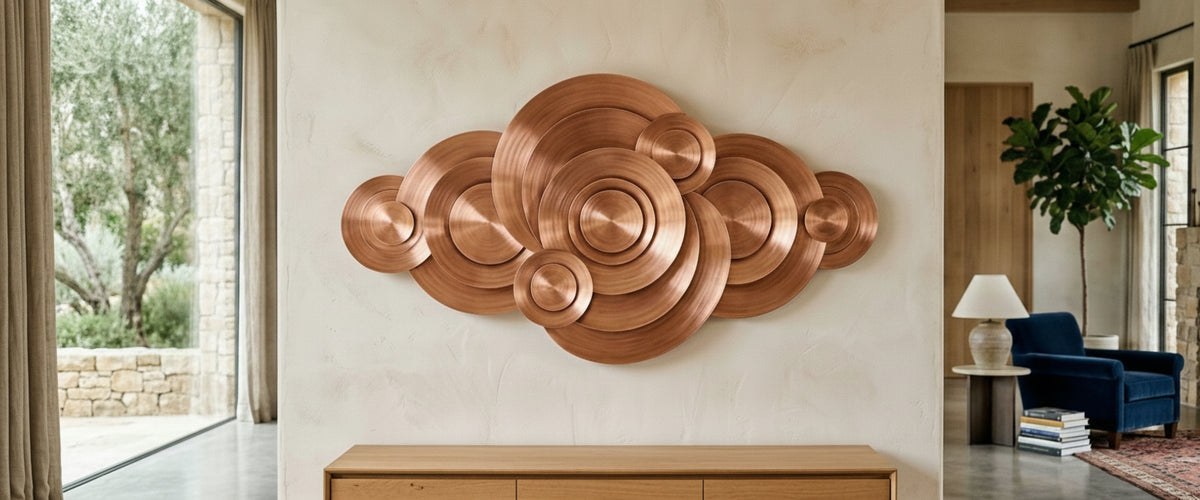
A warm metallic burst reads almost sculptural when a wall catches directional light.

Key Takeaways for Placing Modern Abstract Metal
Scale first: a piece should occupy roughly two-thirds of the visual field it sits in, not float alone on a vast wall.
Light is the material: brushed, mirrored, and patinated metal all behave differently under raking light versus flat light.
Backdrop contrast decides impact: a copper burst reads on charcoal, disappears on beige.
Indoor and outdoor need different metals: finish and grade matter far more outside.
Height is a system, not a guess: sightlines from where people actually stand should set the center point.

What Modern Abstract Metal Looks Like in Real Rooms and Gardens
Modern abstract metal covers a wide territory, from wall-mounted bursts and layered discs to freestanding forms in stainless steel or Corten. The common thread is that the form is doing the talking, not a literal subject. That freedom is exactly why placement carries so much weight; there is no obvious "front" or story to anchor the eye, so the room has to give it context.
In a double-height living space, a large metallic burst can hold a chimney breast that would swallow a framed canvas. A concentric spun-metal piece like the Eclat Sphere Copper Abstract Metal Wall Art throws warm reflections across a room in late afternoon and reads almost sculptural in relief, which is why it works better on a wall that catches directional light than one lit flat from above.
Outdoors, the calculus changes. A brushed or mirror-polished stainless form in a coastal garden picks up sky and foliage and shifts through the day. A Corten piece does the opposite; it sits warm and matte against green planting and reads as mass rather than movement. Neither is better. They answer different questions about the space.

Scale, Sightlines, and Pedestal Height
The most common fix we recommend is not a different sculpture. It is a different size of the same idea. Buyers routinely choose a piece that looks generous on screen and then find it stranded on the wall in person, because a phone crops out the empty space around it.
A workable rule for modern abstract metal wall art: the piece should fill roughly two-thirds of the usable wall width above a console, sofa, or fireplace. On a solo feature wall with nothing beneath it, you can push larger. When in doubt, cut a paper or cardboard template to the exact footprint and tape it up for a day before you commit. It sounds basic. It saves the most regret.
For freestanding work, pedestal height is the lever nobody thinks about. Raise a piece of modern abstract metal too high and it reads as a trophy; set it too low and people look down on it, which flattens the silhouette. As a starting point, we aim for the visual center of the piece to land near standing eye level for the room's typical viewing distance. In a gallery-style hallway where people pass close, drop it slightly so the top edge does not crowd the ceiling line.
Sightlines matter more than symmetry. Walk the route people actually take into the room and place the piece where that first glance lands, not where the tape measure says the wall's exact center is.
Outdoors, finish and grade matter far more than they do inside.

Indoor Versus Outdoor: When Each Wins
Indoors, you can use finishes that would struggle outside. Colored powder-coated steel, delicate patinas, and mirror polishes all stay stable in a controlled interior. A saturated red or teal burst becomes the color anchor of a neutral room, which is why the Eclat Sphere Teal Blue Abstract Metal Wall Art tends to land in spaces that are otherwise gray, white, and timber. The modern abstract metal supplies the one strong hue.
Outdoors, the material has to earn its place against weather. Marine-grade stainless steel (typically 316) resists coastal salt far better than standard grades, which matters enormously for gardens near the ocean. Corten, or weathering steel, is designed to form a stable rust-like patina that then slows further corrosion. Weathering steel performs best where it can dry between wettings, so a piece that sits in constant shade or standing water will not develop the same protective layer. See the ASTM A847 specification for weathering steel for the technical baseline.
The honest answer to "indoor or outdoor" is that you decide the environment first, then choose the metal and finish to suit it. Retrofitting an indoor finish to an exposed garden almost always disappoints.
Light, Backdrop, and Contrast
Metal has no fixed color. It reports whatever light and surroundings you give it, which is the whole trick with modern abstract wall art. A mirrored sphere on a pale wall in flat overhead light looks like a gray smudge. Move it to a wall that gets low, raking side light and the same piece of modern abstract metal throws depth, edge, and shadow.
Three practical checks before you hang or install:
Direction of light: raking light from the side reveals texture and relief; flat frontal light kills it. Position layered or dimensional pieces where light crosses them at an angle.
Backdrop value: warm metals (copper, bronze) sing against dark or cool walls; cool metals (steel, silver) read best against warm or mid-tone backdrops. On a lighter wall where a warm form would sink, something like the Eclat Sphere Black Abstract Metal Wall Art holds its edge, provided the wall behind it stays pale enough for the form not to dissolve.
Reflection content: a polished piece will mirror whatever faces it. Check what it reflects: a clean window and garden is good; a cluttered kitchen is not.
For colored pieces, think about what the room's artificial light does after dark. Warm bulbs mute cool tones and push warm ones. We have had clients swap a single fitting from a warm to a neutral temperature and finally get the blue they thought they had bought.
Common Placement Mistakes We See in Commissions
For wider placement ideas, Abstract Metal Sculpture: Reading the Forms That Last is useful companion reading before finalising the setting and sightlines.
Some patterns come up again and again once a piece of modern abstract metal is on site.
Hanging too high. The single most frequent issue. People align the top of a piece with door frames or picture rails instead of centering it on the eye. Drop it.
Choosing size by wall, not by furniture. A large abstract burst above a narrow console looks top-heavy. The piece should relate to the object beneath it, not just the wall.
Ignoring the reflection. Mirror finishes are wonderful until they reflect a ceiling vent or a run of downlights straight back at the sofa. Sit where people will sit and look before you fix anything.
Fighting the architecture. A busy stone or heavily patterned wall competes with an intricate modern abstract metal form. On those surfaces, go simpler and larger. Save the layered, detailed pieces for calm backdrops.
Under-lighting outdoor work. A garden sculpture with no dedicated light disappears at dusk, exactly when people are outside with a drink. A single low, angled fixture changes everything. The DarkSky guidance on shielded, downward-directed lighting is a good sanity check so you light the sculpture, not the neighbor's bedroom.
Commissioning at Scale
When a piece of modern abstract metal has to fit a specific wall, ceiling height, or garden sightline, a bespoke commission removes the guesswork. At Giant Sculptures we work in metals built to last outdoors, including stainless steel, Corten, and bronze, and we scale abstract forms to suit the actual architecture rather than forcing a stock size into a space it was never made for.
The practical starting point is simple: send the dimensions, a couple of photos of the wall or garden with the light as it falls at different times of day, and a note on whether the modern abstract metal lives indoors or out. From there we can advise on size, finish, and fixing before anything is fabricated. If you are still gathering ideas, the metal wall art collection and our contemporary and modern sculptures are the best places to see how form and finish behave at different scales.
Get the placement right and modern abstract metal does what it should: it holds a room or a garden without shouting, and it keeps rewarding the second and third look.