





































































































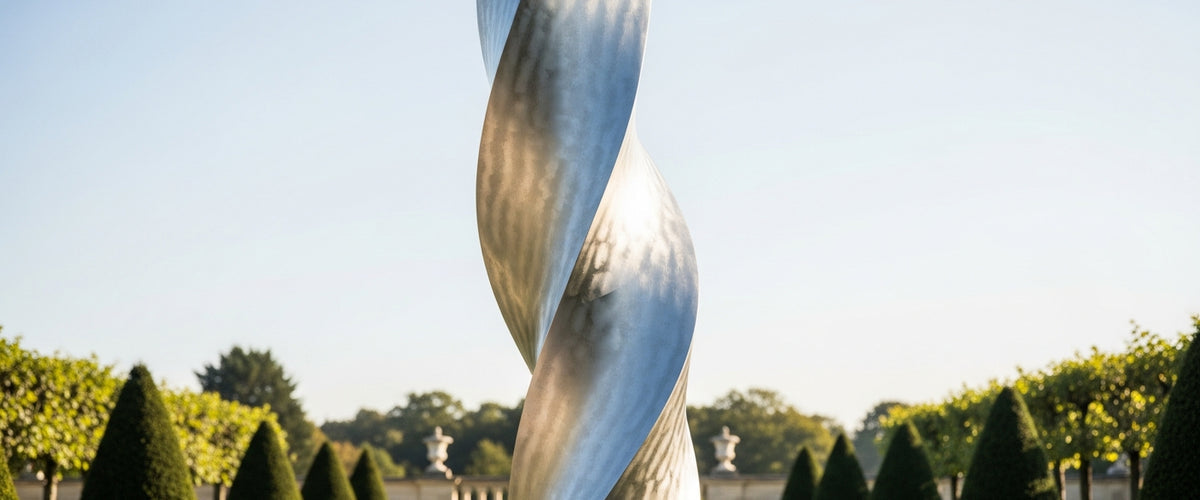

Most abstract metal sculpture fails for one reason: it was bought before it was understood. A swirl of stainless steel that looked decisive in a gallery photograph becomes restless on a long wall at home. A weathering steel column that promised gravitas in a render reads as a rusty post in the wrong corner of a garden. The metal is rarely at fault. The reading was.
At Giant Sculptures we spend a lot of time helping clients translate instinct into specification, particularly when they are commissioning an abstract metal sculpture at scale. Abstract work is the hardest category to buy well, because it offers no obvious narrative handles. There is no horse, no figure, no story to lean on. There is only form, finish, light and the air around it. This guide is about learning to read those four things properly before you commit.

Key takeaways for buying abstract metal sculpture
Form first, finish second. A resolved abstract metal sculpture works in silhouette before colour or polish enters the conversation.
Metals have personality. Stainless reflects, Corten breathes, aluminium floats, mild steel anchors.
Scale is usually wrong by half. Most rooms and gardens need a piece bigger than the buyer first imagines.
Negative space is part of the sculpture. Plan the void as carefully as the volume.
Commission with intent. Bespoke metalwork rewards clear references, site photos and honest constraints.

What makes an abstract metal piece feel resolved
A resolved abstract metal sculpture has a job, even if it never names it. It might be holding a corner, marking a threshold, drawing the eye across a courtyard, or anchoring a double-height wall. An unresolved piece tries to do all of those at once and ends up doing none of them. When clients send us images of work they admire, we start by asking what the sculpture is for in that space. The answer shapes everything that follows.
Read the silhouette first. Squint at a photograph of any abstract sculpture metal piece you are considering. If the outline still has rhythm, tension and a clear top, middle and base, the form is doing its job. If it collapses into a blob, no amount of mirror polish will save it. Resolved abstraction has internal logic: lines arrive somewhere, curves resolve into other curves, voids are deliberate rather than accidental.
The second test is rotational. Walk around it, even in your imagination from photographs. A serious freestanding abstract metal sculpture should offer at least three distinct readings as you move. If two of those readings are weak, the sculpture is really a relief pretending to be in the round, and it belongs on a wall.

Stainless, Corten, mild steel, aluminium: the personality of each metal
The material is not a neutral carrier of form. It is half the sculpture. Choosing between metals is closer to casting an actor than selecting a finish.
Stainless steel is the showman. Mirror-polished, it dissolves into its surroundings, borrowing sky, foliage and architecture. Brushed or satin, it holds its own shape and reads as confident industrial craft. Marine-grade 316 is the right specification for coastal sites or anywhere chlorides are in play. Stainless suits an abstract metal sculpture that depends on reflection, optical play, or a dialogue with changing light.
Corten, or weathering steel, is the patient one. It develops a stable oxide layer that protects the metal beneath, giving that deep, velvety russet so beloved of landscape designers. The Tate's overview of Cor-Ten steel traces its use through Richard Serra and Beverly Pepper, and the material still rewards bold, planar abstraction at architectural scale. Worth noting: Corten runs in its first years, so plinth and ground detailing matter.
Mild steel with a high-quality powder coat or marine paint system is the workhorse. It accepts almost any colour, holds crisp edges, and lets a sculptor build complex welded geometry without the cost of stainless. The trade-off is maintenance: the coating is the protection, and once it is compromised, corrosion follows.
Aluminium is the lightweight specialist. It is the right call when you need a large abstract metal wall sculpture that will not overload a partition, or a roof-terrace piece where weight matters. Anodised or powder-coated, it holds colour beautifully and resists corrosion without the mass of steel.
Indoor wall sculptures vs freestanding garden installations
Abstract metal wall art and freestanding abstract metal garden sculptures are different disciplines, even when they share a maker. A wall piece is composed for a single principal viewpoint and a controlled background. A freestanding abstract metal sculpture must survive being seen from everywhere, in every weather, with the background changing by the hour.
For interior walls, depth is the variable most buyers underestimate. A flat panel reads as graphic; a relief with 80 to 200 mm of projection starts behaving like sculpture, throwing shadows that change with the time of day. Where a long hallway or stairwell needs the relief to actually animate the wall rather than sit flat against it, layered circular geometry such as the Aurivista Blue & Silver Abstract Circle Panel 3D Metal Wall Art is closer to the right approach than a single-plane panel.
Texture is the other lever. A heavily worked, almost geological surface like the Terranica Metallic Crust Textured Abstract Metal Wall Art reads as landscape compressed into a wall, and pieces of that kind need raking light from one side to come alive. Consider where your wall washers or windows actually sit before you commit to anything that depends on shadow play.
Outdoors, the rules invert. You are now competing with sky, planting and architecture, all of which are large. An abstract metal sculpture in a garden needs either real mass or real height to hold its own. A 1.2 m piece marooned in a 20 m lawn looks like a forgotten ornament. The same form at 2.5 m, sited against a hedge or at the end of a sightline, becomes the reason the garden has that view.
Patina, powder coat and brushed finishes in real light
Finish samples lie. They are photographed under controlled studio light, often against neutral grey. Your wall is not neutral grey and your garden is not a studio. Before you sign off a finish on a serious abstract metal sculpture commission, see a sample at the actual site, in morning and late-afternoon light, against the actual backdrop.
Mirror polish is unforgiving. Every weld, every grind line, every fingerprint shows. It is glorious when executed properly and embarrassing when not. Brushed and satin stainless are far more tolerant and, in many interiors, more elegant. Where colour is part of the brief but you still want the metal to do the optical work, a brushed substrate beneath a translucent finish, as on the Zephyr Crimson Swirl Abstract Metal Wall Art, catches light in long controlled streaks rather than bouncing it flatly back at the viewer.
Powder coat looks identical to paint in a brochure and behaves nothing like it in practice. A quality polyester powder coat over a properly prepared and primed substrate will hold colour for many years outdoors; a cheap coat over poorly prepped steel will fail at the edges within two or three winters. Ask, in writing, about pre-treatment, primer, top-coat thickness and warranty position before you commission an outdoor abstract metal sculpture.
Corten patina cannot be rushed honestly. Pre-weathered finishes exist, but the deepest, most varied surfaces are the ones that have spent real time outside. If you want the dense, textured look of a mature Corten piece, accept that the first 12 to 18 months are part of the artwork.
Scale and negative space: why most rooms need bigger than you think
Scale is where commissions go wrong most often. People measure the wall, subtract a generous margin, and order an abstract metal sculpture safely smaller than the space can carry. The result looks tentative.
A working rule for an interior abstract metal wall sculpture: the piece should occupy roughly two-thirds of the visual width of the wall or furniture grouping below it, and ideally more in double-height spaces. For freestanding work, the sculpture should read clearly from the point where the viewer first sees it, which is often further away than the buyer remembers.
Negative space matters as much as volume. The void inside a looping form, the gap between two leaning planes, the air around a vertical shaft, these are doing structural work in the composition. When we develop a bespoke abstract metal sculpture, we model the surrounding space as carefully as the piece itself. A great abstract form sculpts its own clearance.
Artists and movements worth knowing before you commission
You do not need an art history degree to commission well, but a handful of reference points will sharpen your brief. Among twentieth-century abstract metal sculpture artists, David Smith, Anthony Caro, Eduardo Chillida, Beverly Pepper and Richard Serra established most of the vocabulary still in play today. Smith and Caro brought welded steel into the language of high art; Chillida made mass feel weightless; Pepper and Serra made it feel inevitable.
Knowing which of these voices speaks to you is genuinely useful when commissioning an abstract metal sculpture. "I want something with the planar weight of early Serra but warmer" is a brief a sculptor can work with. "Something abstract and modern" is not.
A practical commissioning checklist
Site photos in morning, midday and evening light, with measurements visible.
Sightlines: where will the piece first be seen from, and from how far?
Material shortlist based on environment, weight limits and the personality you want.
Three reference images of work you admire, with notes on what specifically draws you.
Constraints stated upfront: access routes, crane requirements, fixing substrates, planning sensitivities.
Maintenance expectations agreed in writing for finish, fixings and inspection intervals.
Budget framed honestly. Cost on a bespoke abstract metal sculpture depends on material, scale, engineering, finishing and installation, so expect a tailored quote rather than a fixed list price.
Buying with the long view
The pieces that earn their place over decades share one quality: they were chosen for the right reasons. Not because they matched a cushion, but because their form held a corner of a room or a garden in a way nothing else could. Giant Sculptures works with private collectors, designers and developers to commission an abstract metal sculpture at architectural scale, and the conversation always starts the same way, with the space, the light and the silhouette. Get those right and the finish, the material and the budget conversation follow naturally.
For wider placement ideas, Metallic Marvels: Abstract Sculptures That Shine in Gold and Silver is useful companion reading before finalising the setting and sightlines for your abstract metal sculpture.
For general conservation principles, Canadian Conservation Institute outdoor object care is a useful external reference, though the final care routine should always follow the material and finish specified for the individual commission.