





































































































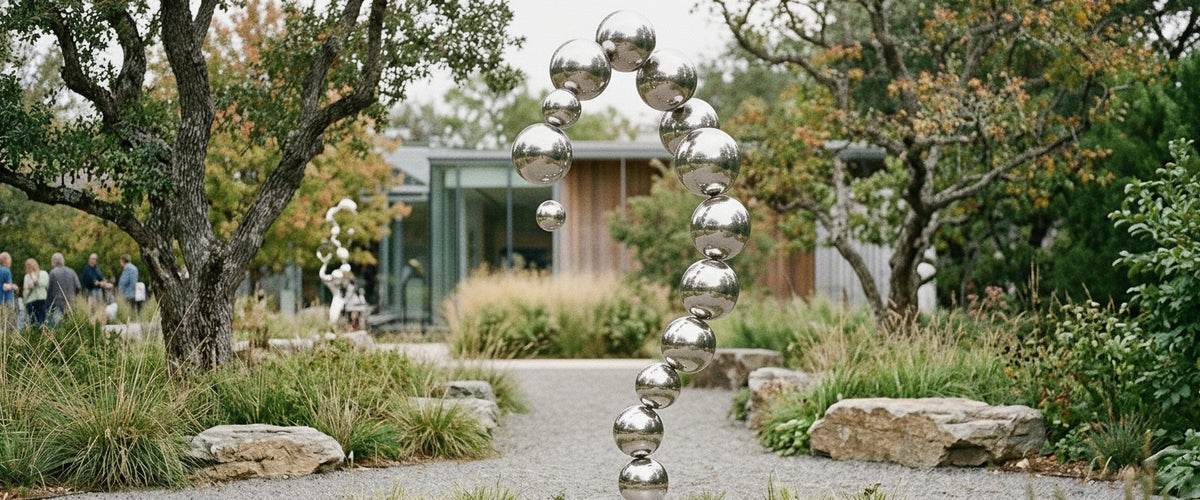

Buy the right piece, put it in the wrong spot, and a contemporary abstract sculpture reads as an afterthought. We see it constantly: a strong bronze or a clean stainless steel form that would command a courtyard instead crammed against a wall, lit flat, competing with a hedge behind it. The sculpture is fine. The placement killed it. Abstract work is unforgiving that way, because it has no obvious front, no face to orient you, and no story to carry a weak position.
Placement is where most of the value is won or lost. Get the scale, the sightline, and the backdrop right and even a mid-size contemporary abstract sculpture feels intentional. Get them wrong and a monumental commission can look stranded.
Give abstract work room to breathe and the composition reads as intended.

Key Takeaways
Scale to the space, not the room you photographed it in. Abstract forms need breathing room to read as sculpture rather than decor.
Pedestal height changes everything. A few inches up or down shifts where the eye lands and how the silhouette breaks against its background.
Outdoors rewards contrast; indoors rewards restraint. Sky and planting flatter bold metal; interiors want a quieter backdrop.
Light is a design decision, not an accident. Raking light reveals surface; flat frontal light flattens it.
The most common mistake is under-scaling. Buyers routinely choose a contemporary abstract sculpture one size too small for the sightline it has to hold.

What Contemporary Abstract Sculpture Looks Like in Real Rooms and Gardens
A contemporary abstract sculpture behaves differently depending on where it sits. Indoors, a contemporary abstract metal sculpture on a console or plinth becomes a focal point you read at close range, so surface finish and edge quality matter enormously. In a double-height entry or a stairwell void, the same form can be scaled up dramatically and viewed from several floors at once, which changes what pose actually works.
Outdoors is a different animal. A garden gives you distance, weather, and a moving sun. For a form built to be read from across a lawn, where the negative space between elements does real work against sky and planting, something like the Large Contemporary Abstract Raindrop Cluster Sculpture - 250cm (about 8.2 feet tall) needs that distance to breathe. Put the same piece in a tight side return and the composition collapses; you lose the gaps that make it legible.
Material sets the mood before form even registers. Bronze warms and darkens as its patina matures, which suits a wooded or planted setting. Polished stainless steel throws reflections and light, so it belongs where there is something worth reflecting: water, planting, a clean architectural facade. A contemporary abstract stone sculpture reads heavier and more grounded, at home on a terrace where it can sit low and solid. If you are still weighing materials, our abstract sculptures collection is a useful way to compare how the same contemporary abstract sculpture language changes tone across bronze, steel, and stone.

Scale, Sightlines and Pedestal Height
Three numbers decide whether a contemporary abstract sculpture lands: how tall it is, how far away you stand, and how high it sits. Buyers obsess over the first and ignore the other two.
Start with the sightline. Measure the primary viewing distance, then the secondary ones. A sculpture seen mostly from 30 feet (about 9 meters) across a courtyard needs a bolder silhouette and more overall mass than one you pass at arm's length in a hallway. As a rough working rule from the studio, if a piece has to hold a view from more than 25 feet away, size up rather than down. Under-scaling for a long sightline is the single most frequent regret we hear about after delivery.
Pedestal height is the quiet lever that decides where the eye lands.
Pedestal height is the quiet lever. Raise a torso so its natural center of interest sits near eye level and the whole thing reads as considered. Drop it too low and viewers look down on it, which flattens the form and kills the profile. Where a close-range interior focal point is the goal, a piece such as the Large Contemporary Abstract Female Torso Bronze Sculpture - 140cm (roughly 4.6 feet) makes the case for pedestal height: on the floor it is a nice object; on a plinth that brings the upper body to standing eye line, it becomes the piece that organizes the room. When we commission a contemporary abstract sculpture, we ask for the intended plinth height before we finalize proportions, because the two decisions are joined.
A Quick Placement Checklist
For wider placement ideas, Contemporary Abstract Metal: How to Place It so It Actually Reads is useful companion reading before finalising the setting and sightlines.
Measure your primary and secondary viewing distances before choosing size.
Decide the intended eye line, then work out pedestal height to match.
Walk the full approach path; check the silhouette from every angle people will use.
Leave clear space around the piece equal to at least its own footprint, ideally more outdoors.
Check the backdrop for clutter, competing lines, and color clashes.
Confirm the base and ground can carry the weight (large bronzes can run into hundreds of pounds).

Indoor Versus Outdoor: When Each Wins
Indoors wins when you want intimacy and control. You dictate the light, the backdrop stays constant, and the viewer meets the work at close range, so fine surface and finish reward the effort. A contemporary abstract ceramic sculpture or a smaller bronze suits a gallery wall, a library, or a hotel lobby niche where people slow down and look closely.
Outdoors wins when you want presence and scale. A garden gives a monumental contemporary abstract sculpture the distance it needs and the changing light that keeps it alive across the day. Where a setting needs a genuine landmark rather than a focal object, a piece like the Monumental Contemporary Abstract Horse Head Bronze Sculpture - 450cm (nearly 14.8 feet) only makes sense with real air around it and sky behind. Indoors it would overwhelm; on an open lawn or at the entrance to a corporate campus, it reads as a landmark.
If a piece is heading outdoors permanently, material and finish decisions carry more weight. Bronze and Corten steel are built for it and mature handsomely. Some stone weathers beautifully; others do not enjoy hard freeze-thaw cycles. The Smithsonian American Art Museum's guidance on caring for outdoor sculpture is a sensible primer on why maintenance planning belongs in the buying decision, not after it.

Light, Backdrop and Contrast
Light does more for a contemporary abstract sculpture than almost any other factor, and most people leave it to chance. Frontal light flattens form because it fills every shadow; the piece loses its modeling and reads as a flat outline. Raking light from the side, low in the morning or late afternoon, moves across the surface and pulls out every curve and edge. When we photograph commissions in the studio, we chase that low side light because it is what makes a form look three-dimensional.
Backdrop decides contrast. A dark bronze against a dark yew hedge disappears; the same bronze against a pale render wall or open sky snaps into focus. Polished stainless steel is the opposite problem, since it borrows its surroundings, so a busy backdrop turns into visual noise. Give reflective work something clean and calm to reflect.
Color matters more than buyers expect. A warm patinated bronze fights a cool gray granite terrace; a cooler steel sits well against it. Test this before you commit. We often send finish samples so clients can hold the actual patina against their own wall or paving in daylight, because a color that works in a rendering can read completely differently on site.

Common Placement Mistakes We See in Commissions
The mistakes repeat, which is why they are worth naming.
Under-scaling for the sightline. Already flagged, and still the number one issue. A contemporary abstract sculpture chosen to look right in a showroom photo often looks lost in a real garden. When in doubt, go up a size and pull it forward so it does not drown against distant planting.
Ignoring the approach. An abstract contemporary sculpture has no fixed front, so how people walk toward it defines the experience. A directional piece such as the Monumental Contemporary Abstract Trotting Horse Bronze Sculpture - 290cm (about 9.5 feet) rewards careful orientation: sited facing the house, one client lost the sense of motion entirely, but rotated to greet the driveway approach, the movement in the legs finally read as movement rather than a static profile. Same sculpture, completely different impact.
Cluttered backdrops. Fences, downpipes, parked cars, and busy borders all steal attention. Give the work a clean plane behind it.
Forgetting weight and foundations. Large bronzes and stone can be very heavy, and outdoor pieces need a base rated for wind load and ground movement. Sort the engineering before the piece arrives, not on delivery day.
Copying a look without the context. A polished contemporary abstract sculpture that dazzles in a sunlit courtyard with a reflecting pool will fall flat on a shaded roof terrace with nothing to bounce. Buy for your conditions, not for someone else's photograph.
Commissioning With Placement in Mind
The strongest results come when placement is part of the brief, not an afterthought. Tell us the site, the sightlines, the light through the day, and the backdrop, and we design proportion, pose, and finish to suit. Whether you are drawn to figurative abstraction or the cleaner geometry in our contemporary and modern sculptures, a bespoke contemporary abstract sculpture lets you size the work to the exact distance it has to hold and specify a patina or finish that fits your setting.
Budget depends on material, scale, complexity, engineering, installation, and finishing, so the honest answer is to request a tailored quote once the concept and site are clear. Giant Sculptures works with clients worldwide on large-scale, bespoke abstract pieces built to last, and we would rather get the placement conversation right at the start than fix a stranded contemporary abstract sculpture later.