

































































































A hotel lobby has roughly six seconds to convince a guest the rest of the stay will be worth it. A hotel lobby metal sculpture, when it is sized and sited well, does that work without saying a word. Get it wrong and you have a heavy, expensive object that everyone walks past on the way to the elevators.
This playbook is for the designers, owners and procurement teams we deal with at Giant Sculptures when they are specifying a hotel lobby metal piece for the first time, or trying to make a difficult double-height space finally read as finished. The advice below comes from hotel lobby metal commissions we have shipped to boutique properties in Napa, resort hotels in the Hamptons, and a few towering corporate lobbies in Texas where the brief was simply: fill it.

At a Glance: What Good Hotel Lobby Metal Looks Like
Scale rule of thumb: for a freestanding piece, aim for roughly one third to one half the ceiling height once you add the pedestal.
Sightline rule: the focal point should sit between 5 ft and 6 ft 6 in (1.5 to 2 m) off the floor for most adult eye lines.
Material default: mirror-polished or brushed stainless steel for light, bronze for weight and warmth, Corten for outdoor arrival courts.
Backdrop rule: the wall or void behind the piece does at least half the work. Plan it together.
Mistake to avoid: ordering the hotel lobby metal sculpture before the lighting plan is locked.

What Hotel Lobby Metal Actually Looks Like in Real Rooms
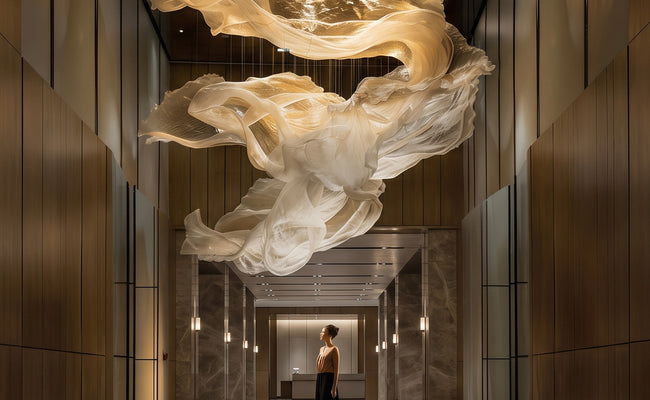
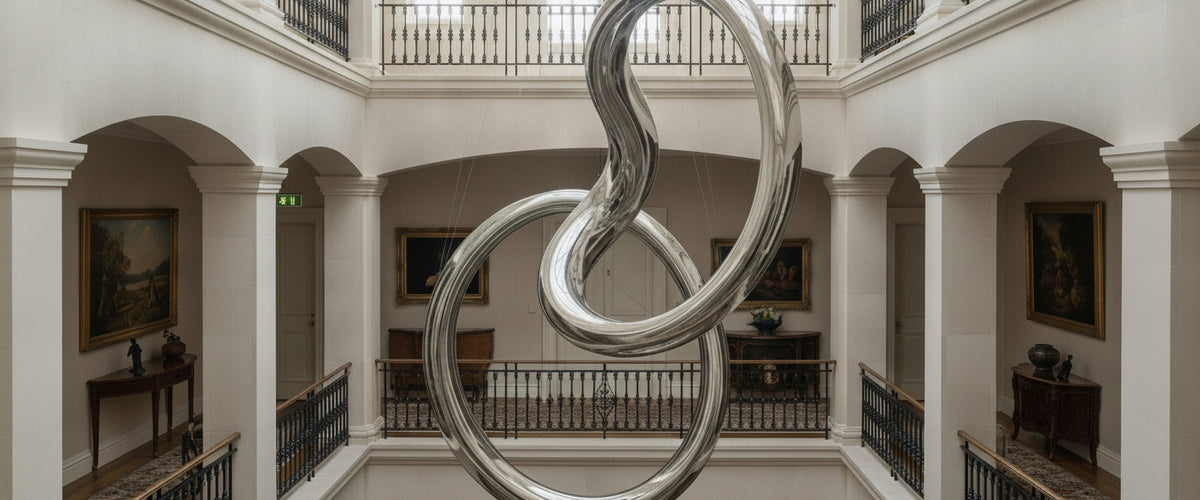
The phrase covers a wider range than people expect. In a low-ceilinged boutique check-in, hotel lobby metal might be a 4 ft (1.2 m) brushed bronze figure on a stone plinth beside the concierge desk. In a 30 ft (9 m) atrium it could be a suspended stainless steel form weighing 600 pounds (270 kg), reading as a chandelier from the mezzanine and as a sculpture from the floor. Outside the front doors, on the arrival drive, hotel lobby metal might be a Corten steel piece patinating quietly through its first winter.
The material does different things in each setting. Polished stainless catches the moving light from revolving doors and turns guests into part of the piece. Bronze absorbs warm downlights and gives a lobby gravitas, which is why we see it specified for properties that want to read as established rather than new. Corten belongs outdoors or in genuinely industrial interiors; it is a poor choice for a marble check-in floor because the oxide can mark stone. The metal sculptures catalog gives a useful sense of how these materials behave at scale before you commit to a hotel lobby metal commission.

Scale, Sightlines and Pedestal Height
The single most common error we correct on hotel lobby sculpture briefs is undersizing. A hotel lobby metal piece that looks generous in a showroom photo will shrink the moment it is lifted into a 22 ft (6.7 m) lobby with a 12 ft (3.6 m) reception desk behind it. The room eats it.
A workable starting formula: measure ceiling height, subtract roughly 18 in (45 cm) of breathing room at the top, and aim for a combined sculpture-plus-pedestal height that fills one third to one half of what remains. For a 20 ft (6 m) ceiling, that is a 6 to 9 ft (1.8 to 2.7 m) total assembly. The pedestal is part of the sculpture, not a stand for it. Get the stone, steel or board-formed concrete spec right and the piece reads as belonging to the building.
Sightlines matter as much as height. Walk the lobby from the front door, from the elevators, from the bar, from the top of the stairs. The piece should anchor at least two of those sightlines and not block any of them. A common fix on our drawings is rotating a figurative bronze five or ten degrees so the strongest profile faces the entrance rather than the desk staff.
Indoor Versus Outdoor: When Each Wins
Indoor hotel lobby metal work wins when you want controlled lighting, a quiet acoustic frame, and a piece that interacts with guests at close range. Polished surfaces, fine detail, and figurative bronze all reward being seen from 6 ft away. This is also where wall-mounted work earns its place. Where a long check-in wall would otherwise need three smaller artworks fighting for attention, a single large-format panel such as Waverno Blue & Green Flow Metal 3D Wall Art can hold the wall on its own, and the color shifts as guests move along the queue.
Outdoor wins when the arrival sequence is the story. Resort properties, ranch hotels and any building set back from the road benefit from a sculpture that announces itself before the doors do. Here you want weather-tolerant alloys, sealed welds, and a foundation engineered for wind load. Stainless steel reads crisply against planting and sky; Corten reads beautifully against stone walls and gravel. If you are weighing a mirror-finish piece for an outdoor court, walk the stainless steel sculptures catalog with a polarizing eye, because real-world glare can be a guest complaint if the orientation is wrong.
A hybrid we are seeing more often: a smaller interior hotel lobby metal piece that echoes a larger exterior commission, in the same hand and material family. It gives the property a quiet narrative without anyone needing to explain it.
Light, Backdrop and Contrast
Lighting decides whether a hotel lobby metal sculpture looks expensive or invisible. Three things we insist on before sign-off:
Dedicated fixtures. Ambient lobby lighting is not enough. Plan for at least two adjustable accent fixtures per freestanding piece, ideally on a separate dimming circuit.
Color temperature match. Bronze and warm patinas want 2700 to 3000K. Polished stainless can take 3000 to 3500K. Mixing temperatures across the same piece is the fastest way to make a serious sculpture look cheap.
Backdrop contrast. A dark bronze on a dark walnut wall disappears. A mirror-polished piece against a glass curtain wall doubles itself into nothing. Plan the wall or void behind the sculpture with the same care as the sculpture itself.
Where a warmer, darker palette is already established in the lobby joinery, a piece in the ember and graphite range, such as Waverno Ember & Graphite Flow Metal 3D Wall Art, sits more comfortably than a high-polish stainless work that would fight the timber. Good hotel lobby metal design treats finish and surround as one decision.
For technical guidance on art lighting in public interiors, the Illuminating Engineering Society publishes accessible standards that your lighting designer should already be working from.
Common Placement Mistakes We See
For wider placement ideas, Get the Luxe Look: Metal 3D Art You Can Actually Afford is useful companion reading before finalising the setting and sightlines.
After years of shipping large hotel lobby metal pieces into hotels, the same handful of errors keep surfacing. Most are fixable on paper if you catch them before the crate arrives.
Ordering before the millwork is final. A reception desk that grows 8 in during value engineering will swallow the base of your sculpture.
Forgetting the rigging path. A 7 ft bronze that cannot fit through the service corridor is a very expensive lesson. We ask for door, elevator and turning radius dimensions on every commission.
Placing the piece dead center. Symmetry is not always your friend. Off-axis placement, anchored to a structural column or a strong wall, almost always reads better in photography and in person.
Underspecifying the floor. A 900-pound (410 kg) sculpture on a thin stone tile over a post-tension slab needs a structural sign-off. Get the engineer involved early.
Treating wall art as an afterthought. If the lobby has a strong horizontal wall behind a long sofa, a sculptural panel can carry the room without needing a freestanding piece at all. Decide early which wall, which void, which moment you are dressing.
Skipping the maintenance brief. Polished stainless shows fingerprints. Bronze patinas shift with humidity. Outdoor finishes need annual inspection. The American Institute for Conservation publishes useful caretaker guidance you can hand to facilities.
Commissioning a Bespoke Piece
Off-the-shelf works for some lobbies. For most flagship properties, a bespoke hotel lobby metal commission is the only way to get scale, material and narrative aligned. A typical Giant Sculptures hotel lobby metal project runs from initial concept sketches through scaled maquettes, engineering drawings, foundry or fabrication, finishing, crating, freight and install supervision. Budget depends on material, scale, complexity, engineering, installation and finishing, and the honest answer to any pricing question early in the process is: let us scope it and quote it.
Two questions worth answering before you brief any studio. First, what do you want a guest to feel in the six seconds after the doors open? Second, what does the sculpture in the hotel lobby need to do in photographs for the next ten years of marketing? Those two answers shape everything else: material, scale, finish, placement, lighting, and whether you are buying a hotel lobby metal sculpture or commissioning a landmark.