





































































































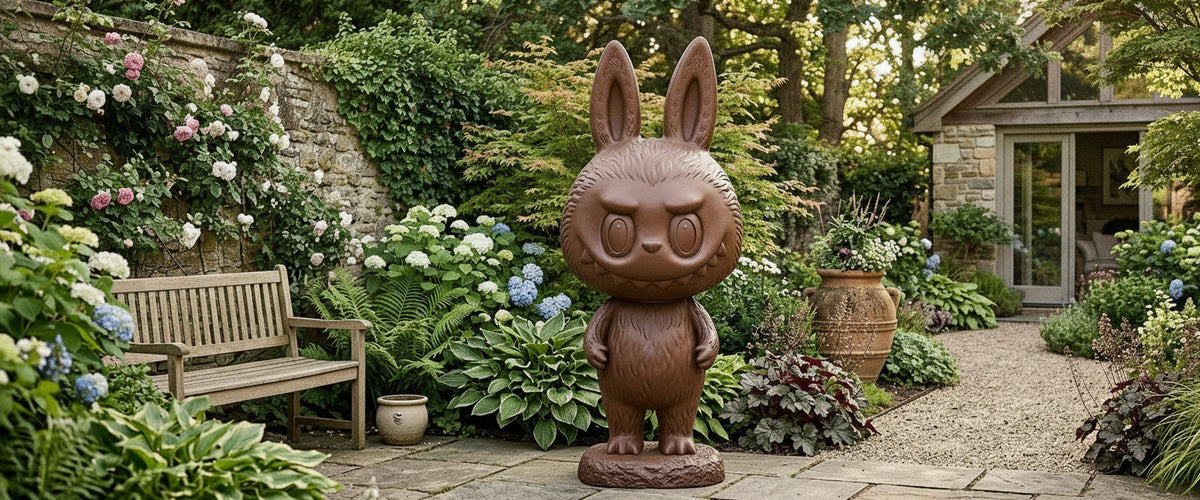

A giant brown Labubu sculpture is a hard piece to place well. Get it right and the figure anchors a double-height entry or a lawn the way a bronze stallion used to in an older era of collecting. Get it wrong and you have a charming character marooned in a corner, fighting the sofa for attention. The difference is not the sculpture; it is the planning around it.
We have shipped giant brown Labubu sculpture commissions from our studio to clients in Los Angeles, Austin and a private members' club in Miami, and the same three questions come up every time: how tall, how far from the wall, and what sits behind it. This guide answers those, then works through the placement decisions that actually move the needle.

Quick Answer: What Makes a Giant Brown Labubu Sculpture Work
Scale: Aim for the figure's head to land between eye level and roughly 18 inches above it for indoor settings; outdoors you can go taller.
Clearance: Leave at least 3 feet (about 0.9 m) of breathing room on the primary viewing side, ideally more.
Backdrop: A plain wall, hedge or sky beats a busy backdrop every time. A brown Labubu sculpture reads warmest against off-white, cream limestone, weathered cedar or deep green planting.
Pedestal: Optional indoors, often unnecessary outdoors above 5 feet (1.5 m). When used, keep the plinth visually quieter than the figure.
Light: Side light at roughly 30 to 45 degrees reveals the form. Flat overhead light flattens it.

What the Piece Actually Looks Like in a Room
The character itself is mischievous, with that toothy grin and oversized ears, and the brown finish gives a giant brown Labubu sculpture a warmer, more grounded presence than the candy-colored variants. At around 3 feet (1 m), it reads as a sculptural object you walk around. At 5 feet (1.5 m) it becomes a presence in the room: visitors greet it before they greet you. Push past that into truly giant territory and the piece changes register again, behaving more like a small architectural feature than a decorative object.
Inside a contemporary home, a brown Labubu sculpture plays surprisingly well with mid-century woods, travertine and bouclé. The ear silhouette wants air above it, which is why double-height foyers, mezzanine landings and stairwells with a clear sightline upstairs tend to work best. In a standard 9 foot (2.7 m) ceiling, a 5 foot figure leaves enough headroom; an 8 foot figure does not.
Outdoors, the warm brown finish holds up beautifully against planting. We have seen the same giant brown Labubu sculpture read as playful on a clipped lawn and as almost reverent at the end of a gravel walk through a Napa olive grove. The setting decides the mood.

Scale, Sightlines and Pedestal Height
The most common mistake collectors make when buying a giant brown Labubu sculpture is choosing scale by floor area. Floor area matters, but sightlines matter more. Walk the approach. If guests see the piece from 30 feet away across an open plan room, the figure needs enough vertical mass to hold that distance. A 100 cm Labubu placed at the far end of a long room disappears; the same piece on a console at the room's natural pause point dominates.
For a long approach across an open plan, a piece at the scale of the The Monster Freckles Mega Labubu Sculpture - 160cm tends to hold the room without crowding the ceiling line. In a tighter snug, study or gallery wall, the same character in the The Monster Freckles Mega Labubu Sculpture - 100cm at floor level reads better than a smaller piece lifted onto a plinth.
On pedestals: indoors, a low plinth (4 to 8 inches / 10 to 20 cm) lifts the piece off the floor visually and protects it from vacuum cleaners and curious shoes. Anything taller starts to feel like museum mode, which is the wrong register for a character piece. Outdoors, a pedestal makes sense if the figure sits in a planted bed and needs to clear foliage, or if drainage is a concern. Otherwise, ground-level placement keeps a giant brown Labubu sculpture honest.
One studio rule we follow: the plinth should never out-talk the sculpture. A heavy stone block under a playful brown figure neutralizes it. A simple steel or honed concrete base lets the figure speak.

Indoor Versus Outdoor: When Each Wins
Indoor wins when you want a giant brown Labubu sculpture to participate in daily life, hold a conversation with the furniture, and stay in pristine condition. Climate is controlled, lighting is designed around it, and the sculpture becomes part of the architecture.
Outdoor wins when you want scale freedom and seasonal drama. The same figure under a heavy snowfall in Aspen, or framed by autumn maples in Connecticut, gains a layer of meaning the same piece in a foyer cannot reach. Materials matter here. For exterior commissions we recommend bronze with a stable brown patina, or a properly engineered composite with UV-stable pigment and a marine-grade clear coat. Resin pieces intended for interiors can be re-engineered for outdoor use as a bespoke commission, but it is not a finish you achieve with an off-the-shelf piece and a tin of varnish.
For collectors who want the option to move a giant brown Labubu sculpture between a sculpture garden and a covered loggia, we often build a discreet stainless steel armature into the base so the figure can be craned without stress on the shell. That sort of detail only makes sense as a bespoke commission, which is most of what we do at Giant Sculptures.

Light, Backdrop and Contrast
Brown is a tonal color, not a graphic one. It needs contrast to read. The simplest test: photograph the proposed location in black and white. If the wall behind the piece sits in the same gray band as a brown Labubu sculpture will, find another wall.
Indoors, the best backdrops we have seen for this character are off-white plaster, pale oak paneling, polished concrete in a light tone, and deep navy or forest green when you want the figure to glow. Avoid heavily patterned wallpaper directly behind a giant brown Labubu sculpture; the ear silhouette gets eaten by the pattern.
Lighting wants intention. A single warm spot at roughly 3000K, aimed from a 30 to 45 degree angle, sculpts the face and ears without throwing harsh shadow on the wall behind. Two lights crossing at lower intensity work for larger pieces. The Illuminating Engineering Society publishes general guidance on accent lighting ratios for art (see ies.org), but in practice we mock it up on site with a portable fixture before committing to ceiling positions.
Outdoors, the sun does most of the work, but think about where it sits at the hours you actually use the garden. A piece that looks perfect at noon can flatten out completely at 6 pm cocktail hour, which is when guests will see it. For evening drama, uplighting a giant brown Labubu sculpture from two flanking ground fixtures with warm filters gives the brown finish depth without the theme-park glow that cool LEDs produce.
Placement Mistakes We See in Commissions
For wider placement ideas, Bearbrick vs Giant sculptures: The Honest Size, Price & Quality Comparison is useful companion reading before finalising the setting and sightlines.
Five recurring issues come up in client briefs for a giant brown Labubu sculpture, and all of them are fixable before the piece ships:
Sizing to the empty room. The room will be full of furniture, rugs and people. Size the figure to the furnished space, not the architect's render.
Putting it in a corner. A character piece in a corner looks punished. Give it a wall to face or a clear axis to anchor.
Mixing it with too many other statement objects. One protagonist per room. If you already have a major painting or a chandelier doing heavy work, the figure wants its own zone.
Ignoring the back view. If guests will see it from behind on the way upstairs, the back has to hold up. We finish bespoke commissions to museum standard on all sides for this reason.
Floor protection. A heavy resin or bronze piece on a soft timber floor will mark it within a year. Discreet felt pads or a thin neoprene layer under the base solves this without showing.
Commissioning a Bespoke Piece
Most clients who reach us for a giant brown Labubu sculpture want something the catalog cannot quite deliver: a specific height, a custom patina tone (warmer chocolate, cooler walnut, weathered bronze), or an outdoor-rated build. Budget for a giant brown Labubu sculpture varies widely depending on material, scale, internal engineering, surface finish and installation complexity, so we work to a tailored quote rather than published bands.
A typical giant brown Labubu sculpture commission at Giant Sculptures runs through three reviews: a maquette or digital model, a finish sample on the actual substrate, and a pre-shipping inspection at the studio. For very large pieces we will also discuss site access, door widths, and whether the piece needs to be cast or built in sections that bolt together on site. The American Institute for Conservation publishes useful general guidance on the long-term care of outdoor sculpture (culturalheritage.org) which we typically share with clients planning exterior installations.
If you want to see how the figure scales across sizes before committing to a giant brown Labubu sculpture, the large and giant Labubu sculptures collection is the right starting point, and the broader Labubu and The Monsters range shows how the character behaves across the full size ladder.
Final Thought
A giant brown Labubu sculpture at this scale is a confident choice. It declares that the room or garden has a sense of humor and a sense of scale. The placement work above is what turns that declaration into something a collector still loves five years in, not a piece that quietly migrates to the guest house.