





































































































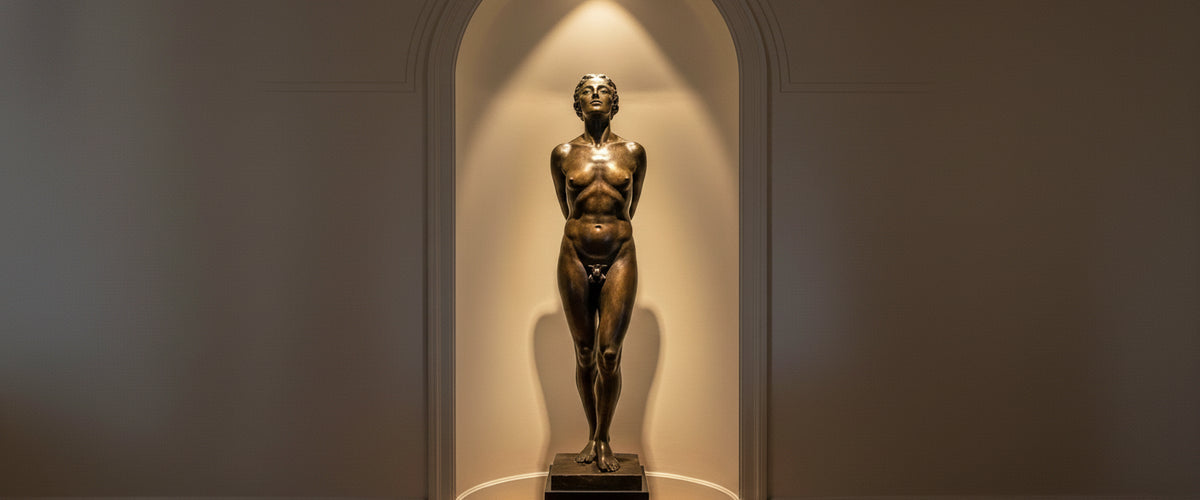

A six-foot bronze can look monumental in one room and oddly invisible in another. The sculpture has not changed. The placement has. Emphasis by placement in art is the principle every good curator, gallerist and interior designer leans on, and it is the single biggest reason collectors call us back after install asking why the piece feels twice the size it did in the studio. Get the position right and a single work organizes the entire space around it. Get it wrong and even a serious commission reads as decoration.
This is a working guide to placing sculpture so that emphasis by placement in art does the heavy lifting. It is written for buyers planning a hallway centerpiece in a Pacific Heights townhouse, a garden anchor in the Hamptons, or a lobby piece for a Dallas hotel. The rules are the same. Only the sightlines change.

Quick Answer: Emphasis by Placement in Art
For wider placement ideas, Emphasis by Placement in Art: How a Single Sculpture Anchors a Room is useful companion reading before finalising the setting and sightlines.
One hero per sightline. If two objects compete, both lose.
Map the sightlines first. Doorway, primary seat, dining chair, stair landing.
Give it room to breathe. Negative space is the frame.
Confirm with light and contrast. Color temperature and background tone seal the focal point.
Scale to the architecture, not the wall. Ceiling height and approach distance matter more than square footage.
Emphasis in Art, Translated From the Textbook to the Living Room
Art school defines emphasis as the visual weight that pulls the eye to a specific area of a composition. In a painting that might be a red coat in a gray crowd. In a room, the composition is the architecture and the furniture, and the sculpture is the red coat. At the interior scale, emphasis by placement in art is less about the object itself and more about everything around it: where you stand when you first see it, what your eye passes on the way, and what sits behind it as a backdrop.
This is why two clients can buy the same edition of a piece and have wildly different results. One installs it at the end of a 40-foot enfilade with nothing behind it but a pale plaster wall. The other tucks it into a bookshelf alcove between a lamp and a framed photograph. Same bronze. One commands the floor. The other disappears. Placement in art is the variable doing the work.

The One-Piece Rule: Why Competing Focal Points Cancel Each Other
The fastest way to weaken a sculpture is to give it a rival. A large abstract painting on the opposite wall, a statement chandelier directly overhead, a fireplace with a heavy mantel arrangement. Each one is fighting for the same job. The eye cannot rest on two heroes, so it bounces, and the room reads busy rather than considered. This is the rule that emphasis by placement in art tests every time.
When we deliver a commissioned bronze or a tall stainless steel work, we ask clients to audit the room honestly. What else in this space is asking to be looked at? Anything competing within the same sightline either needs to step down (smaller, quieter, lower contrast) or move out. A serious figurative work, for example our large bronze female form sculpture, needs a clear visual lane. Put it on a long wall with nothing on the opposing surface and it carries the room. Put it across from a gallery wall of family photographs and it becomes another object on the inventory.
There is one useful exception. A secondary piece can support the hero if it is clearly subordinate in scale, color or finish, and ideally on a different sightline. Think of it as backing vocals, not a duet.
Sightline Mapping From Doorway, Sofa and Dining Seat
Before a sculpture is delivered, we ask clients to stand in three places and photograph what they see. The doorway. The main seat in the room. The chair at the head of the dining table or kitchen island. These are the positions where a person spends real time, and they are the angles where emphasis by placement in art either works or collapses.
From the doorway, you want the sculpture to be the first thing the eye lands on. That usually means positioning it on the far wall, slightly off-center to avoid a bullseye effect, or framed by an architectural opening. From the primary seat, the piece should sit at a comfortable middle distance, not so close that scale overwhelms, not so far that detail disappears. From the dining position, the work often functions as a quiet anchor rather than a hero. That is fine. Not every sightline needs to climax.
For outdoor work the same logic of placement in art applies, scaled up. A Corten steel piece or a large stainless work in a Napa garden should be visible from the kitchen window, the terrace and the approach from the driveway. A tall reflective form like the stainless steel sculpture collection includes pieces designed to read across long lawn sightlines, where the polished surface picks up sky and trees and turns into a beacon at distance.
Negative Space as the Frame Nobody Notices Doing the Work
Galleries leave acres of wall between works for a reason. Empty space is not waste. It is the frame the human eye needs to register an object as important. Crowd a sculpture with furniture, accessories or pattern and the message becomes: this is one item among many. Surround it with calm and the message becomes: look here. Emphasis by placement in art depends on that quiet.
A practical rule we share with clients: give a freestanding sculpture a clear radius equal to at least half its height in every direction. A five-foot bronze wants a clear zone of roughly two and a half feet (about 0.75 m) on every side, more if the room allows. For wall-mounted relief or large-scale metalwork, leave the surrounding wall genuinely bare. No floating shelves, no sconces fighting the silhouette, no gallery cluster creeping toward the edge.
Negative space is also what makes an outdoor piece read against landscape. A garden sculpture set into a wide lawn with low planting around the base will always carry further than the same piece tucked against a hedge.
Color, Contrast and Lighting That Confirm the Focal Point
Once placement and breathing room are settled, the backdrop and light finish the job. A dark bronze on a dark wall reads as a silhouette and can lose its modeling. The same bronze on a warm off-white wall keeps every contour. A polished stainless piece in front of a busy patterned wallpaper will look chaotic. Against a single tonal surface, the reflections become the point. This is where emphasis by placement in art tips from theory into practice.
Lighting is where most placements quietly fail. Overhead downlights flatten a three-dimensional object. Sculpture wants directional light from one or two angles, ideally with a warmer color temperature in the 2700K to 3000K range to flatter bronze, marble and patina finishes. The Getty Conservation Institute publishes useful guidance on lighting levels for art that is worth a read before you specify fittings (getty.edu/conservation). For outdoor work, low ground-level uplighters create the drama. Top-down floodlights kill it.
Contrast is the final lever. If the sculpture is pale, the background should be darker. If the sculpture is dark or reflective, the background should be lighter and quieter. The eye reads the boundary first.
Case Study: The Same Bronze Placed in Three Different Rooms
A client commissioned a roughly six-foot (1.8 m) figurative bronze from us and, over the course of a renovation, moved it three times before settling. The first position was a corner of an open-plan living room beside a tall bookshelf. The bronze read as another tall vertical object in a row of tall vertical objects. The shelf won. So much for emphasis by placement in art when the placement is wrong.
The second position was the center of a long entry hall, on axis with the front door. From outside the door the piece looked theatrical. From inside the house it blocked circulation and the sightline felt aggressive. Emphasis was there but the placement fought the architecture.
The third position, which stuck, was an alcove at the end of a side gallery off the main living space. Plain plaster behind, a single warm spot from above, a clear two-foot zone on each side, and a clean sightline from both the sofa and the kitchen island. Same bronze. Suddenly the room had a center of gravity. The lesson we keep relearning: emphasis by placement in art is a relationship, not a property of the object.
A Placement Checklist Before You Commit
Walk the three sightlines (door, seat, dining) and photograph each.
Identify any competing focal points and decide which one steps down.
Measure the clear radius around the proposed position.
Confirm the background tone contrasts with the sculpture finish.
Plan directional lighting before, not after, the piece arrives.
Check approach distance: how far away is the viewer when they first see it?
For outdoor pieces, verify the view from inside the house at the times of day you actually use the room.
Curator Labels, Training Routes and Adjacent Questions
Two questions come up often enough to address here. First, what are the placement cards next to art by curator? Those small printed tags are wall labels or tombstone labels, and they carry artist, title, date, medium and credit line. They are a different lever of emphasis by placement in art, telling the viewer where to put their attention through information rather than position. In a private home you rarely need them, but a discreet plaque near a major commission can lend gallery weight.
Second, collectors who care about the wellbeing side of practice sometimes ask about art therapy masters ranked by job placement. That is a question for graduate program review sites rather than a sculpture studio, but the underlying point matters: how a work is positioned, lit and framed shapes how people feel in a room, which is the same instinct that drives clinical use of art. Placement in art is therapeutic as well as aesthetic.
Where Bespoke Commissioning Changes the Conversation
When clients commission rather than buy off the shelf, emphasis by placement in art leads the brief. We start with the room, the sightlines and the architecture, and the sculpture is sized, posed and finished to serve that position. A figure intended to be seen mostly in three-quarter view from a sofa is modeled differently from one designed to be circled in a garden. A piece destined to sit against a dark paneled wall is patinated differently from one going in front of pale limestone. This is the practical case for bespoke. The object is engineered for emphasis by placement in art from day one, rather than asked to fight for it on arrival.
If you are weighing placement options for a specific room or garden, our studio is happy to review floor plans and photographs before you commit to scale. Most of the expensive mistakes around placement in art could have been caught with a fifteen-minute sightline conversation.