





































































































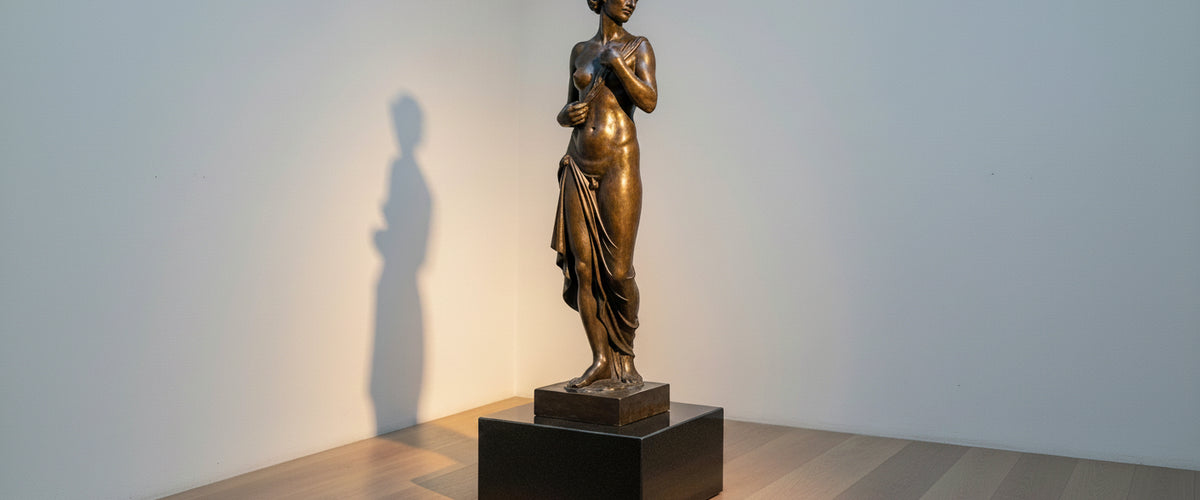

Walk into a great room and your eye lands somewhere on purpose. That is emphasis by placement in art, and it is the difference between a space that feels styled and a space that feels resolved. A single sculpture set in the right spot, at the right height, with the right breathing room, will outwork a wall of pretty objects every time.
Looking for the full range in this category? Browse our Cardboard Art collection for every available finish, size, and configuration.
Most of our client visits start the same way. The piece is right; the position is wrong. The bronze is twenty inches off-axis, the plinth is six inches too short, or the lighting is washing the face flat. Small fixes, big shift. Below is how we think about emphasis by placement in art when we plan an install or advise on a commission.

Quick Answer: What Emphasis by Placement in Art Actually Means
For wider placement ideas, Pop Art Sculpture: Ideas, Materials and Placement That Actually Work is useful companion reading before finalising the setting and sightlines.
- Emphasis is the visual hierarchy of a space; what your eye sees first, second, third.
- Placement is the tool. Position, height, sightline, and negative space create that hierarchy without changing the object itself.
- One strong piece at a deliberate focal point will read more confidently than three competing ones.
- Scale matters more than cost. An undersized sculpture in a generous room will always look tentative.
- Lighting and a plinth are part of the artwork, not afterthoughts.
What Emphasis by Placement in Art Means in Design Terms
In classical composition, emphasis is created with contrast: color, scale, isolation, or line. Position is the architectural version of that idea, and emphasis by placement in art uses the room itself, its walls, doorways, sightlines, and floor plane, to push one object forward and let everything else recede. The Tate's glossary of art terms covers the formal principles; siting is how those principles leave the page and meet a real floor.
For a sculpture, three locational variables do most of the heavy lifting. First, the approach: how the viewer arrives and from which angle they first see the piece. Second, the surround: what sits within six feet of it (3 ft / 0.9 m on each side is a useful minimum for a life-size figure). Third, the elevation: floor-mounted, low plinth, eye-level plinth, or wall-mounted. Change any one of those and the same bronze reads completely differently, which is emphasis by placement in art at work.
Focal Points: Why One Strong Object Beats a Cluster
A common mistake in larger homes is treating a great room like a gallery shop. Three medium pieces spread across a 40-ft (12 m) living room will fight each other and cancel out. One generously scaled sculpture in a single decisive position will hold the whole room together and let your furniture, rugs, and smaller works breathe around it. That is emphasis by placement in art reduced to its simplest rule.
This is where scale conversations get honest. A 6 ft (1.8 m) bronze figure in a double-height great room is not large; it is correct. A 3 ft (0.9 m) piece in the same space is decoration. We have shipped figurative bronzes to clients where the brief started at "life-size" and ended at "larger than life" once we walked the room virtually and traced sightlines from the front door, the kitchen island, and the head of the dining table.
If you are still narrowing down what kind of focal piece suits the room, our sculptures by placement collection is grouped the way designers actually shop: by where the work lives, not by subject. Useful when you know the room before you know the piece.
Sightlines From the Door, the Sofa, and the Dining Table
Before we agree on a position, we map three sightlines. This is the practical side of emphasis by placement in art.
- The arrival line. Stand at the main entry to the room. What is the first thing you see at eye level, roughly 25 to 30 ft (7.6 to 9.1 m) in? That is your strongest focal slot. Put your best piece there, on-axis with the door if the architecture allows.
- The dwell line. Sit on the primary sofa. Where does your eye rest when you are not looking at another person? That position rewards quieter, slower work; a torso study, a small bronze on a console, a stone piece you read with your eyes half-closed.
- The table line. From the head of the dining table, what is the far focal point through the room? Long sightlines flatter vertical sculpture. A tall figurative bronze or a slender stainless steel form at the end of a 30-ft (9.1 m) sightline will pull the whole plan together.
If those three sightlines hit one object, you have your anchor. If they hit three different objects, one of them is in the wrong place, and the emphasis by placement in art falls apart.
Plinths, Lighting, and the Negative Space That Frames a Piece
A plinth is not furniture. It is part of the sculpture's silhouette, and its job is to lift the work into the eyeline you want. As a rough starting point, position the visual center of a figurative piece between 54 and 62 inches (137 to 157 cm) off the floor for a standing viewer. Lower for seated rooms such as a den or library; higher for grand entries where people view from a distance. Height is one of the quietest levers in emphasis by placement in art.
Material choice for the plinth matters more than people expect. A honed black granite cube under a polished bronze reads serious and museum-grade. A bleached oak block under the same bronze reads warm and residential. A painted MDF plinth in a hallway will always look like a painted MDF plinth, no matter how good the sculpture on top of it is. For permanent installs, we specify stone, solid hardwood, or fabricated steel with a powder-coated finish.
Lighting is the other half. A single warm 2700K to 3000K accent at roughly 30 degrees off vertical will model a figure properly without flattening the features or throwing a harsh shadow on the wall behind. Two crossing lights soften shadows; a single light keeps drama. Avoid downlights directly overhead, which carve dark sockets under brows and chins. The Getty Conservation Institute publishes useful guidance on lighting for art if you want to go deeper on lux levels and UV.
Negative space is the cheapest tool in emphasis by placement in art and the most ignored. Give a major sculpture at least 3 ft (0.9 m) of clear floor on every visible side; for monumental work, more. If the piece is backed against a wall, leave the wall blank or near-blank. Hanging a painting six inches behind a bronze head is the visual equivalent of two people talking over each other.
Common Placement Mistakes We Fix on Client Visits
- The corner exile. Pushing a strong sculpture into a corner because "it fits there." Corners kill emphasis. Move the piece into the room, even by 18 inches (45 cm), and it comes alive.
- The undersized hero. Buying a 3 ft (0.9 m) piece for a 20 ft (6 m) ceiling. Scale up, or accept it is a secondary piece and find a true anchor.
- The traffic-path placement. Putting a bronze where people brush past it carrying coats and grocery bags. Beautiful for a week, chipped patina by month six.
- Symmetry by default. Centering everything. Off-axis siting, set against a strong architectural line, almost always reads more confident than dead-center.
- Forgetting the back. A figurative sculpture in the round needs to be seen from behind too. If the back of the piece faces a wall two feet away, you are paying for half a sculpture.
- Lighting after the fact. Installing a 600 lb (272 kg) bronze and then realizing there is no power for accent lighting. Plan the electrics before the rigging.
How Placement Shapes a Bespoke Commission
When clients commission through Giant Sculptures, emphasis by placement in art is the first conversation, not the last. We ask for floor plans, ceiling heights, and photographs from the three sightlines above before we talk about subject or material. A piece designed for a walled courtyard behaves differently from one destined for a loft apartment, and the foundry decisions follow from that: bronze versus stainless steel versus Corten, hollow-cast versus solid, internal armature for outdoor wind loads, base detail tuned to the floor finish on site.
The point of bespoke is that the sculpture and its place are designed together. That is what makes emphasis by placement in art feel inevitable rather than arranged. You stop seeing the object and the room as two things; you see one composition.
Curator-Style Labels and Career Notes
For general conservation principles, V&A sculpture techniques is a useful external reference, though the final care routine should always follow the material and finish specified for the individual commission.
Two questions we get often, worth answering briefly. First, what are the placement cards next to art by curator? Those are interpretive labels, sometimes called tombstones, listing artist, title, date, materials, and a short context line. A discreet plaque on the plinth is the residential equivalent of that curatorial layer of emphasis by placement in art. Second, for readers researching art therapy masters ranked by job placement, those programs are tracked separately by accrediting bodies such as the AATA; the word "placement" there refers to clinical employment outcomes, not gallery siting, even though the underlying instinct, matching a work, or a practitioner, to the right context, is surprisingly similar.
A Short Checklist Before You Install
- Have you walked the three sightlines (arrival, dwell, table) and chosen one anchor position?
- Is the visual center of the piece between 54 and 62 inches (137 to 157 cm) for standing viewing, adjusted for the room?
- Is there at least 3 ft (0.9 m) of clear floor around the piece on every visible side?
- Is the plinth material chosen to support the sculpture, not compete with it?
- Is the accent lighting specified, wired, and aimable before the piece arrives?
- For outdoor work, have wind load, drainage, and frost been engineered into the base?
Get those six right and emphasis by placement in art will do what you bought the sculpture to do: anchor the room, set the tone, and quietly run the place for the next thirty years.