





































































































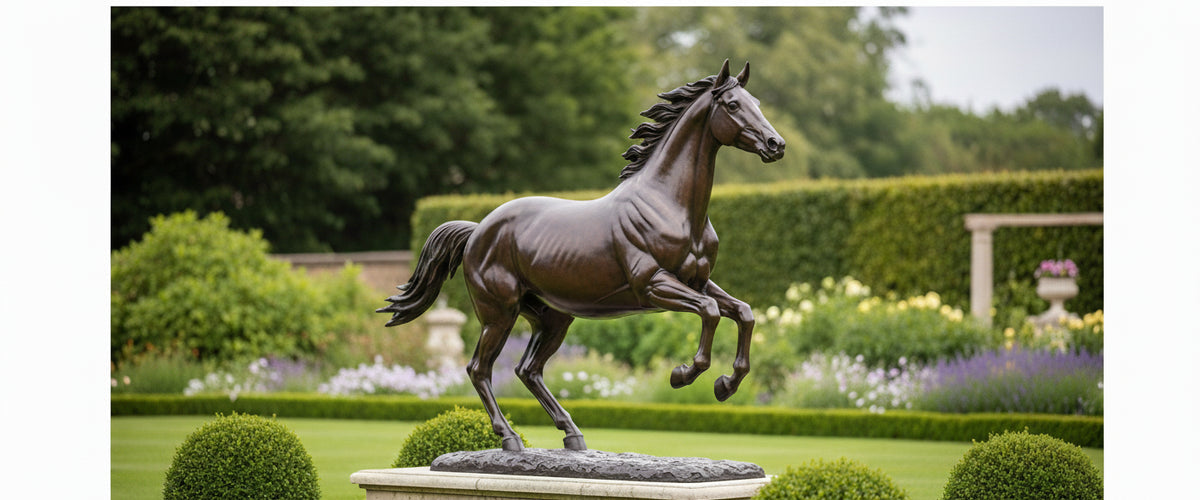

A bronze statue horse is one of the hardest pieces to place well, because the subject is large, the pose carries direction, and the patina shifts the moment the light changes. Get it right and the sculpture organizes an entire courtyard or library around it. Get it wrong and a beautiful casting ends up looking parked, as if it wandered in from another property and stopped.
Most of the placement calls we field at Giant Sculptures are not about the horse itself. They are about the eye-line, the pedestal, the backdrop wall, and how the piece will read at 7 a.m. versus 6 p.m. This guide pulls together what we have learned from commissions shipped to ranches in Texas, country estates in Virginia, and gated entries in Bel Air.

At a Glance: Quick Rules for a Bronze Horse Statue
- Eye-line: the horse's eye, or its shoulder if it is a head study, should sit close to the viewer's eye height at the main viewing distance.
- Pedestal: add height to gain presence, but keep total height under the ceiling's visual third indoors.
- Direction: a horse in motion should move into the space, not out of it.
- Backdrop: warm bronze patinas need a matte, mid-tone backdrop. White walls flatten them.
- Light: raking side light at roughly 30 to 45 degrees reads the musculature; flat overhead light kills it.
- Outdoor base: reinforced concrete footing sized to the piece, not just the plinth.

What a Bronze Statue Horse Actually Looks Like in Real Rooms and Gardens
A life-size bronze horse stands roughly 5 to 6 feet at the withers (1.5 to 1.8 m) and can weigh 600 to 1,500 pounds (270 to 680 kg) depending on wall thickness and pose. That is the size most clients picture when they say "bronze horse statue," and it is the size that causes the most placement trouble. A standing horse in a 12 ft by 14 ft (3.7 by 4.3 m) entry hall does not feel grand. It feels stabled.
Step the scale down and the piece becomes far more flexible. A 24 to 36 inch (60 to 90 cm) bronze horse head, set on a stone or steel pedestal, reads as sculpture rather than as a model of a horse. That is why head studies and half-figure rearing poses are the most common indoor commissions we ship to apartment buyers in Manhattan and collectors in San Francisco. They carry the same equine presence without colonizing the room. For tighter foyers where even a 100 cm head feels heavy, a smaller study such as the Graceful Horse Head White Marble Outdoor Sculpture - 60cm is closer to the right footprint and translates cleanly into a comparable bronze commission.
Outdoors, the math flips. A full-size piece set in the middle of a five-acre Napa garden can look undersized from the driveway approach. Distance eats scale fast. As a rule of thumb, if the main viewing point is more than 80 feet (24 m) away, you want a horse that is life-size or slightly over. Anything smaller dissolves into the planting.

Scale, Sightlines and Pedestal Height
Three numbers decide how a bronze horse statue reads: the height of the piece, the height of the pedestal, and the height of the viewer's eye at the main approach. Most clients only think about the first.
A useful starting point: the horse's eye, or the center of mass on a galloping piece, should sit between 60 and 72 inches (152 to 183 cm) from the ground at the main viewing position. Below 54 inches (137 cm) and the viewer looks down at the work, which drains authority. Above 78 inches (198 cm) and the piece reads as monumental, which is right for civic and commercial placements but heavy in a private home.
For head studies, the pedestal does the lifting. A 100 cm bronze horse head on a 42 inch (107 cm) steel plinth places the muzzle at roughly chest height of a standing viewer, which is the sweet spot for a foyer or gallery wall. A piece like the Noble Horse Head White Marble Outdoor Sculpture - 120cm is a useful proportion check before you commit to a full body in bronze, since the head-to-base relationship translates almost directly between marble and cast metal.
For full-figure pieces, the pedestal is usually low. A galloping horse wants 6 to 18 inches (15 to 46 cm) of plinth, no more. The point is to lift it off the ground plane just enough to suggest motion, not to put it on a podium. A rearing or standing horse can carry a taller base, up to about 30 inches (76 cm), because the vertical line of the body absorbs the extra height. The 220 cm Noble Standing Horse Marble Outdoor Sculpture - 220cm is a useful proportion study for this: the pose dictates how much base it can take before the silhouette feels stilted.

Indoor Versus Outdoor: When Each Wins
Bronze is happy in both. The question is whether the room is.
Indoors works when you have ceilings of at least 11 feet (3.4 m), a single dominant sightline (a hallway, a stair landing, a double-height living room), and a backdrop wall that is not glass. We have placed bronze horse heads in a Pacific Heights library where the piece sat on an oak pedestal in front of a tobacco linen wall, and it became the room without competing with the books. The same piece in a glass-walled Hamptons living room would have read as a silhouette, all outline and no surface.
Outdoors works when you have a defined arrival sequence: a driveway curve, a gate, a lawn that terminates at a hedge or wall. A bronze horse statue placed in the open middle of a lawn, with sky behind it from every angle, loses three-quarters of its modeling. The eye has nothing to push the bronze against. Where the setting calls for a contemporary equine accent rather than a classical full-figure piece, a sculptural head study like the Fluid Motion Horse Head Marble Outdoor Sculpture - 100cm sits more comfortably against modern architecture and pared-back planting.
Climate matters too. Bronze develops its patina through controlled oxidation, and coastal salt air accelerates that process in ways that can be either lovely or aggressive. The Smithsonian Museum Conservation Institute has published useful guidance on what salt, acid rain, and chlorides do to unprotected bronze over decades. For oceanfront placements in Malibu or the Outer Banks, we specify a heavier wax regime and recommend an annual professional clean.

Light, Backdrop and Contrast
Bronze is a low-reflectance material with a narrow tonal range. It needs help from its surroundings.
The backdrop is the single biggest variable. A dark green hedge, a Corten steel screen, a warm limestone wall, a navy plaster panel: any of these will hold a bronze horse and let the patina sing. A white stucco wall in full sun will turn the same piece into a flat brown shape. If the only available backdrop is pale, plant against it or run a backing panel of textured material behind the pedestal.
Side light is your friend. For indoor placement, a single warm spot (around 2700 to 3000 K) raked across the piece from one side at roughly 30 to 45 degrees will pick out every muscle and tendon line the foundry put there. Two spots from above will flatten the same modeling. Outdoors, orient the piece so the main viewing time, often late afternoon for entertaining, gives you side light from the west or east, not full overhead noon sun.
Contrast also runs the other way. A vintage bronze horse statue with a deep brown-black patina disappears against a charcoal wall but glows against pale travertine. Test with a fabric swatch or large color sample on the proposed backdrop before you commit; we have had clients repaint a foyer twice after a piece arrived, which is avoidable.

Antique and Vintage Bronze Horse Statues: A Buyer Note
An antique bronze horse statue, whether a 19th-century French animalier piece or an early 20th-century American foundry casting, has a different placement logic than a new commission. The patina is irreplaceable and often patchy in interesting ways. Direct sprinkler spray, pool chlorine vapor, and de-icing salt will all damage that surface. For older pieces we generally recommend covered or semi-covered placement: a loggia, a portico, a courtyard with overhanging eaves. The Getty Conservation Institute has published useful work on patina preservation that is worth reading before you site an heirloom piece outdoors.
For a vintage bronze horse statue being moved into a new property, get a condition report before installation. Cracks at the legs, repairs at the tail and ears, and old armature corrosion all affect how the piece can be mounted and whether it can carry its own weight on a slim pedestal.
Common Placement Mistakes We See
For wider placement ideas, Decorating with Animal Garden Sculptures: A Buyer’s Guide is useful companion reading before finalising the setting and sightlines.
- The roundabout problem. A horse placed in the center of a circular drive with no defined backdrop loses scale and direction. Anchor it to one side, against planting or a wall.
- Facing the wrong way. A horse in motion should move into the property, not toward the road. The visual energy of the piece guides the eye where it points.
- Pedestal too tall. Clients often over-correct for scale by raising the base. A galloping horse on a 36 inch (91 cm) pedestal looks like it is on a parade float.
- Lighting the floor, not the piece. Uplights at the base wash the belly and lose the head. Use a mix of low uplight and a higher raking source.
- Ignoring the back. A bronze horse statue gets viewed from every angle outdoors. The hindquarters need to read as resolved as the front; check this before signing off a commission.
- Undersizing the footing. A 1,000 pound (450 kg) bronze on a residential paver will sink, tilt, or crack the surface within a year. Pour a proper concrete footing.
Commissioning a Bronze Horse Statue With Giant Sculptures
Most of our bronze horse commissions begin with a brief that is half practical, half emotional: a specific breed, a remembered pose, a site plan with a marked spot. From there we work through maquette, scale tests, patina samples, and engineering for the base. Lead times for fully bespoke bronze pieces are measured in months, not weeks, and the engineering for a life-size piece, including internal armature and mounting hardware, is as much of the work as the sculpting.
Budget depends on scale, pose complexity, finishing, base engineering, and shipping route. We quote each commission individually rather than publishing bands, because a 60 cm head study and a 220 cm rearing stallion are not the same conversation. If you want to see how the catalog handles different poses and patinas before commissioning, the bronze horse statues collection is the most direct starting point, and the broader bronze animal sculptures range shows how the same foundry language reads across other subjects.