





































































































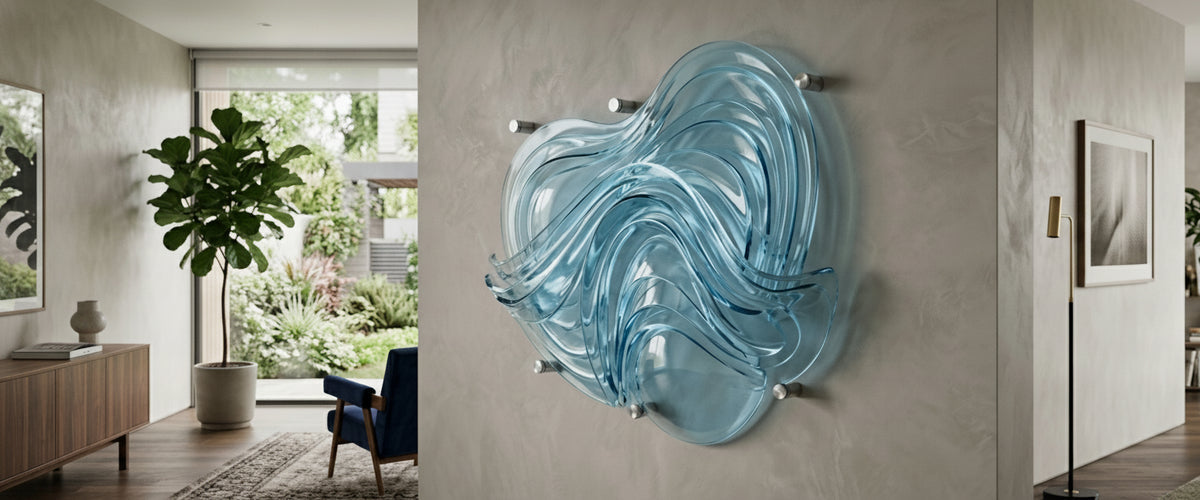

The most common mistake with acrylic glass wall art is hanging a beautiful panel in a spot where light never touches it. The material does its best work when light moves through and across it, throwing color and depth onto the wall behind. Put it in a dead corner and you have spent good money on something that reads flat. Get the placement right and a single acrylic panel can hold a double-height entry on its own.
We ship a lot of large-format acrylic glass wall art to homes and venues across the US, and the questions that decide success are almost always the same: how big, how high, what is behind it, and where the light comes from. This guide walks through those choices the way we walk a client through them before a commission goes into production.
A single dimensional panel placed in raking light to anchor a tall entry wall.

Key Takeaways Before You Buy
Light is the material. Acrylic glass wall art relies on transmitted and raking light. Plan placement around your light source first, the wall second.
Scale beats quantity. One large acrylic wall art panel usually outperforms three small ones on the same wall.
Backdrop contrast matters. A panel needs a wall tone that lets its color and edges register.
Indoor and outdoor are different briefs. UV exposure, mounting and glare all change outdoors.
Custom is the norm at scale. Sizing and color to the room is how a piece earns its place, and budget depends on scale, finish and engineering, so ask for a tailored quote.

What Acrylic Glass Wall Art Actually Looks Like in a Room
Acrylic glass wall art is artwork built from layered, carved or printed acrylic that catches and bends light rather than sitting on the surface like a flat print. Some pieces are sculptural and dimensional; others are color fields that shift as you move past them. The shared trait is depth. You get an object that feels lit from within even when it is only catching ambient light.
In a great room with tall ceilings and a lot of daylight, a dimensional piece like the Dome Ice Blue Acrylic 3D Wall Art reads as cool and architectural; the curved surfaces collect window light and release it slowly through the day. Drop the same idea into a darker, paneled study and a warmer choice such as the Dome Burnished Copper Acrylic 3D Wall Art does more work, picking up lamp light and glowing against wood.
That is the first lesson we give clients. The room decides the palette as much as taste does. Cool acrylic wall art wants daylight and pale walls. Warm tones survive lower, moodier lighting and darker backdrops.

Scale, Sightlines and Hanging Height
Scale is where most buyers get nervous and then regret going small. A piece of acrylic glass wall art that looks generous leaning against the studio wall can shrink the moment it is up on a 12-foot (3.7 m) wall with furniture below it. As a working rule, a feature wall piece should fill roughly two-thirds to three-quarters of the open wall width above whatever sits beneath it. Anything smaller starts to look like a placeholder.
Hanging height follows sightlines, not a fixed number. The old gallery default puts the visual center near 57 to 60 inches (145 to 152 cm) from the floor, which suits a standing viewer in a hallway. Over a console, a sofa or a credenza, raise the piece so there is a comfortable gap above the furniture, usually 6 to 10 inches (15 to 25 cm), and let the lower edge breathe rather than crowding the backrest.
Think about where people actually stand. In an entry, viewers see the piece head-on from across the room, so center it to the architecture. In a stairwell, the sightline climbs, so a tall vertical composition or a stacked arrangement reads better than a single landscape panel. Where the viewing angle changes as people move, a spiral or illusion design such as the Helix Rosewood Spiral Illusion Acrylic 3D Wall Art turns that shift into part of the effect, which is why it suits a stair wall better than a static composition.
A vertical illusion panel sized to a climbing stairwell sightline.

Indoor Versus Outdoor: When Each Wins
Indoors, acrylic glass wall art is forgiving. You control the light, the wall and the climate, so the design choices are aesthetic. Outdoors is a different brief. Acrylic handles weather far better than most people expect, but sustained UV is the real test over years, and not every acrylic is rated equally. For exterior placement, ask specifically about UV-stable acrylic and UV-printed color; the difference shows up in fade resistance a few summers later. Manufacturers of cast and extruded acrylic publish weathering data on exactly this point, and it is worth reading before you commit a piece to a south-facing wall (Plexiglas technical resources are a useful reference for outdoor-grade behavior).
Outdoor wins when you have a covered loggia, a pool wall, or a shaded courtyard in a place like Austin or Palm Springs where the piece gets reflected light without baking all afternoon. Glare is the enemy here: a glossy panel of acrylic glass wall art in direct midday sun can wash out completely. Indoors wins when the work is detailed, layered, or color-critical, because you can tune lamp placement and avoid the harsh contrast outdoor sun creates.
Light, Backdrop and Contrast
This kind of art is a light instrument. The single biggest upgrade to any installation is a small adjustable spot or a discreet wall washer aimed across the surface rather than straight at it. Raking light catches edges and dimension; flat frontal light kills them. If you are commissioning acrylic glass wall art for a specific wall, tell us where the lighting sits, because we can angle the design to that source.
Backdrop contrast decides whether the piece registers at all. A pale, gradient acrylic art wall panel disappears against bright white drywall and sings against a soft gray or a deep navy. A saturated piece like the Dome Crimson Red Acrylic 3D Wall Art needs a quieter wall so the color does the talking. We often tell clients to paint the feature wall one or two shades deeper than the rest of the room; it costs a tin of paint and transforms the result.
Texture behind the piece matters too. A flat plaster wall reads clean and modern. A textured stone or wood wall competes for attention, so you either lean into the contrast deliberately or choose a calmer piece of acrylic glass wall art. For a curated sense of what works together, our acrylic art collection shows how palette and backdrop pair across different pieces.
Common Placement Mistakes We See
For wider placement ideas, 3d Wall Art Sculptures: A Placement Guide for Rooms That Deserve Better Than a Print is useful companion reading before finalising the setting and sightlines.
The list below covers the issues that come up most when an acrylic glass wall art commission is being planned, or when a client sends a photo asking why a panel feels underwhelming.
Hung too high. Floating a piece near the ceiling breaks the connection with the furniture and the viewer. Lower it.
Too small for the wall. A modest panel on a broad wall looks lost. Size up, or commission to fit.
No dedicated light. Relying on a central ceiling fixture flattens the depth that makes acrylic worth buying.
Wrong wall color. White-on-white kills pale work; busy wallpaper drowns detailed work.
Glare in the sightline. A glossy panel facing a window or low sun bounces light back at the viewer.
Undersized fixings. Large acrylic wall art has real weight. Wall anchors must match the substrate and the panel mass.
How to Hang Acrylic Wall Art
Most quality acrylic glass wall art mounts on standoff hardware: polished metal barrels that hold the panel a short distance off the wall so light slips behind it. That floating gap is part of the look, not an afterthought. Mark your fixing points off the panel itself, drill into the correct anchor for your wall type (drywall, masonry or stud), and use a level across both top points before final tightening. For heavier pieces, two people and a measured template save you from cracked acrylic and patched holes.
For custom acrylic wall art, we supply mounting guidance matched to the panel weight and your wall construction, because a 4-foot (1.2 m) dimensional piece behaves very differently on plasterboard than on brick. If you are unsure of the substrate, photograph the wall and the surrounding fixtures and send it across before you drill.
Commissioning a Piece That Fits
Off-the-shelf works when the dimensions and palette already suit the wall. When they do not, a bespoke acrylic glass wall art panel is the smarter route, and it is how most of our larger installations happen. We size to the wall, tune color to the room's light, and engineer the mounting for the weight and substrate. A layered gradient like the Lattice Indigo Fade Acrylic 3D Wall Art can be scaled and recolored so it lands as a true centerpiece rather than a near miss.
Budget for acrylic glass wall art depends on scale, finish, layering complexity, engineering and installation, so the honest answer is to request a tailored quote rather than work from a guessed range. Tell us the wall dimensions, the light, the backdrop color and whether the wall art on acrylic is indoor or outdoor, and we will steer you toward the right format. Browse the full wall art and wall decor range, including our acrylic prints wall art, to see how scale and material change the read, then come back with the wall that needs solving.