

































































































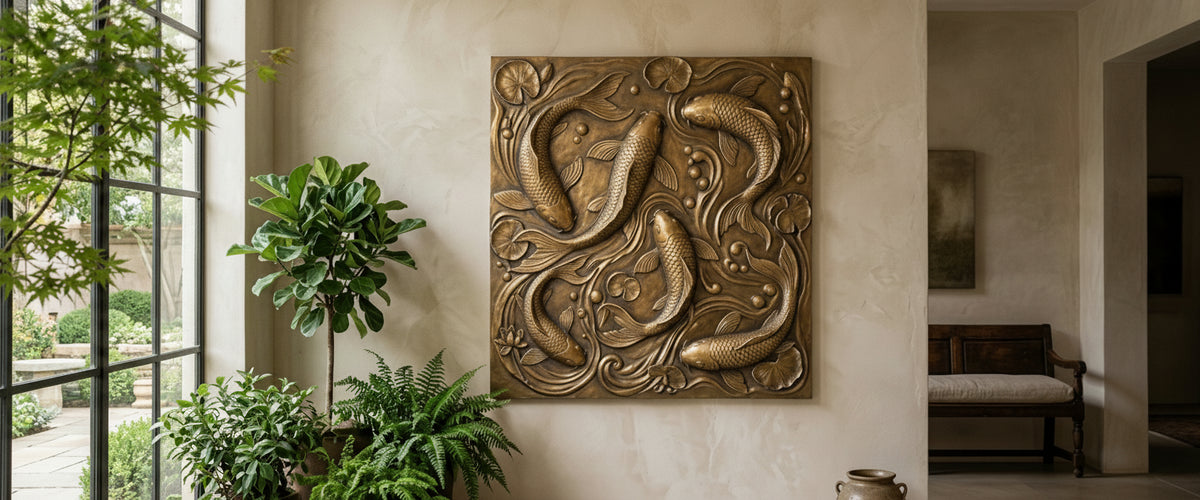

A flat canvas on a tall wall is the design equivalent of a whisper in a stadium. The room swallows it. That is the moment most buyers start looking at 3D wall art sculptures, because relief, shadow and physical depth do something a print cannot: they react to the light in the room across the day. Done well, a sculpted wall piece reorganizes the architecture around it. Done badly, it looks like an oversized fridge magnet. The difference is almost never the artwork. It is the placement.
Looking for the full range of 3D wall art sculptures in this category? Browse our Wall Art and Wall Decor collection for every available finish, size, and configuration.
At Giant Sculptures we ship wall-mounted work into everything from double-height entries in Austin to gallery walls in Hamptons summer houses and lobby walls in Midtown. The questions we get asked at the planning stage of 3D wall art sculptures are remarkably consistent, and the mistakes we end up rescuing are too. This is the placement guide we wish more buyers had read before they drilled the first hole.

At a Glance: The Decisions That Matter Most
Wall size first, art size second. Aim for the sculpture to occupy roughly 55 to 75 percent of the usable wall width.
Center of interest at eye level. Around 57 to 60 inches (145 to 152 cm) from the finished floor for standing rooms; lower for seated lounges.
Relief depth dictates light angle. 3D wall art sculptures with 2 inches (5 cm) or more of projection need raking light, not flat downlight.
Outdoor walls demand outdoor materials. Bronze, stainless steel, Corten, cast stone. Not MDF, not acrylic, not painted plaster.
Background contrast is half the install. A sculpted piece on a busy wallpaper disappears; on a quiet matte wall it sings.

What 3D Wall Sculptures Actually Look Like in a Real Room
The 3d wall sculptures category covers a wide range, from low-relief textured panels of an inch or two off the wall to fully cantilevered metal forms projecting a foot or more into the room. These pieces behave very differently depending on which end of that spectrum you are in.
Low-relief textured work reads almost like a painting until you walk past it and the shadows shift. For a corridor or dining wall where the viewer moves past the work rather than sitting with it, something quiet and tonal like Bloomark Sandstone Floral Abstract Texture 3D Wall Art does more useful visual work than a deeply projecting metal piece would in the same spot. High-relief 3D wall art sculptures and sculptural metalwork are the opposite. They command a stop. A school of koi in a polished gold finish, for example, wants a wall you actively walk toward, ideally with three or four steps of approach before you reach it.
Outdoor wall reliefs behave differently again. A Corten steel piece on a poolside wall in Napa weathers into a sunset orange over the first year and then stabilizes. A polished stainless work on a shaded north-facing wall in NYC will read almost like a mirror. Same category of 3D wall art sculptures, completely different visual job.
Scale, Sightlines and Mounting Height
The single most common mistake we correct on installs is hanging height. Galleries default to a 57 to 60 inch center because that matches average standing eye level for a mixed audience. Living rooms are not galleries. If your sofa is the primary viewing position, drop the center of the piece by 4 to 6 inches (10 to 15 cm) so a seated viewer is not staring at the bottom edge.
Scale is the second mistake. A six-foot (1.8 m) sofa with a two-foot (60 cm) wall piece floating above it looks lost. The art should read as roughly two-thirds the width of the furniture below, with a vertical gap of 6 to 10 inches (15 to 25 cm) between the top of the sofa back and the bottom edge of the piece. For an empty wall with no anchor furniture, switch to a wall-percentage rule instead: 55 to 75 percent of the usable wall width, leaving generous breathing room on either side.
For double-height walls in stairwells and entries, resist the urge to fill the whole vertical. Instead, anchor the piece to the dominant sightline, usually the landing or the first-floor ceiling line, and let the empty wall above frame it. This is where a single tall wall sculpture tends to outperform a gallery cluster. Clusters work in apartments. Sculptural relief works on architecture.
Indoor Versus Outdoor: When Each Wins
Indoor walls give you total control over light and humidity. You can specify mixed media, gilded finishes, hand-applied pigments, and softer materials that would never survive outside. Where the room can carry a hero finish, layered gilded 3D wall art sculptures such as Aurevo Golden Koi School Textured 3D Wall Art belong in a dining room or stair wall where they stay dry and the lighting is designed for them; the same finish would not last a season on an exposed terrace.
Outdoor walls reward a much shorter list of materials. Bronze patinated to a chosen color, stainless steel in brushed or polished finish, Corten weathering steel, cast stone, and high-fired ceramic are the workhorses. The American Institute for Conservation has written extensively on how outdoor metal finishes age in different climates; if you are buying for a coastal site, salt exposure changes the maintenance picture significantly and is worth reading up on before you specify a finish (culturalheritage.org).
Outdoor wins when you want the piece to change. A Corten relief that shifts color through the first year, a bronze that deepens, a stainless form that mirrors the seasons. Indoor wins when you want the 3D wall art sculptures to stay exactly as you first saw them.
Light, Backdrop and Contrast
Relief work lives or dies by raking light, light hitting the surface at a low angle so the projecting elements throw shadows. Flat downlight from a recessed ceiling directly above the piece will flatten a sculpted panel into something that looks like a photograph. The fix for most 3D wall art sculptures is a wall washer or adjustable track head positioned about 18 to 30 inches (45 to 75 cm) out from the wall and angled at roughly 30 degrees.
Backdrop matters as much as light. A heavily patterned wallpaper behind a textured piece creates visual noise that hides the relief. Matte paint in a quiet mid-tone, limewash, plaster, or natural stone all let the sculpture lead. If the wall behind is already the feature (a beautiful exposed brick, a book-matched marble), you almost always want lower relief and a calmer surface on the art itself. Two heroes in one frame is one too many.
Color contrast deserves its own line. Gilded and warm-metal 3D wall art sculptures want a darker backdrop. Matte stone and ceramic pieces want a lighter one. A cooler tonal panel such as Bloomark Blue Floral Abstract Texture 3D Wall Art reads best against an off-white or soft warm gray; on a saturated wall color it competes with itself.
Placement Mistakes We Keep Fixing
For wider placement ideas, From Sculptural to Textured: Top 3D Art Wall Styles Taking Over is useful companion reading before finalising the setting and sightlines for your 3D wall art sculptures.
Hanging too high. If you have ever tilted your head back to look at the art, it is too high. Drop it.
Undersizing for the wall. A small piece on a large wall looks like a mistake, not a choice. Either scale up the art or reduce the wall with paneling or a paint block.
Lighting from directly above. Kills shadow, kills depth. Move the source out from the wall.
Indoor materials outside. Acrylic, MDF, and unsealed plaster do not belong on an exterior wall, however covered the patio.
Centering on the wall instead of the sightline. The middle of the wall is not always the middle of the view. Mock it up with paper first.
Forgetting the structural wall. Anything over about 40 pounds (18 kg) needs fixings into studs, masonry, or a backing plate, not drywall anchors.
Commissioning a Bespoke Wall Sculpture
Most of the 3D wall art sculptures we ship are bespoke in at least one dimension: size, finish, palette or subject. The reason is simple. Wall art sized to your specific wall and lit for your specific room behaves entirely differently from a stock piece dropped into place. When clients come to us with a difficult wall, a long corridor, a curved entry, an outdoor courtyard, the conversation starts with measurements, photographs of the light at three times of day, and the materials already in the room.
Budget on commissioned 3D wall art sculptures depends on material, scale, depth of relief, finish complexity, structural engineering for mounting, and installation logistics. We always quote against the actual brief rather than a price band, because a 10-foot bronze relief and a 4-foot ceramic panel have almost nothing in common cost-wise. If you are weighing options, send us the wall and the room and we will tell you honestly what fits.
A Quick Word on Hand-Carved and Wood-Carved Work
Hand-carved and wood-carved wall pieces sit at the craft end of the 3D wall art sculptures category. They are made by removing material rather than building it up, which gives a different surface quality, crisper edges, visible tool marks, more honest grain. They suit interiors with warm materials already in play: oak floors, linen, leather, plaster. They do not suit exterior walls without serious finishing and ongoing maintenance, because wood moves with humidity and ultraviolet light. If you want the carved aesthetic outdoors, cast it in bronze from a wood master. We do this often.
Where to Look Next
If you are still narrowing down 3D wall art sculptures as a category, the 3D wall art collection is the right place to scan textures, palettes and scales side by side. For larger architectural 3D wall art sculptures, the wall sculptures collection leans heavier and more sculptural. Both can be commissioned to a specific size and finish; very little of what we make is fixed.