



































































































A sculptural panel hung in the wrong spot looks like a flat print with delusions. The relief flattens, the shadows vanish, and a piece that should pull people across the room sits there doing nothing. That is the gap between buying 3d panel wall art and placing it well, and it is the part most buyers underestimate. The panel does half the work; the wall, the light and the eye line do the rest.
We see this constantly in commissions for 3d panel wall art. A client falls for a piece in a showroom render, then mounts it on a corridor wall with a single ceiling downlight and wonders why it looks dead. The fix is rarely a different panel. It is a different placement.

Key Takeaways
Relief needs raking light. Light hitting a panel from the side throws the shadows that make 3d wall art panels look three-dimensional. Flat front light kills the effect.
Hang to the room, not the wall. Center height should sit on the primary sightline of where people stand or sit, not at an arbitrary 60 inches.
Indoors rewards subtlety; outdoors rewards mass. Material and scale choices shift sharply between the two.
Backdrop contrast decides impact. A pale panel on a pale wall reads as texture, not as art.
Scale is the most common miss. Buyers size to the panel, not to the wall and the viewing distance.

What 3D Panel Wall Art Looks Like Across Different Rooms
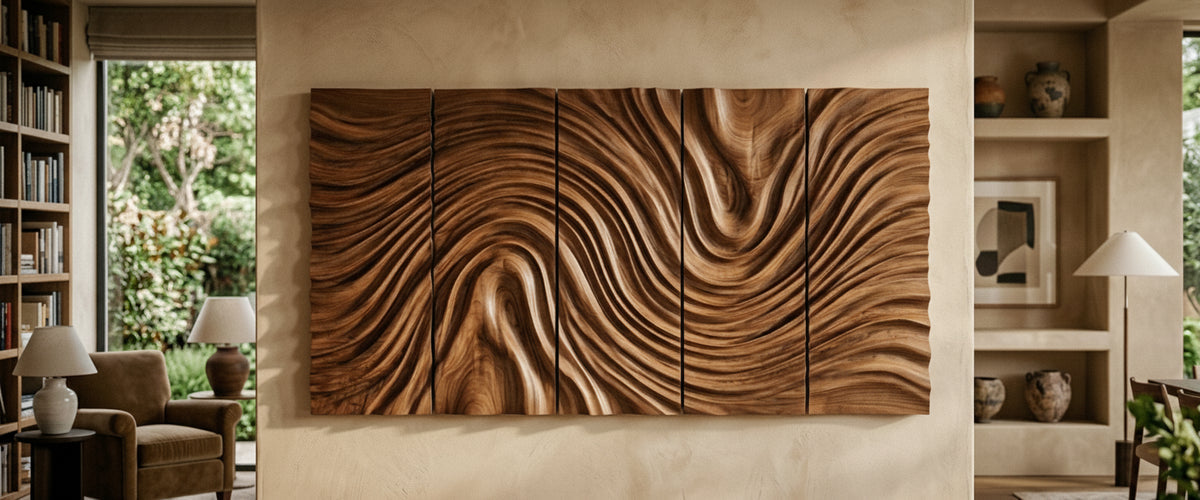
The 3d panel wall art category covers a wide spread, from carved wood reliefs to layered acrylic and engineered metal. A multi-panel carved piece such as the Alvarae 5-Panel Flowform Wood Carving 3D Wall Art behaves very differently from a glossy acrylic set. The wood carving reads through its grain and undulating depth, so it wants warm, slightly angled light and a calm backdrop. Where the room is busier and brighter, a piece like the Bounce Orange & Mint Panel Acrylic 3D Wall Art reads through color and gloss, so it holds its own against more visual noise. This is why a single wall art panel 3d format never suits every room.
In a double-height living room, a five-panel run of 3d panel wall art can span a wall that would swallow a single canvas. In a tight apartment, a three-panel format gives you the sculptural depth without overwhelming the space; for that compromise the Alvarae 3-Panel Flowform Wood Carving 3D Wall Art covers the same design language in a smaller footprint. The point is to match the panel's depth and footprint to how far back the viewer actually stands.

Scale, Sightlines and Mounting Height
For wall-mounted 3d art wall panels, the equivalent of pedestal height is mounting height. The reflex is to hang everything with the center at roughly 57 to 60 inches (145 to 152 cm), the gallery default. That works for a standing viewer in a circulation space. It fails over a sofa, where everyone is seated and looking slightly up at a panel hung too high.
Drop the center down to suit the dominant viewing position. Over seating, that often means the lower edge of the 3d panel wall art sits closer to the furniture than instinct suggests. In an entryway where people stand and approach, raise it. The rule we use in the studio: place the center on the line your eye naturally lands when you are in the spot you will use the room from.
Width matters too. A panel or panel run should generally occupy somewhere between two-thirds and three-quarters of the wall or furniture it sits above. Go smaller and it reads as an afterthought; go full-width and it crowds. With multi-panel sets, decide your reveal gap (the space between panels) before you drill. A tight gap reads as one composition; a wide gap reads as separate objects.

Indoor Versus Outdoor: When Each Wins
Acrylic and carved wood panels are indoor pieces. They will not survive freeze-thaw cycles, UV exposure and sustained moisture, and no finish makes them outdoor-grade. If you want sculptural relief on an exterior wall, the conversation changes to metal.
Outdoors, mass and durability win. Corten steel, stainless steel and cast bronze panels handle weather and scale in a way interior materials cannot. A bronze wall relief develops a patina that interior pieces never get to show. The Cleveland Museum of Art's conservation notes on outdoor bronze are a useful primer on how exterior patina behaves over time. For exterior 3d panel wall art commissions, we steer buyers toward engineered metalwork with proper standoff fixings so air moves behind the panel and water never sits trapped against the wall.
Indoors, the win goes the other way. Subtlety, color and tactile depth carry more than sheer mass. Where the setting is climate-controlled and viewed up close, a layered acrylic piece such as the Current I Blush Coral & Snow White Acrylic 3D Wall Art works because its translucency and edge play actually register at that distance.
Light, Backdrop and Contrast
Light is the single biggest lever on a 3d wall panel art piece, and the most ignored. Relief depends on shadow. Front-on light, the kind a recessed downlight directly in front of a panel produces, fills in the shadows and flattens everything. Side light, raking across the surface at a shallow angle, does the opposite; it exaggerates depth and gives the piece its sculptural read.
Aim a wall-washer or adjustable spot from one side, ideally at around a 30-degree angle to the surface. Test it before you commit; move a lamp around the room at night and watch how the shadows shift across the relief of your 3d panel wall art.
Backdrop contrast is the second lever. A pale carved wood panel on an off-white wall reads as quiet texture. Put the same panel on a deep charcoal or forest-green wall and the relief snaps forward. Glossy acrylic does the inverse; it can carry a bold wall because its color and shine already hold their own. Decide whether you want the panel to contrast with or melt into its wall, and paint accordingly. Both are valid; drifting into one by accident is not.
Placement Mistakes We See and How to Avoid Them
For wider placement ideas, Sandstone Art Panels That Redefine 3D Wall Decor is useful companion reading before finalizing the setting and sightlines for your 3d panel wall art.
Sizing to the panel, not the wall. A piece that looked big in the studio shrinks on a large wall. Measure the wall first, then choose scale.
Flat front lighting. The fastest way to make 3D art look 2D. Light from the side.
Hanging too high over seating. Center on the seated eye line, not the standing one.
Ignoring the gap in multi-panel sets. Mark out the full layout on the floor or with painter's tape before drilling.
Mounting interior pieces outdoors. Acrylic and wood will not last; commission metal instead.
Wrong wall, wrong fixings. Heavy panels need anchors rated to the substrate. Drywall plugs do not hold a multi-panel metal run.
Buying and Commissioning: Decision Criteria
Start with the wall and the viewing distance, then work backward to material and scale. For an interior feature wall viewed up close, acrylic or carved wood gives you color and tactile depth. For an exterior or a grand double-height interior, engineered metal gives you the scale and longevity. If you want a specific color, format or footprint that off-the-shelf art 3d wall panels do not cover, that is where a bespoke 3d panel wall art commission earns its place.
Giant Sculptures works as a bespoke sculpture supplier, so a panel can be sized to your exact wall, finished to a chosen palette, and engineered with fixings suited to your substrate. Browse the full 3D wall art range to see 3d panel wall art formats, or look at bronze wall art if your project is heading outdoors or needs serious presence.
On budget: it depends on material, scale, panel count, finishing and installation complexity, so the honest answer is to request a tailored quote rather than work to a guessed number. A small acrylic set and a large multi-panel bronze relief sit in very different places, and the engineering behind a custom exterior piece is most of the cost.
Care, Briefly
Interior acrylic and wood 3d panel wall art wants dusting with a soft dry cloth and no harsh solvents. Keep it out of direct, sustained sunlight to protect color. Exterior metal panels need an occasional rinse and, for some finishes, a periodic wax or sealant depending on the patina you want to preserve. Whatever 3d panel wall art you choose, ask at commission stage what the specific finish needs; it varies more than people expect.