





































































































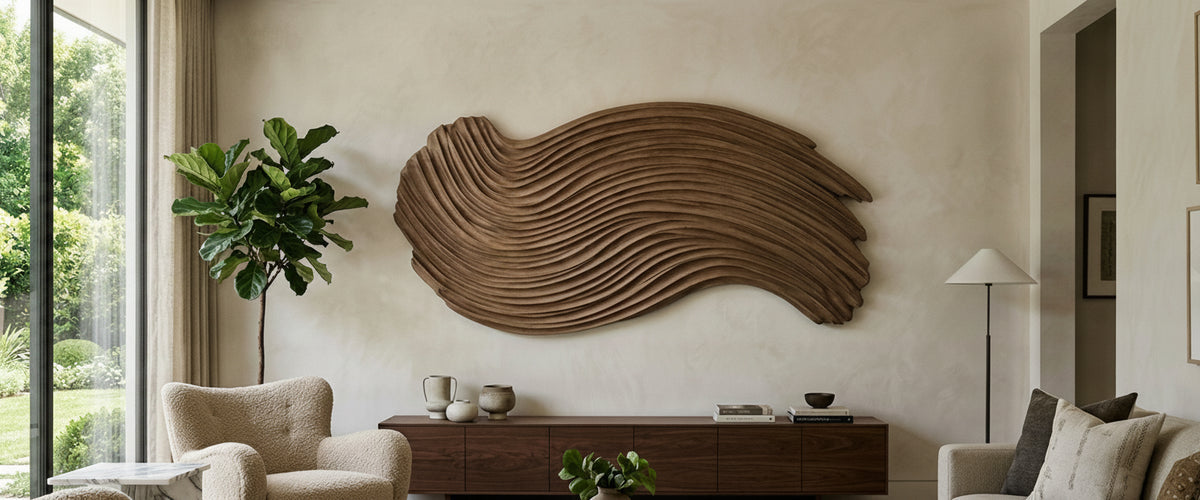

Most abstract large wall art fails for the same reason: somebody picked a composition that worked on a screen and scaled it up without rethinking a single decision. The eye sees flat. The body reads depth, shadow, and weight. A piece of abstract large wall art that looks confident at 18 inches can collapse into wallpaper at 12 feet, and a piece engineered for a 25-foot atrium can feel oppressive in a 9-foot living room. Before our studio quotes a commission, we spend more time on those questions than on the artwork itself.
This is a behind-the-curtain look at how we approach abstract large wall art at Giant Sculptures: what we ask, what we test, and where commissions usually go wrong. If you are about to brief a maker, or you are weighing a stock piece against a bespoke one, the same logic applies to any abstract large wall art project.

Key Takeaways
Scale is not a slider. A composition has to be redesigned, not just enlarged, once it crosses roughly 6 feet (1.8 m) on the long edge.
Material drives cost more than size. Carved hardwood, cast metal, and laminated acrylic sit in very different brackets, and finish work is where budgets quietly balloon.
Viewing distance changes everything: relief depth, color contrast, and edge sharpness should all be tuned to where the viewer actually stands.
A proper studio process for abstract large wall art runs maquette, sample panel, fabrication, then install. Skipping the sample is the single most common buyer regret.
Walls move, expand, and carry services. Engineering and mounting are part of the artwork, not an afterthought.

What a Sculptor Actually Thinks About Before Quoting
When a brief lands for an abstract large wall art commission, the first thing a sculptor wants is not a mood board. It is the wall. We ask for elevation drawings, ceiling height, the position of any HVAC, the light sources by time of day, and the typical viewing distance. A 14-foot piece behind a reception desk that visitors stand 4 feet from is a completely different problem to a 14-foot piece at the end of a 40-foot gallery hallway.
Then comes orientation. Horizontal compositions sit calmly behind sofas and beds. Vertical ones add perceived ceiling height, which is why they read well in stairwells and double-height entries. Square formats are the hardest to land; they need a strong internal rhythm or they read like a panel rather than a piece of abstract large wall art.
Only after that do we talk about style. The reason is simple: the wall sets the constraints, and the constraints shape what abstract language will actually carry the room. A heavily textured carved relief needs raking light to come alive. A high-gloss acrylic piece needs the opposite, because direct sun will turn it into a mirror by 3 p.m.
Craft Decisions That Change the Final Result (and the Price)
Buyers often ask why two pieces of abstract large wall art at similar size can sit in very different price brackets. The honest answer is that material and process do most of the work, and the visible surface is only the last 10 percent.
Substrate. Carved hardwood panels, MDF cores with applied relief, aluminum honeycomb, and cast resin all behave differently over a 10 or 15 year horizon. Hardwood moves with humidity, which matters if the piece is going to a Scottsdale home with dry winters or a Miami penthouse with sea air. Aluminum honeycomb stays flat but costs more and limits how deep the relief can be carved.
Relief depth. A carved wood piece with a single sweeping gesture, such as Deralin Mocha Stroke Abstract 3D Carving Wall Art, reads as sculpture because the shadow lines do real work; you can see the gesture from across the room. Where the room asks for a quieter, more fragmented mark instead, something like Deralin Mocha Trace Abstract 3D Carving Wall Art shifts the same material language toward rhythm rather than statement. Drop the relief depth on either by half and you have a textured painting. Buyers underestimate how much depth their abstract large wall art actually needs at scale.
Finish. A matte limewash hides imperfections and softens light. A high-gloss UV-cured finish, like the kind used on Linea Abstract Embrace Minimal Acrylic UV 3D Wall Art, magnifies every flaw underneath, so the substrate prep has to be near-perfect. That prep is the invisible labor that costs money.
Color system. Pigmented finishes age differently to stained ones. For exterior-adjacent walls or sun-drenched rooms, we steer clients toward UV-stable pigments and ask the kind of question the Getty Conservation Institute would ask: how will this read in ten years, not ten weeks?
On budget: we are deliberately not quoting price bands here because they would mislead. A 6-foot piece in carved hardwood with a hand-applied patina, engineered for a curved wall, can sit well above a 12-foot piece in routed MDF with a sprayed flat finish. Brief, materials, and engineering decide the number. Ask for a tailored quote and a line-item breakdown.
Why Some Abstract Large Wall Art Reads Right at 10 ft and Wrong at 30
Scale is where most stock-bought large abstract wall art falls apart. A composition designed to be viewed at arm's length usually has fine internal detail, tight color transitions, and edges that resolve at close range. Push that to 30 feet and the detail disappears, the transitions go muddy, and the eye has nothing to hold on to.
Pieces of abstract large wall art that work at long viewing distance share a few traits. They have a clear primary gesture you can read in a single glance. They use larger value contrast (the gap between lightest and darkest areas) than feels right up close. And they tend to push relief depth, because shadow is what carries form across a room.
The flip side matters too. A composition built for a 30-foot lobby will feel coarse and bossy in a 12-foot dining room. We have had clients buy abstract large wall art sized for a gallery and try to retrofit it into a Tribeca loft; the proportion was wrong and no amount of lighting fixed it. The lesson, repeated often: design to the room, not to a Pinterest screenshot.
A practical rule we use in the studio. For pieces viewed under 8 feet (2.4 m), fine surface texture earns its keep. From 8 to 20 feet, relief depth and value contrast do the work. Above 20 feet, simplify the composition and let silhouette and shadow carry the piece. If a maker cannot articulate which of those zones your abstract large wall art is being designed for, that is a flag.
Studio Process: Maquette, Sample, Fabrication, Install
A proper bespoke process for abstract large wall art has four stages, and skipping any of them is where buyers get burned.
1. Maquette. We build a scaled study, usually around one-fifth size, in the actual material logic of the final piece. Not a render. A render flatters everything; it cannot show you how shadow falls across a carved ridge at 4 p.m. The maquette is signed off before any full-size work begins.
2. Sample panel. A 12 to 18 inch (30 to 45 cm) sample in the final substrate, with the final finish, photographed in the client's actual room where possible. This is where color, sheen, and grain decisions are locked. Many clients change their mind on finish at this stage, which is exactly the point.
3. Fabrication. Depending on technique, this runs anywhere from six to sixteen weeks for a single piece of abstract large wall art. Hand carving takes the long end; CNC-roughed and hand-finished pieces sit in the middle. Cast metal abstracts (which we sometimes use as wall-mounted reliefs) need pattern, mold, and chase time on top.
4. Install. Pieces of abstract large wall art are not picture-hook objects. We specify a French cleat or a custom bracket system rated to at least four times the piece weight, located into studs or a backing panel. For pieces over roughly 80 pounds (36 kg), we send installation drawings and, where the client is in a major US metro, recommend a local fine art installer rather than a handyman.
Honest Red Flags Buyers Should Ask About
Here is the checklist we wish more clients used before committing to any large wall art abstract commission.
No sample panel offered. If a studio is willing to fabricate 12 feet of art with no physical material sample, walk away.
Vague material spec. "Mixed media" or "premium composite" without a substrate name, density, and finish system is a problem. Ask exactly what the core is and what coats it.
Renders only, no maquette photography. Anyone can render. Ask to see in-progress photos from previous abstract large wall art commissions of comparable scale.
Silence on mounting. If the conversation about how it attaches to your wall happens after fabrication, the engineering was not designed in.
No conditions advice. A studio that does not ask about humidity, direct sun, or proximity to a kitchen or fireplace is not thinking about ten-year ownership. Conservation bodies like the American Institute for Conservation publish useful guidance on how environment affects mixed-material artworks; a serious maker will already think this way.
No revision points. Good studios build review gates into the timeline. "Trust us, we will deliver" is not a process.
Unclear warranty on finish. Ask what is covered if the finish checks, yellows, or delaminates within five years.
One last point on sourcing. The question of where to buy abstract wall art large enough to anchor a feature wall usually comes down to whether you want a curated stock piece or a true commission. Stock is faster and the risk is lower because you can see the actual object before you buy. A commission gives you abstract large wall art with proportion, palette, and texture tuned to your room, which a stock piece cannot. Many of our clients start by browsing our abstract art collection and the broader wall art and wall decor range to anchor a direction, then commission a scaled, modified version once they know what they respond to.
The abstract large wall art that ages well is rarely the work that photographs best on day one. It is the work whose maker thought carefully about the wall, the light, and the next decade. Brief accordingly.
For wider placement ideas, What Sculptors Really Weigh Up Before Building a Large Metal Wall is useful companion reading before finalising the setting and sightlines.