






































































































Most large metal wall commissions go sideways for the same reason: someone fell in love with a photograph at 1,200 pixels wide and tried to scale it to 20 feet (6.1 m). The drawing looked the same. The piece did not. At Giant Sculptures we have rebuilt enough oversized panels for clients who learned this the hard way to know that a large metal wall is a different animal from a framed artwork, and the craft calls behind it are worth understanding before you commission one.
This is what actually goes through a sculptor's head when a large metal wall brief lands, from the first sketch on butcher paper to the moment the panel is lifted into place on a winery facade or a lobby wall.

Key Takeaways
A large metal wall panel reads completely differently at 8 feet (2.4 m), 20 feet (6.1 m) and 30 feet (9.1 m); the design has to be drawn for the viewing distance, not the floor plan.
Material, finish and substrate choices drive cost more than overall size does.
A proper studio process runs maquette, material sample, full fabrication, dry-fit, then site install. Skip a step and you pay for it later.
The biggest red flags are vague fixing details, no engineering letter, and a quote that ignores access and rigging.

What Sculptors Actually Think About Before Taking on a Commission
Before anyone talks about steel grades or patinas, a sculptor is reading the wall. How tall is it? What is behind the cladding? Is it brick, blockwork, structural steel, or a rainscreen with a 4 inch (10 cm) air gap and nothing to bolt into? A large metal wall piece lives or dies on its fixings, and the fixings depend on what is hiding under the finish.
Then comes the light. South-facing walls in hot, dry climates will bleach a colored patina inside a few seasons if the lacquer system is wrong. A north-facing lobby wall barely sees direct sun, so the same piece will need more relief and shadow to stop it reading flat. We sketch with a sun path in mind, not just a hero shot.
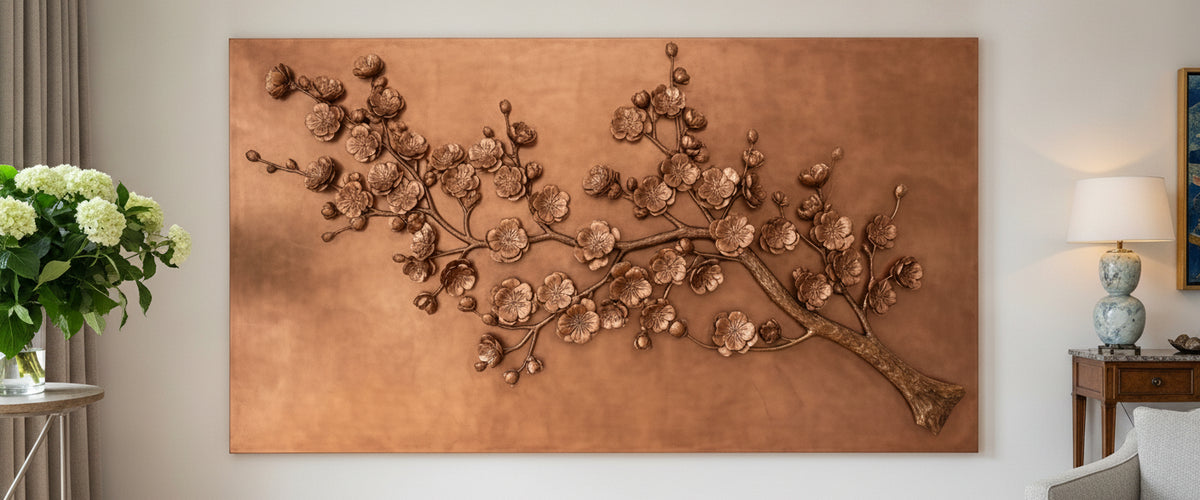
The third question is honest: can we make this beautiful at the size the client wants, or are we just enlarging a small idea? Some compositions earn their scale. Others collapse. A branching botanical motif like the Copper-Gold Blossom Branch Metal Wall Sculpture - 500cm works at almost 16.5 feet (5 m) because the negative space carries the rhythm; squeeze it to 4 feet and the gaps fight the composition. Knowing which ideas scale up into a large metal wall composition is half the job.
Craft Decisions That Change the Final Result (and the Price)
Buyers often ask why two large metal wall pieces of similar size can be quoted very differently. The answer is in the choices that never appear in the marketing photo.
Sheet gauge. A 1.5 mm sheet flexes; a 3 mm sheet holds a crisp edge and lets us hand-form a deeper relief. Heavier gauge means more weight, more welding heat to manage, and more structure behind the wall.
Cut method. Laser cutting is clean and repeatable. Plasma is faster and leaves a more honest, slightly rougher edge that suits Corten and industrial work. Hand-cut with an angle grinder reads as craft, and on the right piece it is the only correct answer.
Finish. Brushed stainless, mirror polish, hot patina on bronze, chemical patina on copper, powder coat over mild steel, raw Corten left to weather. Each has a different lifespan outdoors and a different maintenance rhythm. The American Institute for Conservation publishes public guidance on the care of outdoor metal artworks that is worth reading before specifying a finish for a large metal wall.
Substrate and mounting. Floating panels on standoffs read modern and let light skim behind the work. Direct-mounted panels read graphic and architectural. Concealed French cleats hide the fixing entirely but limit re-leveling on site. Each choice changes the engineering, the install time, and the quote.
None of these are right or wrong. They are decisions, and a serious studio will explain the trade-offs rather than default to whatever is cheapest to fabricate.
Why Some Pieces Read Right at 10 Feet and Wrong at 30
Scale is the trap most buyers fall into. A piece that photographs beautifully on a designer's portfolio at 4 feet (1.2 m) often looks thin and busy when stretched to 30 feet (9.1 m). The eye reads detail differently at distance. Fine lines under about half an inch (12 mm) thick tend to disappear past 25 feet (7.6 m). Surface texture that felt subtle in the studio vanishes outdoors under flat midday light.
This is why we draw for the viewing cone. If the wall is in a double-height lobby and the main sightline is from 40 feet (12 m) back, the composition needs bolder gestures, deeper relief, and fewer competing focal points. A compact 3D piece like the Celestara Grey Round 3D Wall Art with Red Metal Ball rewards a near viewer, where the suspended ball and shadowed dish are part of the read; apply the same logic to a 25 foot atrium and the detail dissolves before anyone notices it.
On commercial scale projects we often build a full-size paper or tape mock-up on the actual wall before cutting any metal for a large metal wall build. It looks low-tech. It saves five-figure mistakes.
Studio Process: Maquette, Sample, Fabrication, Install
A well-run large metal wall commission moves through four clear stages. If a supplier cannot describe these to you in plain language, that itself is information.
1. Maquette
A scaled physical model, usually around one-tenth size, that lets the client see the composition in three dimensions rather than as a flat render. We use the maquette to test proportion against a printed wall elevation and, where possible, against photographs of the actual site.
2. Material Sample
A flat sample of the chosen metal in the exact finish, large enough (we aim for at least 12 by 12 inches, around 30 by 30 cm) to judge under real light. Patina samples in particular look very different on a desk versus on a sunlit wall, and shipping a sample to the client before fabrication of the large metal wall starts is cheap insurance.
3. Fabrication and Dry-Fit
The piece is built in the studio, then assembled flat on the workshop floor or hung on a mock wall for a full dry-fit. We photograph the dry-fit from the same angles the client will see in their building. Any panel that does not sit right gets adjusted here, not on a scissor lift on site.
4. Install
Crating, shipping, and rigging are part of the craft, not afterthoughts. A 16 foot (4.9 m) panel that weighs 180 lb (82 kg) needs two trained installers and the right access equipment. We will not ship a large metal wall piece without confirmed fixing details, a method statement, and, for commercial sites, an engineer's letter confirming the wall can carry the load.
Honest Red Flags Buyers Should Ask About Before They Commit
If you are sourcing large metal wall art and decor for a serious project, the questions below will tell you very quickly whether you are dealing with a studio or a reseller.
What gauge and grade of metal are you using, and why? A vague answer means the spec has not been thought through.
Show me the fixing detail. A real drawing, with anchor type, spacing, and load per fixing. "We will sort it on site" is not an answer for a 200 lb large metal wall piece.
What is the finish system, and how does it age? Especially outdoors. Ask for a written care note.
Will you provide a maquette and a material sample before fabrication? If not, you are paying full price for a prototype.
Who installs it? A studio that hands you crated panels and walks away is a different proposition from one that manages the rigging and sign-off.
How is the quote built? Honest answer: budget depends on material, scale, depth of relief, finish, engineering, crating, freight and installation. Anyone giving you a firm number before those are settled is guessing. We always prefer a tailored quote based on the actual site and brief.
Beyond the spec sheet, ask to see in-situ photographs of finished large metal wall commissions at a similar scale. Studio shots are easy. A piece photographed two years after install, in real light, on a real building, is the proof that matters.
Matching the Piece to the Room and the Wall
One question we get constantly: how do you match wall art and decor with the furniture that already exists? The short version is to start from the wall, not the sofa. The surface itself sets the scale, the light, and the viewing distance. Furniture changes every few years; the sculpture should outlast three rounds of upholstery.
Pick the metal family first. Warm metals (bronze, copper, brass, gold-finished steel) sit well with timber, wool, leather and stone. Cool metals (stainless, blackened steel, raw Corten) carry concrete, glass, and high-contrast modern interiors. Where the brief calls for warmth without the full weight of patinated bronze, a hybrid timber-and-metal piece like the Prismetal Copper Flow Wood Carving 3D Wall Art is closer to the right design language, because the wood carrier softens the metal and lets it sit above a fireplace as comfortably as it does in a hotel corridor.
Then think about visual weight. A heavily textured rug and a heavily textured large metal wall piece will fight. If the room is busy below the dado line, give the surface some breathing room above it. If the room is calm and architectural, the large metal wall panel can carry more drama.
If you want to keep browsing large metal wall options, our Metal Wall Art and Outdoor Wall Art & Decor collections are organized by intended setting rather than purely by size, which usually helps narrow things down faster than a generic search.
Done properly, a large metal wall is a 20 year decision. It is worth the extra few weeks of process to get the craft calls right at the front end rather than the back.
For wider placement ideas, Metal Wall Art Decor: What Sculptors Weigh Before Saying Yes is useful companion reading before finalising the setting and sightlines.