





































































































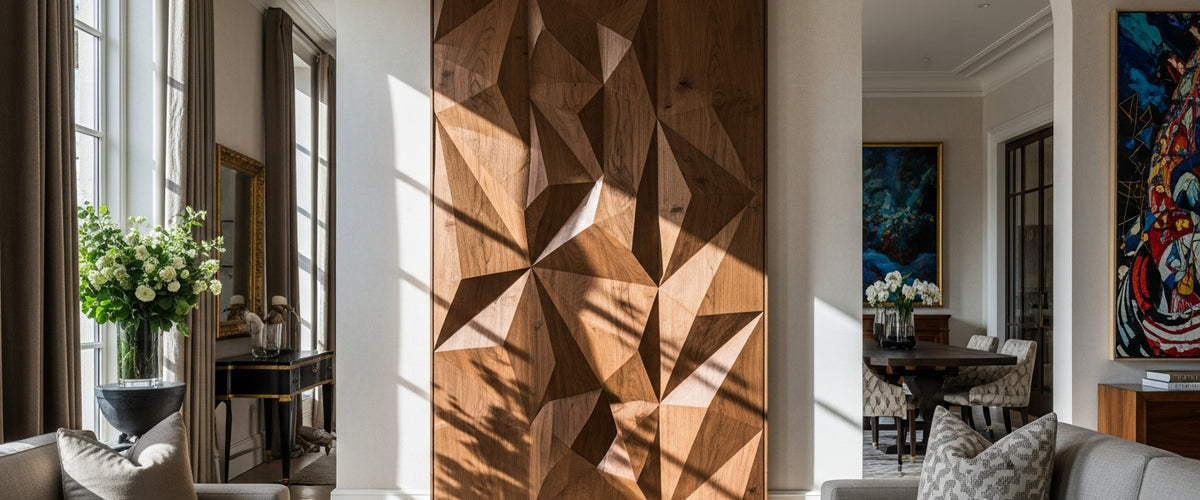

The first question a sculptor asks about a carved wood wall art commission is rarely about the design. It is about the wall. How tall, how lit, how humid, how far the viewer will stand. Get those four answers wrong and the most beautifully carved panel in the world will look flat, warp in a year, or read as decorative wallpaper from across the room. Get them right and a single piece can carry a 20 ft (6 m) double-height entry without trying.
This is a behind-the-bench look at how we think about carved wood wall art at Giant Sculptures, what changes the result, and the honest red flags buyers should raise before they sign anything.

At a Glance: What Actually Drives a Carved Wood Wall Art Commission
- Species and cut set the grain, weight, movement and how the carving catches light.
- Relief depth (shallow, medium, deep, pierced) controls whether the piece reads at 10 ft or 30 ft.
- Joinery and substrate decide whether the panel stays flat for decades or cups in a dry winter.
- Finish (oil, hardwax, lacquer, ebonized, gilded) changes the whole mood, not just the color.
- Fixings are engineered to the wall type, not chosen at install.
- Budget follows scale, species, carving hours, finishing, crating and install, so a tailored quote is the only honest number.

What Sculptors Think About Before Taking the Brief
Before any sketch, we want to know the architecture. A carved wood wall art panel destined for a Napa tasting room with cathedral ceilings behaves nothing like one heading to a Manhattan apartment with 9 ft (2.7 m) plaster walls. The Napa piece needs deeper relief, bolder rhythm and a species that holds shadow. The apartment piece needs finer carving, a quieter grain and a finish that does not fight the room.
We also ask about climate. Wood is a living material. A reclaimed wood wall art panel installed above a fireplace in Aspen will dry differently than the same panel facing the Pacific in Malibu. Species selection, moisture content at delivery, and the back-bracing system all change accordingly. The American Hardwood Information Center publishes baseline guidance on dimensional movement for anyone who wants the underlying numbers (hardwoodinfo.com).
Lighting is the third pillar. Carved wood lives or dies by raking light. If the only illumination is a flat ceiling downlight directly in front of the wall, even a masterfully carved relief will look like a printed graphic. We frequently ask clients to add a wall washer or an adjustable spot at roughly 30 degrees off the wall plane before the install date.

Craft Decisions That Change the Final Result
Species and Why It Matters
Walnut carves cleanly and holds crisp detail, which suits geometric wood wall art with sharp facets. White oak is tougher on tools but rewards deep relief and ages beautifully under oil. Tulipwood and basswood are the traditional carvers' woods, soft enough for delicate undercuts but needing protection from knocks. Teak and iroko handle covered outdoor walls. Reclaimed oak beams, sawn and rejoined, give a denser, more characterful surface for clients who want history in the panel rather than a pristine board.
Relief Depth
Shallow relief (under 1 in / 25 mm) reads as texture. Medium relief (1 to 3 in / 25 to 75 mm) gives proper shadow and movement. Deep and pierced relief (3 in / 75 mm and beyond) starts to behave like sculpture on a wall, throwing shadow that shifts through the day. The choice is not aesthetic alone. It dictates panel thickness, weight, and how the piece is engineered to the wall.
Joinery
A wide panel made from a single slab will move. Honest studios break the field into staves, alternate the grain direction, and laminate to a stable substrate or a back-frame with sliding cleats. If a maker promises a 6 ft (1.8 m) wide single-board carving with no movement strategy, that is a red flag.
Finish
Hardwax oils keep the wood looking like wood and are easy to refresh. Lacquers give a harder shell but can yellow and are unforgiving to repair. Ebonizing with iron acetate produces a deep, matte black that lets carving read as pure form. Selective gilding on a carved ground is a classical move that works surprisingly well in modern interiors when used sparingly.

Why Some Carved Wood Wall Art Reads Right at 10 ft and Wrong at 30
The single most common mistake we see in wood wall art decor is scale and detail tuned for the wrong viewing distance. A panel covered in fine, even, all-over carving looks rich at arm's length and dissolves into visual noise from a mezzanine. A piece with bold primary rhythm, three or four dominant shadow lines, and finer carving nested inside those lines reads at every distance. The composition needs a hierarchy, the way a good building has massing before it has detail.
When clients send us reference images of small handmade wood wall art they admire from Etsy or a boutique, we often have to redesign rather than scale up. A 2 ft (0.6 m) panel translated literally to 8 ft (2.4 m) becomes wallpaper. The carving needs to be re-composed for the room.
Where the brief calls for repeating geometry rather than figurative carving, a piece like Helix Rosewood Spiral Illusion Acrylic 3D Wall Art is a useful sanity check for how a rhythmic field holds attention across a tall wall before any wood is committed. For clients leaning toward tonal depth and layered shadow rather than sharp facets, Cascade Rosewood Fade Paper 3D Wall Art is closer to the visual language a deep-relief carved panel would aim for.

Studio Process: Maquette, Sample, Fabrication, Install
A serious carved wood wall art commission moves through four stages.
1. Maquette. We build a scaled model, usually one-fifth or one-quarter size, in a workable wood or dense foam. The maquette is photographed against a wall image of the client's actual space. This catches scale problems while they are cheap to fix.
2. Carving sample. Before any full panel is touched, we cut a 12 in (300 mm) square sample in the chosen species, at the proposed relief depth, with the proposed finish. The client signs off on grain, tone, sheen and tool marks. This is the moment to change your mind about ebonizing, not after the panel is carved.
3. Fabrication. Panels are jointed, stabilized and rough-shaped by CNC where the design allows, then hand-carved for the detail layer. Pure hand carving is offered for traditional or figurative work; pure CNC is reserved for highly geometric pieces where the tool marks would otherwise read as inconsistencies. Most of our work is hybrid, and we are upfront about which is which.
4. Install. Large carved panels are engineered to the wall, not screwed to it. We typically use a French cleat system in tempered aluminum, sometimes with secondary safety fixings into studs or masonry. For pieces over roughly 80 lb (36 kg), we either install ourselves or supervise the local contractor on a video call. Conservation guidance from conservation-us.org on environmental controls is worth reading if the piece is going into a high-value interior.

How to Hang Heavy Carved Wood Wall Art: The Short Version
- Confirm the wall type before fixings are chosen. Drywall on metal studs, drywall on wood studs, plaster on lath, brick, blockwork and poured concrete all need different anchors.
- Use a French cleat sized to the panel weight, not a single picture hook. Two cleats on very wide panels.
- Add a bottom spacer or kicker so the panel sits parallel to the wall and cannot pivot.
- For panels over 50 lb (23 kg), fix into structure, not into board alone.
- Leave the piece to acclimatize in the room for at least 48 hours before final fixing, especially in dry winter climates.
Honest Red Flags Before You Commit
A few questions separate a serious maker from a risky one.
Ask how the panel is constructed. If the answer is vague, walk away. You want to hear about stave width, grain alternation, substrate or back-frame, and movement allowance.
Ask for the moisture content at delivery. A reputable studio kiln-conditions wood to the destination climate. A panel built at 12% MC and shipped to an Arizona interior at 6% MC will crack.
Ask what is hand-carved and what is machined. Both are legitimate. Pretending CNC work is hand carving is not.
Ask about finish refresh. Oils can be re-coated by the owner. Lacquers usually cannot. Know what you are signing up for over a 20-year ownership horizon.
Ask for references on scale. A studio that has only made 3 ft (0.9 m) pieces is not automatically wrong for an 8 ft (2.4 m) commission, but they should be honest about it. Our portfolio of larger wood wall art and broader wall art commissions exists precisely so buyers can sanity-check scale before they brief.
Ask about crating and insurance. A 7 ft (2.1 m) carved panel needs a custom crate, foam-lined, with humidity indicators. If the quote does not mention crating, the quote is incomplete.
Budgets for carved wood wall art vary widely with species, scale, relief depth, carving hours, finishing, crating and installation. Anyone giving a firm number before seeing the wall and the brief is guessing. We prefer to quote against a real space.
For wider placement ideas, Carved Wood Wall Art: An Insider Guide to Commissioning Pieces That Actually Work is useful companion reading before finalising the setting and sightlines.